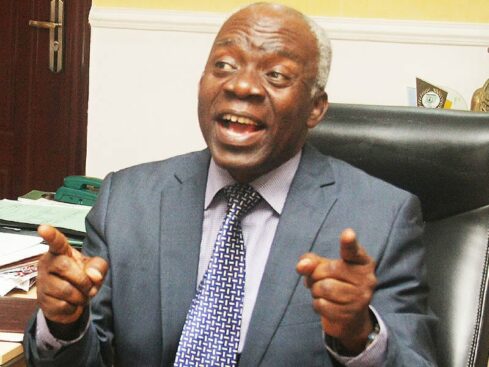
Human rights lawyer and Senior Advocate of Nigeria, Femi Falana, has urged political leaders and public figures to refrain from turning the recent abduction of schoolchildren and teachers in Oyo State into a political issue, insisting that efforts should instead be directed toward rescuing the victims and tackling the nation’s worsening security situation.
Falana made the appeal on Friday during an appearance on Channels Television’s Politics Today, where he expressed concern over statements made by certain politicians in reaction to the kidnappings.
Speaking on the controversy surrounding the incident, the senior lawyer criticised individuals who have publicly accused political opponents of being responsible for the abductions without presenting evidence to security agencies.
According to him, some public office holders have chosen to inflame tensions rather than assist in efforts to address the tragedy.
He said a minister and a former governor “are currently inciting people in Oyo State by politicising the tragedy of our people.
“How can anybody in their right sense say, ‘I know it was a state government that kidnapped the children’? Please, if you know this, go to the police, go to the State Security Service and lodge a complaint,” he said.
Falana questioned why those making such serious allegations had failed to provide intelligence or formal reports to relevant authorities if they genuinely possessed credible information.
“Somebody says, ‘I know the politicians [who] are responsible.’ Why have you not reported them? Because the parents of those children who were kidnapped are listening to these statements,” Falana added.
The legal practitioner stressed that public discourse should focus on supporting security agencies and ensuring the safe return of the victims rather than fueling political controversies.
He also called on President Bola Tinubu to prioritise strengthening the country’s security institutions by improving both their welfare and operational capacity.
“Equip the armed forces, motivate the armed forces, equip the police force, and motivate the operatives working in the security sector,” he urged.
Falana’s comments come amid increasing public concern over the growing wave of kidnappings and insecurity affecting several parts of Nigeria.
The abduction of 39 pupils and seven teachers from schools in Oyo State on May 15, alongside the kidnapping of 42 pupils in Borno State on the same day, has generated widespread condemnation across the country.
Nearly three weeks after the incidents, the victims remain in captivity, heightening anxiety among families, communities and education stakeholders.
The attacks have sparked protests by teachers, calls for urgent government intervention and intensified rescue efforts by both federal and state authorities.
As discussions continue over how best to address the country’s security challenges, renewed attention has been placed on the proposed creation of state police.
The debate gained fresh momentum after the Presidency announced on Thursday that progress had been made toward developing the constitutional framework required to establish state police across the federation.
The announcement followed months of consultations involving the Presidency, the National Assembly and security agencies on ways to strengthen Nigeria’s security architecture.
Despite growing support for the initiative in some quarters, Falana expressed reservations about the proposal, arguing that existing security institutions should first be properly managed and funded before creating additional structures.
“These guys are only interested in creating agencies without funding them to work. We do not have a federal government police; we have a federal police. That is why it is called the Nigeria Police Force,” he said.
He argued that the Nigerian Police Council, which is constitutionally empowered to oversee and supervise the police, has not effectively performed its duties over the years despite having all state governors as members.
According to Falana, state governors have largely failed to exercise their constitutional responsibilities regarding police administration.
“The governors since 1999 have always abdicated their constitutional duty to the president. So the President alone administers, supervises and organises the Nigeria Police Force, contrary to the provisions of the Constitution,” Falana stated.
He further pointed out that several states already operate security outfits that function as community-based policing structures.
Among the examples he cited were the Amotekun Corps operating in South-West states, the Lagos Neighbourhood Safety Corps and the Civilian Joint Task Force active in Borno State.
According to him, these organisations already perform many functions associated with state policing.
“We already have state police. What is missing is proper support, coordination, and access to equipment,” he argued.
Falana also questioned how state police would be sustainably financed if eventually established, noting that many existing security outfits currently struggle with inadequate resources and limited operational capabilities.
He stressed that security personnel deployed to confront heavily armed criminal groups are often not provided with sufficient weapons and equipment to effectively carry out their duties.
“How can you ask security personnel to go to the forest and confront criminals armed with AK-47 rifles? The Amotekun operatives and others are only allowed to carry locally made weapons,” he said.
The senior advocate maintained that addressing the funding, coordination and equipment challenges facing current security agencies would yield greater results than simply creating new institutions.
He urged government authorities at all levels to focus on practical measures capable of improving intelligence gathering, strengthening law enforcement operations and enhancing the ability of security personnel to respond swiftly to threats across the country.