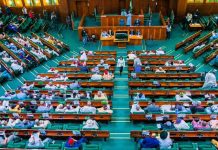


The House of Representatives has directed the Federal Government to conduct a comprehensive audit of all assets seized, forfeited, recovered, managed, disposed of or repatriated by government agencies since Nigeria returned to democratic governance in 1999.
The lawmakers also advocated the creation of a digital National Asset Recovery and Management Registry to strengthen transparency, accountability and legislative oversight in the management of recovered public assets across the country.
The resolutions were adopted on Tuesday after the House considered and approved a motion sponsored by the member representing Arochukwu/Ohafia Federal Constituency of Abia State, Rep. Ibe Okwara Osonwa.
Presenting the motion, Osonwa expressed concern over the absence of a unified database for recovered assets, arguing that poor documentation and weak oversight systems have made it difficult to effectively track their value, location, management, disposal and utilisation.
He relied on Sections 88 and 89 of the 1999 Constitution (as amended), which empower the National Assembly to investigate the activities of public institutions and examine how public funds and assets are managed.
The lawmaker also cited the Proceeds of Crime (Recovery and Management) Act, 2022, noting that the legislation provides a legal framework for tracing, recovering, preserving, managing and disposing of proceeds derived from criminal activities.
According to him, anti-corruption agencies, security institutions, ministries, departments and agencies (MDAs), regulatory bodies and the courts have recovered significant assets over the years from cases involving corruption, money laundering, terrorism financing, illicit financial transactions and other criminal offences.
He listed the recovered assets as including cash, landed properties, shares, petroleum assets, vehicles, vessels, aircraft, investments, digital assets and several other movable and immovable properties.
Despite these recoveries, Osonwa observed that Nigeria still lacks a centralized national system capable of providing complete information about recovered assets.
“There is presently no centralized and publicly accessible National Asset Recovery and Management Register capable of providing comprehensive information on the status, value, location, management, disposal, utilisation and proceeds of recovered assets across the Federation,” he said.
The lawmaker also raised concerns over challenges affecting the management of recovered assets, including poor record-keeping, valuation difficulties, inadequate monitoring, deterioration of assets and possible revenue leakages.
He argued that the absence of a coordinated digital platform has weakened public confidence while making effective legislative oversight more difficult.
According to him, establishing a comprehensive digital registry would improve accountability, promote better coordination among government institutions and provide accurate information on the status of recovered assets.
The motion received overwhelming support from members and was adopted through a voice vote presided over by the Speaker of the House, Tajudeen Abbas.
Following its adoption, the House urged the Federal Government to immediately embark on a nationwide audit and verification of all assets seized, forfeited, recovered, managed, disposed of and repatriated by MDAs, anti-corruption agencies, security institutions and the courts from May 29, 1999, to date.
Lawmakers also called for the establishment of a digital national asset registry that would ensure proper documentation, transparency and accountability in the management of recovered assets.
Recovered assets have remained a major component of Nigeria’s anti-corruption campaign, with institutions such as the Economic and Financial Crimes Commission (EFCC), the Independent Corrupt Practices and Other Related Offences Commission (ICPC), the Nigeria Police Force and other security agencies recording substantial recoveries over the years.
However, concerns over fragmented documentation, inconsistent record-keeping and the absence of a centralized national database have continued to generate calls for stronger oversight and more transparent management of recovered public assets.