Iranian political and military leaders gathered on Sunday for the second day of funeral rites for the late Supreme Leader Ali Khamenei, while his son and successor, Mojtaba Khamenei, remained noticeably absent from the public ceremonies.
Ali Khamenei led the Islamic Republic from 1989 until he was killed at the age of 86 in an airstrike on the opening day of the United States-Israel conflict with Iran on February 28.
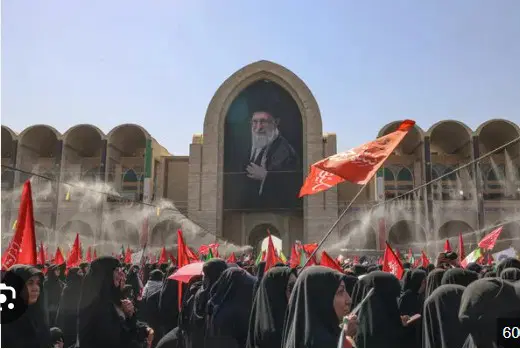
President Masoud Pezeshkian, Revolutionary Guards Commander Ahmad Vahidi and other senior government officials joined thousands of mourners at the funeral prayers held in Tehran.
However, Mojtaba Khamenei, who was appointed Supreme Leader shortly after his father’s death in early March, has not appeared publicly since assuming office. Reports indicate that he sustained injuries during the strike that claimed his father’s life.
In contrast, the late leader’s three other sons — Masoud, Mostafa and Meysam — were present during Sunday’s ceremony.
The prayers took place at Tehran’s Grand Mosalla religious complex and were led by renowned Shia cleric Ja’far Sobhani, the 97-year-old scholar widely respected for his teachings at seminaries in the holy city of Qom.
Iran declared Sunday a public holiday to allow citizens to participate in the funeral activities.
Authorities announced that Khamenei’s body would later be transferred from the Grand Mosalla in preparation for a large funeral procession through the streets of Tehran scheduled for Monday.
AFP correspondents reported that the expansive prayer complex and surrounding roads were filled with mourners from early Sunday morning.
Despite temperatures expected to exceed 35 degrees Celsius, many participants continued arriving while volunteers distributed water and refreshments. Some mourners carried Iranian flags, while others held portraits of the late Supreme Leader.
Government officials estimated that more than 10 million people would participate in the funeral ceremonies across the capital.
Extensive security arrangements were put in place throughout Tehran as officials warned of the possibility of crowd congestion during the gatherings.
According to Iran’s official IRNA news agency, over 4,000 people visited medical centres established within and around the Grand Mosalla to receive treatment, although no fatalities linked to the event had been recorded.
State television broadcast footage of Parliament Speaker Mohammad Bagher Ghalibaf, who also serves as Iran’s chief negotiator in talks with the United States, attending the prayers.
The broadcast also showed Esmail Qaani, commander of the Revolutionary Guards’ elite Quds Force, participating in the ceremony.
Khamenei’s coffin, draped in the Iranian national flag and topped with his signature black turban, was placed alongside the coffins of four relatives who were also killed during the February airstrikes, including one of his infant granddaughters.
Although hostilities between Iran and the United States have paused following a ceasefire and an initial diplomatic agreement, both countries have maintained that they remain prepared to resume military operations if necessary.
Many mourners used the funeral to express demands for justice and retaliation.
“The killers must face punishment,” a 38-year-old mourner identified only by the surname Miremadi told AFP.
“If our leaders are about to proceed with negotiations in this manner, our people will not agree with it,” he added.
According to him, many Iranians attending the funeral preferred revenge over renewed diplomatic engagement.
The funeral is also being viewed internationally as an important indicator of domestic support for Iran’s leadership following widespread anti-government protests earlier this year, which rights organisations say resulted in thousands of deaths during a security crackdown.
“We’re here to show the world that we back our revolution and our leader, and we demand revenge for the blood of our loved ones,” said 39-year-old homemaker Bakand, who attended the ceremony.
Throughout his leadership, Ali Khamenei maintained a confrontational foreign policy toward Western nations and continued Iran’s longstanding support for armed groups opposed to the United States and Israel, including Hamas in Palestine and Hezbollah in Lebanon.
Iranian state media reported that delegations from Hamas and Hezbollah met with Foreign Minister Abbas Araghchi on Saturday ahead of the funeral.
Representatives of Yemen’s Houthi movement and the Palestinian Islamic Jihad also attended the memorial events.
Following Monday’s funeral procession in Tehran, Khamenei’s remains are scheduled to be transported to Qom on Tuesday, before travelling to neighbouring Iraq on Wednesday.
His final burial is expected to take place on Thursday in his hometown of Mashhad in northeastern Iran.