

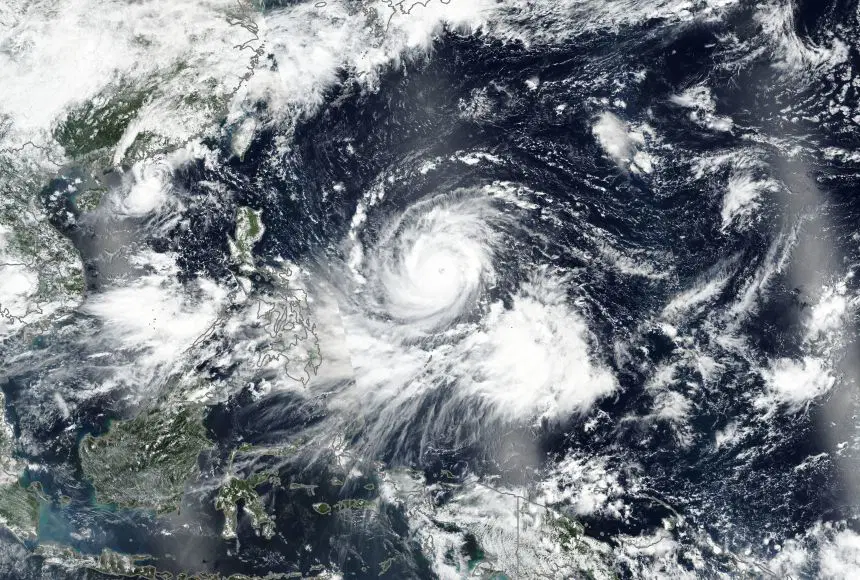
Residents of Guam and the Northern Mariana Islands moved into emergency shelters and rushed to complete final preparations on Sunday as Super Typhoon Bavi approached the United States Pacific territories with destructive winds and life-threatening conditions.
The powerful storm is expected to sweep across the region at about 10:00 a.m. on Monday (0000 GMT), packing sustained winds of about 260 kilometres per hour (160 mph), equivalent to a Category 5 hurricane, with gusts reaching as high as 315 kilometres per hour.
The United States National Weather Service (NWS) described the approaching system as “very dangerous,” warning residents to expect tropical storm-force winds beginning Sunday afternoon or evening before the arrival of the typhoon’s destructive core.
The agency cautioned that communities closest to the centre of the storm could experience catastrophic damage.
“Significant flooding from torrential rains, and coastal inundation are expected,” the NWS warned.
Authorities also forecast waves of up to 35 feet (10.7 metres), roughly the height of a 10-storey building, creating extremely hazardous conditions across surrounding waters.
Heavy rainfall and strong winds had already begun affecting Guam by Sunday, leaving roads unusually quiet as residents remained indoors.
Business owner Pinky Cubacub said she spent about $500 on plywood after queuing early on Saturday to secure supplies needed to protect her newly established restaurant.
“I cannot afford to lose so many days. It hurts,” the 55-year-old told AFP.
“Because I just started, whatever we’re making right now is just for rent, utilities, and my people, and supplies. I don’t even pay myself yet.”
Call centre employee Arabella Paulino said she had reassured her daughters despite growing concerns over the approaching storm.
“My girls were saying to me it’s scary. But it will be okay,” the 48-year-old said.
“My house is concrete, so the worst that can happen is a window could blow in.”
Japanese tourist Miku Sakurai and her friends also found themselves stranded after their scheduled flight to Tokyo was cancelled due to the worsening weather.
“We will stay in the hotel when the storm comes. I am scared,” the 25-year-old office worker said.
Despite the dangerous conditions, several surfers took advantage of the rough seas at Talofofo Bay in Guam.
“There’s quite a lot of debris in the water but it’s a lot of fun,” one surfer told AFP.
The Northern Mariana Islands, located in the western Pacific, have a population of about 40,000 people, while neighbouring Guam is home to approximately 170,000 residents.
The islands have experienced devastating storms in recent years.
Super Typhoon Sinlaku struck the region in April, cutting electricity to tens of thousands of homes, uprooting trees, overturning vehicles and tearing roofs from buildings.
In 2023, Typhoon Mawar caused widespread destruction after becoming the strongest storm to hit the area in decades.
Weather forecasters said Bavi is expected to pass closest to the island of Rota, situated between Guam and Saipan, where about 1,500 people live.
Rota Mayor Aubry Hocog urged residents to remain vigilant and cooperate with emergency authorities.
“By working together and taking the necessary precautions, we can help protect our families, neighbors and community. We pray for the safety of our people,” Hocog said.
The Federal Emergency Management Agency (FEMA) confirmed that emergency response teams had already been deployed to Guam ahead of the storm.
According to the agency, its regional distribution centre has been stocked with approximately 1.1 million litres of drinking water, 1.2 million emergency meals, 6,700 cots and 90 generators to support relief operations.
The National Weather Service warned that the opportunity for residents to evacuate or move to safer locations was rapidly closing.
Officials in Guam opened five evacuation centres in public schools, with enough capacity to accommodate about 1,900 people, particularly those living in vulnerable structures.
Guam Homeland Security official Damon Michael Borja said authorities had significantly improved disaster preparedness following lessons learned from previous storms.
He explained that improvements in electricity restoration, water supply and emergency coordination had strengthened the territory’s response capability.
“Almost three months to get power and water back on for all the places during Mawar, Sinlaku took almost… three weeks,” Borja said.
Climate experts continue to warn that warming oceans are increasing the intensity of tropical storms worldwide.
The European Union’s Copernicus Marine Service reported last week that global oceans experienced their hottest June on record, with temperatures expected to remain unusually high in the coming months.
Warmer sea temperatures provide more energy for tropical cyclones while increasing atmospheric moisture that often leads to heavier rainfall.
The World Meteorological Organization (WMO) also confirmed on Friday that El Niño has officially developed in the tropical Pacific and is expected to strengthen in the coming months.
The climate pattern, which typically occurs every two to seven years and can persist for up to a year, raises sea surface temperatures across the central and eastern Pacific Ocean, altering global weather patterns and increasing the likelihood of extreme weather events in many regions.