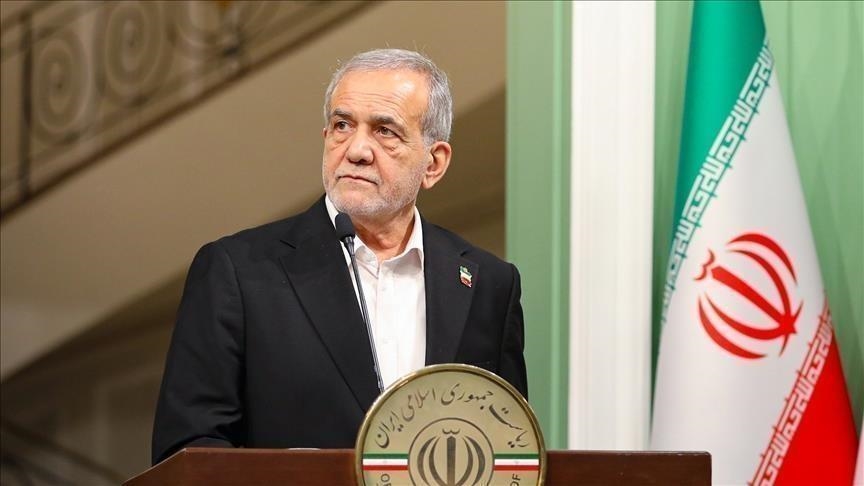
Iran’s President Masoud Pezeshkian confirmed on Tuesday that he had instructed his foreign minister to begin talks with the United States, provided the negotiations are free from threats and unreasonable demands.
In a post on X, Pezeshkian wrote: “I have instructed my Minister of Foreign Affairs, provided that a suitable environment exists — one free from threats and unreasonable expectations — to pursue fair and equitable negotiations.”
He added that the decision followed requests from “friendly governments.”
An Arab official, speaking anonymously to AFP, said a meeting was likely to take place in Turkey on Friday, following diplomatic efforts by Ankara, as well as Egypt, Oman, and Qatar.
The development comes amid escalating tensions. President Donald Trump has threatened military action and deployed an aircraft carrier group to the Middle East following last month’s deadly crackdown on anti-government protests in Iran.
Trump has said he is hopeful a deal can be reached but warned that “bad things would happen” without one.
Iranian Foreign Minister Abbas Araghchi, in a CNN interview broadcast Monday, said Tehran had lost trust in Washington as a negotiating partner but believed a nuclear deal remained possible.
“So I see the possibility of another talk if the US negotiation team follows what President Trump said: to come to a fair and equitable deal to ensure that there is no nuclear weapons,” Araghchi stated.
Nuclear negotiations between Tehran and Washington collapsed last year after Israel launched a major bombing campaign against Iran in June, triggering a 12-day war. Israeli strikes targeted nuclear and military sites, as well as residential areas, killing military commanders, nuclear scientists, and hundreds of civilians. The US briefly joined the conflict, striking key nuclear facilities.
Iran retaliated with drone and missile attacks on Israel and targeted a major US military base in Qatar.
Since returning to office in January 2025, Trump has reinstated his “maximum pressure” sanctions policy, further straining Iran’s already struggling economy.
Protests erupted in Tehran in December over rising living costs and the collapsing rial, quickly spreading nationwide and evolving into broader anti-government demonstrations. Authorities responded with a severe crackdown.
Iranian officials have acknowledged more than 3,000 deaths during the unrest, insisting most were security personnel and innocent bystanders killed in “terrorist acts.” The US-based Human Rights Activists News Agency (HRANA) reports at least 6,854 deaths, mostly protesters killed by security forces, with other rights groups warning the true figure is likely much higher.
HRANA also documented at least 50,235 arrests linked to the protests, with detentions continuing.
Local media reported that 139 foreign nationals were detained in central Iran during the unrest.
Iranian authorities have blamed the United States and Israel for inflaming the protests. Supreme Leader Ayatollah Ali Khamenei described the movement as a “coup” attempt and warned of a “regional war” if the US attacked Iran.
Qatar’s foreign ministry said diplomacy with Iran was “continuing very intensively” alongside efforts with regional neighbours.
UAE presidential adviser Anwar Gargash urged Iran to reach a deal and “rebuild their relationship with the United States,” saying: “I would like to see direct Iranian-American negotiations leading to understandings so that we don’t have these issues every other day.”
Iran has consistently maintained that talks must focus solely on the nuclear issue, rejecting any discussion of its missile programme or defence capabilities.