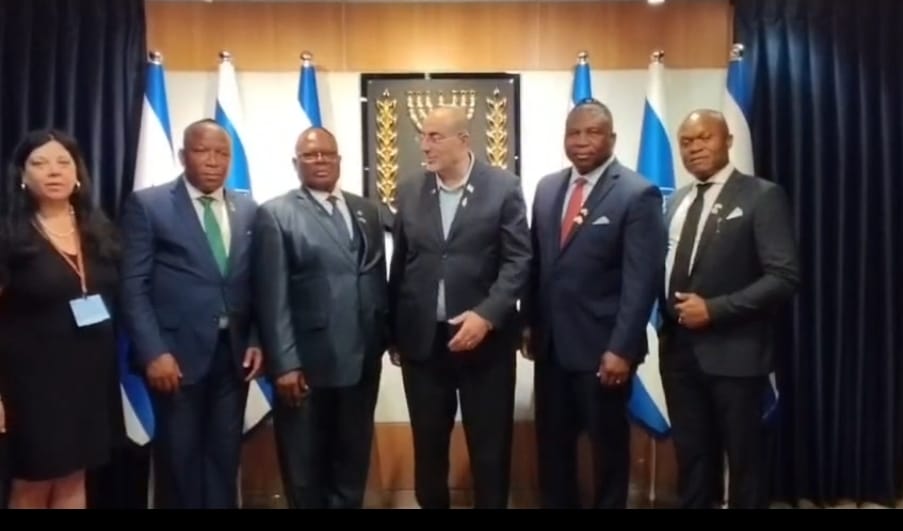
The Indigenous People of Biafra (IPOB) has described as “historic” a meeting its delegation and senior Israeli lawmakers held in Jerusalem, saying the engagement was a diplomatic milestone in its campaign over the fate of its leader, Nnamdi Kanu.
A statement issued on Sunday by the group’s spokesperson Comrade Emma Powerful, said its delegation – under the leadership of Mazi Nnamdi Kanu and coordinated by Mazi Chris Nwaọgụ, head of the group’s Fourth Administration of the Directorate of State – was received by Knesset Deputy Speaker Nissim Vaturi and Deputy Chairman Limor Son Har-Melech, a member of the Foreign Affairs and Security Committee.
The group thanked both lawmakers for what it called “the warm, brotherly, and highly productive reception accorded to our delegation in Jerusalem.”
IPOB described the meeting as “a significant milestone in IPOB’s peaceful international diplomatic outreach,” adding that it was “sincerely grateful for the solidarity expressed – particularly the recognition that this is a global struggle between good and evil, and that good shall ultimately triumph when principled nations stand together.”
The group tied the Jerusalem talks directly to Kanu’s own long-stated position, saying the discussions “powerfully echo the longstanding conviction of our leader… that Biafra’s redemption will be advanced through strategic partnerships with Israel and the United States of America, rooted in shared values of justice, liberty, and human dignity.”
Drawing a historical comparison, IPOB said the Jewish and Biafran peoples “share deep historical affinities forged through persecution, discrimination, displacement, and existential threats,” calling Israel’s founding in 1948 “an enduring inspiration.”
It further argued that an independent Biafra “will serve as a secure homeland and safe haven for persecuted Judeo-Christians and other vulnerable minorities across Nigeria who are currently threatened with extinction.”
The group restated its core position that Biafran independence is, in its words, “the only viable and lasting solution” to insecurity in Nigeria’s southeast, and said this would deliver “genuine peace, security, and stability” through what it called adherence to “universally recognised principles of human rights, self-determination, and international law.”
IPOB said the Jerusalem meeting comes alongside “parallel advocacy” it is pursuing in Washington, D.C., and other capitals, and reaffirmed that it remains “committed to lawful diplomacy and peaceful engagement.”
The statement added, “No amount of political pressure or financial influence can permanently suppress a people’s legitimate quest for freedom when pursued with dignity and in accordance with international norms.”
It reaffirmed its “unwavering commitment to non-violent struggle, the rule of law, and constructive international engagement,” thanking “the Government and people of Israel,” Vaturi, Har-Melech, and “all friends of Biafra standing for justice and human rights” – signing off with “Shalom to Israel.”
Kanu, IPOB’s founder, has been in Nigerian custody since his 2021 re-arrest and was sentenced to life imprisonment on terrorism charges in late 2025 after a decade-long legal battle.
[4:57 pm, 19/07/2026] Cyril Ogar: European Council Accuses FIFA Of Enabling Fraud, Political Influence At W/Cup
The Council of Europe’s secretary general, Alain Berset, has issued a stinging rebuke of FIFA, accusing football’s governing body of providing “an open door to fraud” and allowing political influence to cast doubt on the integrity of the World Cup.
The criticism came in an open letter published to coincide with Sunday’s final. Berset called for a new integrity framework to be built before the 2030 tournament, which will be staged mainly in Europe, and warned that FIFA was embroiled in a crisis involving money and power.
“The Fifa World Cup 2026 has raised question after question,” he wrote.
“A sanction suspended under pressure, within days, with no reasons given.
“The authority of referees called into question.
“Racist abuse of players, some of it from elected officials.
“Betting on every pass, every card, every corner. The celebration will end tonight. The questions will not,” said.
Berset referenced the controversy surrounding FIFA’s decision to shelve the suspension of USA striker Folarin Balogun, and made apparent allusions to remarks by Paraguayan senator Celeste Amarilla about Kylian Mbappé and by former Spanish prime minister Mariano Rajoy about the France team.
The intervention is notable given FIFA and the Council of Europe signed a memorandum of understanding in 2018 – still in effect – aimed at strengthening cooperation on “human rights, integrity and good governance in sport.”
Open criticism between the two partners is described as vanishingly rare.
Berset singled out FIFA’s commercial deal with ADI Predictstreet, which became the World Cup’s official prediction market partner in April.
“Betting has moved from the result of a match to moments a single player can produce without changing the score,” he said.
“A bet is won by making others lose. It is an open door to fraud. And this World Cup has opened the door wider,” he lamented.
On the Balogun case – in which FIFA lifted the ban after a phone call between its president, Gianni Infantino, and US President Donald Trump – Berset said, “When the rules bend under pressure, every result is open to doubt.”
Infantino has maintained the decision to revoke Balogun’s ban was taken independently by FIFA’s disciplinary committee, “based on the applicable regulations and the specific facts.”
Berset, who is Swiss, proposed “a working dialogue that starts tonight” to begin what he called the “urgent work of strengthening the integrity of sport” ahead of future World Cups.
He cited the Council of Europe’s history of intervention in football governance, including a binding treaty on fan safety introduced three months after the 1985 Heysel Stadium disaster, as well as legislation targeting doping in athletics and match-fixing.
The letter follows a complaint filed a week and a half earlier by 72 members of the European Parliament, who wrote to the 27 EU-based football associations demanding an investigation into Infantino’s role in the Balogun case, alleging breaches of political neutrality and possible violations of FIFA’s own code of ethics.
It remains unlikely that UEFA, European football’s governing body, will take the matter further formally.
Separately, in June, 50 members of the European Parliament wrote to Infantino and the FIFA Council requesting an inquiry into the awarding of the FIFA Peace Prize to Trump.
FIFA was contacted for comment but had not responded at the time of the letter’s publication.
The rebuke also comes just a week after it emerged that more than 200 of FIFA’s member associations had formally backed Infantino’s bid for re-election to a fourth term in March.