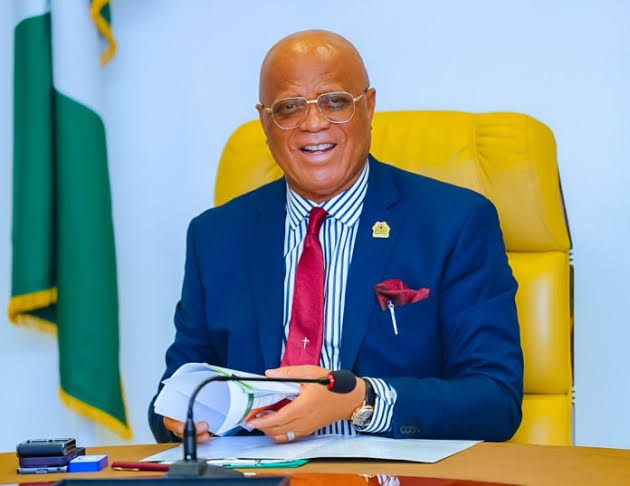
Ekanem Ubong
Akwa Ibom State governor, Umo Eno said plans have been concluded for the state to implement an oil palm revolution targeted at boosting economic prosperity.
Eno said this yesterday while inaugurating the 11km road project implemented under the Rural Access and Agricultural Marketing Project, RAAMP, in Nsit Ibom.
Represented by his Deputy, Senator Akon Eyakenyi, Eno said the plan would boost food production and sufficiency in the state.
He said his administration had a coordinated plan to massively increase oil palm farming, processing and marketing across the 31 local government areas.
The governor added that more farmers would be given improved oil palm seedlings, grants and assistance in land preparation to invest.
Eno reaffirmed his administration’s commitment to sustainable infrastructural development across the state.
He said every local government area in the state had benefited from his administration’s impactful projects such as roads, schools, hospitals among others.
“The essence is to give Akwa Ibom people services that will improve their quality of life,” he said
In her remarks, the Commissioner for Agriculture, Dr Offiong Offor, added that the state government had promptly paid its counterpart funding for the RAAMP project.
Offor stated that improved rural infrastructure would significantly reduce rural-urban migration because it would open up economic opportunities at the local communities.
She disclosed that RAAMP had successfully delivered no fewer than 202 kilometres of rural roads across the 18 local government areas.
“We have established 19 road maintenance groups comprising 65 members across 14 local government areas, this is to ensure sustainability and proper rural roads maintenance,” she said.
Offor thanked the World Bank, French Development Agency and the International Labour Organisation for their support to the project.
The National Project Coordinator, RAAMP, Mr Aminu Mohammed, described Akwa Ibom as one of the “standout states” among the 19 participating states.
He said Akwa Ibom’s performance had qualified it for the second phase of the project, saying ” this is a clear indication of consistency and effective implementation”.
He noted that the project integrated road construction, agro-logistics centres and rural markets to stimulate agricultural productivity.
According to him, the project will also lead to increased income generation and economic opportunities for rural dwellers.