- …Assembly pushes impeachment as power struggle deepens ahead of 2027
- …Traditional rulers, Tinubu Youth Wing seek truce
- As governance stalls
By David Maxwell
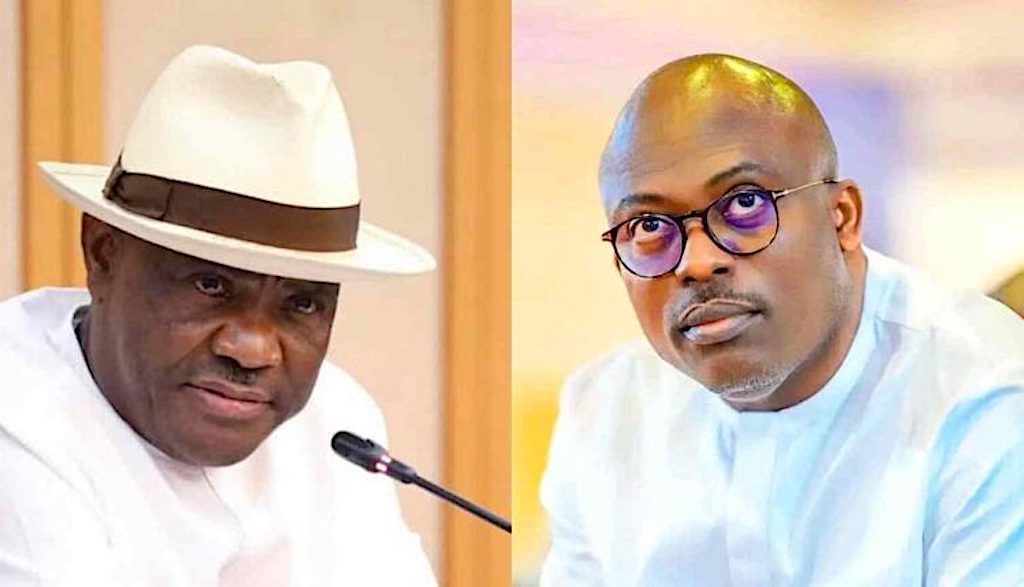
As Nigeria’s political parties prepare for the next electoral cycle, it has become increasingly clear that the protracted feud between former Rivers State governor and current Minister of the Federal Capital Territory, Nyesom Wike, and his successor, Governor Siminalayi Fubara, shows no sign of abating. What was widely expected to ease after the restoration of democratic order following a six-month emergency intervention has instead hardened into a full-blown power struggle with grave implications for governance in the oil-rich state.
The crisis, which took root shortly after the 2023 governorship election that brought Fubara to office, is widely attributed to Wike’s insistence on retaining decisive influence over key state structures — including appointments, funding streams and political direction — even after vacating Government House. When Fubara sought to assert his autonomy, analysts say, the alliance fractured, unleashing a contest that has since come to symbolise the turbulence of subnational politics in Nigeria.
President Bola Tinubu’s intervention last year, culminating in the declaration of emergency measures, was meant to calm frayed nerves and restore institutional balance. Yet critics argue that the truce was superficial. Development projects have stalled, administrative processes have slowed, and the atmosphere of uncertainty has cast a long shadow over public confidence in the government. Many observers lament that the impasse has paralysed governance and diverted attention from the pressing socio-economic needs of Rivers people.
Wike, characteristically combative, has publicly dismissed critics and accused Governor Fubara of constitutional impropriety. In a media interview, he went as far as to suggest that impeachment, regardless of political consequences, would be justified if the governor were found wanting in his constitutional duties. Fubara, on his part, has repeatedly called for restraint and adherence to legal processes, urging political actors to prioritise governance over vendettas. His appeals, however, have struggled to cut through the noise of escalating confrontation.
The conflict took a dramatic turn on Friday, January 16, when the Rivers State House of Assembly resolved to proceed with impeachment moves against Governor Fubara and his deputy, Professor Ngozi Odu. In a sharp reversal, four lawmakers who had earlier called for political reconciliation withdrew their position and joined the impeachment drive.
At the resumption of plenary, the House voted to forward a request to the Chief Judge of Rivers State, Justice Simeon Chibuzor-Amadi, seeking the constitution of a seven-member panel to investigate allegations of gross misconduct against the governor and his deputy. The decision marked a critical escalation in a dispute that many had hoped would be settled through dialogue rather than constitutional brinkmanship.
Earlier in the year, Wike had suspended his ministerial duties to embark on a 17-day tour of Rivers State, which he described as a thanksgiving visit. Political analysts, however, interpreted the tour as a calculated move to undermine Fubara ahead of the 2027 elections — particularly after Wike reportedly insisted that the governor had earlier agreed not to seek re-election. The Assembly’s persistence with impeachment proceedings, despite initial appeals for restraint from the All Progressives Congress (APC), has reinforced suspicions of a deeper political strategy behind the unfolding drama.
The crisis has also exposed rifts within the APC. Adebola Basiru, the party’s National Secretary, had publicly urged Wike to resign his ministerial post and concentrate on what he termed an “obsession” with Rivers politics. Basiru argued that sitting governors must be recognised as party leaders in their states and accorded due respect. Wike responded by telling the APC scribe to steer clear of Rivers affairs.
In a sharply worded statement, Basiru described Wike’s reaction as “uncouth” and reminded him that, as a non-member of the APC, he lacked the standing to interfere in the party’s internal matters. He added that his duties as National Secretary extended beyond his home state of Osun to the entire federation.
Against this backdrop, the Tinubu Youth Wing of the APC has emerged as a significant voice calling for calm and presidential intervention. In a statement signed by its national coordinator, Irhkiafe Rowland, the group expressed concern over what it described as “escalating affronts” to Governor Fubara’s authority, allegedly orchestrated by Wike. While acknowledging Wike’s record as governor and his influence within the ruling party, the youth wing warned that sustained hostilities risk derailing governance and undermining public trust.
“We recognise the commendable efforts of His Excellency, Nyesom Wike, during his tenure,” the statement read. “However, Rivers people will benefit most from continued and stable governance under Governor Fubara.” The group stressed that its intervention was not an attack on Wike’s stature, but a call for unity, restraint and respect for democratic mandate.
The Tinubu Youth Wing on the APC, appealed directly to President Bola Tinubu to wade into the crisis and safeguard peace in Rivers State. It urged the Presidency to ensure that governance remained focused on development rather than political brinkmanship, arguing that the party’s values would be better advanced through cooperation than confrontation. Reaffirming its solidarity with Governor Fubara, the group called on all stakeholders to place the welfare of citizens above factional interests and to embrace dialogue as the pathway to reconciliation.
Traditional institutions have also stepped into the breach. On Wednesday, January 14, the Rivers State Council of Traditional Rulers announced the formation of a nine-member committee to mediate between Governor Fubara and Minister Wike. In a statement signed by the Council’s Chairman, Eze Chike Amadi Worlu-Wodo, Eze Oha Apara IV of Apara Kingdom, the monarch said the committee would engage all stakeholders with a view to restoring peace and stability in the state.
“In view of the sensitive nature of the issues before the public, we appeal to all factions, social media users and citizens to moderate their comments and refrain from acts likely to breach the peace,” he said. The council’s intervention reflects growing concern that the political standoff, if left unchecked, could degenerate into wider social unrest.
Yet, despite these conciliatory efforts, the political temperature in Rivers remains dangerously high. With impeachment proceedings looming, party leaders divided, youth groups mobilising and traditional rulers mediating, the state appears trapped in a cycle of confrontation that threatens both institutional stability and democratic norms.
As 2027 draws nearer, the stakes are rising. What began as a struggle over influence has metastasised into a full-scale battle for political survival, with far-reaching consequences for governance and development. For ordinary Rivers citizens, weary of political theatrics, the overriding hope is for an end to the impasse — and for leaders to return their focus to the urgent task of delivering dividends of democracy.
For now, however, the feud between Wike and Fubara remains unresolved, with no clear pathway to peace in sight. Whether the combined pressure of party structures, youth voices, traditional authorities and presidential intervention can finally force a détente remains to be seen. What is certain is that Rivers State cannot afford a prolonged paralysis — and neither can Nigeria’s fragile democratic experiment.