By Anthony Ochela, Abuja
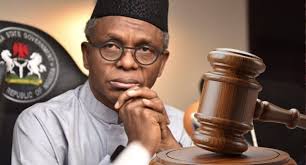
The prosecution in the trial of former Kaduna State governor, Nasir el’Rufai, on Tuesday told a Federal High Court why the defendant was relocated from the custody of the Independent Corrupt Practices and Other Related Offences Commission, ICPC, to the facility of the Department of State Services, DSS.
The DSS is prosecuting el’Rufai on a five-count charge in which he is, among other things, accused of admitting during a television interview that he intercepted the telephone conversations of the National Security Adviser, NSA, Nuhu Ribadu.
Shortly after proceedings resumed, prosecuting counsel, Oluwole Aladedoye (SAN), told the court that the alleged unruly conduct of some members of the defendant’s family, who allegedly made unfounded allegations against the ICPC, necessitated the decision to relocate him.
Aladedoye cited an incident on May 15, when one of el’Rufai’s wives allegedly arrived at the ICPC facility with cameramen and began livestreaming claims that her husband was being denied food and access to family members.
He claimed that politician, Timi Frank, also published allegations suggesting that el’Rufai could be harmed in custody, developments which informed the decision to move him to DSS custody in order to avoid further controversy.
Aladedoye also accused members of the defendant’s family of allegedly weaponising the media and attempting to incite public opinion against the judiciary over his detention and the conditions attached to the bail granted to him on Monday.
He said the former Kaduna State governor’s relatives had repeatedly used social media and press engagements to portray the prosecution and security agencies as persecuting the defendant.
Aladedoye further stated that the situation escalated when members of the defendant’s family, including his two wives and a son, went to the DSS headquarters with journalists and publicly criticised the court’s bail conditions.
He added that, rather than explore legal channels, the family resorted to media campaigns capable of undermining public confidence in the judiciary.
Aladedoye urged the court to caution the defendant and his family members against further public attacks, noting that the case before the court was a criminal prosecution and not political persecution.
In response, defence counsel, E. E. Ekere, said he was unaware of the allegations made by Aladedoye.
Ekere argued that the defendant should not be held responsible for comments allegedly made outside the courtroom.
He assured the court that the defence would advise family members and sympathisers to exercise restraint.
Commenting on the issue, Justice Joyce Abdulmalik said she paid no attention to social media narratives.
Justice Abdulmalik added that issues circulating online should be kept outside courtroom proceedings.
Aladedoye later tendered a flash drive and a certificate of compliance as replacements for those that encountered challenges the previous day, which the court admitted in evidence.
Following this, the judge directed that the flash drive containing a recording of an interview granted by el’Rufai to Arise TV be played in court.
In the recorded 43-minute interview, the defendant allegedly stated that someone had wiretapped a conversation involving the National Security Adviser and forwarded it to him.
During the interview, el’Rufai reportedly attempted to justify the act by arguing that governments routinely monitor communications.
The first prosecution witness (PW1), identified only as APC, who began giving evidence on Monday, continued his testimony on Tuesday.
The witness told the court that shortly after the interview was aired, investigators interviewed the National Security Adviser, who verbally confirmed that the conversation referenced by el’Rufai had indeed taken place between him and the Chairman of the ICPC.
He added that the ICPC Chairman also confirmed having such a discussion with the NSA after portions of the interview were played to him.
According to the witness, the programme anchor, Charles Aniagolu, lawyer Deji Adeyanju, and a cameraman were invited for questioning.
The witness said Aniagolu confirmed that el’Rufai admitted during the interview that someone intercepted the conversation and passed it to him, while also insisting that governments regularly engage in such practices.
Aladedoye later tendered statements obtained from Aniagolu and Adeyanju, which were admitted in evidence without objection from the defence.
The court also admitted another statement made by an Arise TV cameraman, Ugochukwu Agalayana.
The witness stated that investigators concluded that el’Rufai made what they described as an “open confession” during the television interview regarding the interception of the NSA’s conversation.
He added that the investigation team considered the act capable of undermining national security and subsequently recommended prosecution.
The prosecution also tendered a preliminary investigation report, which the court admitted in evidence.
While being cross-examined by another defence counsel, Paul Erokoro, who took over from Ekere, the witness admitted that he did not examine any communication devices belonging to the NSA, obtain IP addresses, or conduct forensic analysis of the alleged interception.
The witness said such steps were no longer necessary after the NSA confirmed the authenticity of the conversation referenced in the interview.
He added that el’Rufai did not specifically state during the interview that he personally carried out the interception, but insisted that the former governor repeatedly maintained that the conversation had been tapped and forwarded to him.
Asked whether the defendant could merely have been boasting as a politician during a politically charged television appearance, the witness said he regarded el’Rufai as a person of integrity and believed he meant what he said during the broadcast.
Justice Abdulmalik subsequently adjourned further hearing until June 22 and 23.