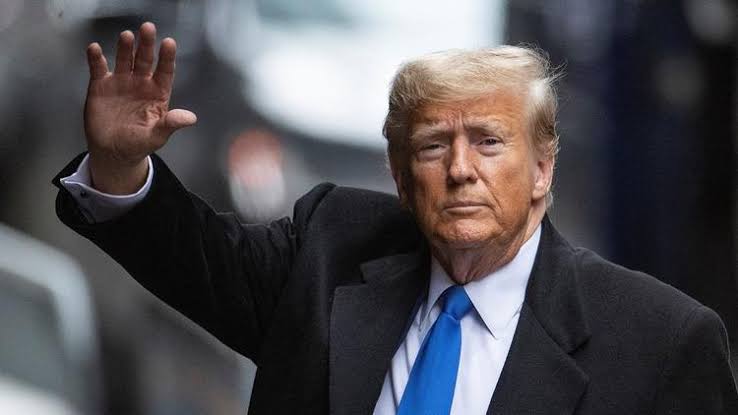
United States President Donald Trump has welcomed a landmark Supreme Court decision that allows states to prohibit transgender athletes from participating in girls’ and women’s school sports, describing the judgment as a major victory.
Responding to the ruling on his Truth Social platform on Tuesday, Trump expressed satisfaction with the outcome, saying it resolved what he described as a long-standing issue.
“The United States Supreme Court just ruled against men playing in women’s sports. Wow! That takes that ridiculous situation off the table!!!” Trump wrote.
The Supreme Court, in a 6-3 ruling divided along ideological lines, held that the US Constitution does not prevent states from enforcing laws that restrict transgender athletes from competing in female school sports.
While the court reached a clear majority on the constitutional question, the justices remained divided over whether such state laws violate federal anti-discrimination legislation.
The judgment is expected to reinforce similar legislation already adopted in at least 27 states, including Idaho and West Virginia, where lawmakers have argued that the restrictions are necessary to preserve fairness and ensure the safety of female athletes.
Delivering the majority opinion, Justice Brett Kavanaugh stated that elected lawmakers and educational authorities are better positioned than the judiciary to determine appropriate policies on transgender participation in sports.
“The legislatures and the schools are better equipped — and under the Constitution, are the more appropriate entities — to assess the competing medical and scientific considerations and draw appropriate lines,” Kavanaugh wrote.
The ruling allows Idaho, West Virginia and numerous other Republican-controlled states to continue enforcing policies requiring students to participate in public school and college sports based on their sex assigned at birth rather than their gender identity.
The decision represents another significant victory for conservative lawmakers and follows last year’s Supreme Court ruling that upheld Tennessee’s prohibition on gender-affirming medical treatment for minors.
The legal challenges were initiated by transgender students who argued that the restrictions violated the Equal Protection Clause of the US Constitution as well as Title IX, the federal law that prohibits sex-based discrimination in educational institutions.
Advocates of the state laws maintain that biological differences between males and females create competitive advantages that undermine equal opportunities for girls and women in sports.
Critics, however, contend that the legislation unfairly targets a small and vulnerable group of students while turning youth athletics into a politically charged national issue.
The Idaho lawsuit originated after the state enacted the Fairness in Women’s Sports Act in 2020, legislation that was challenged by a transgender athlete attending an Idaho university. Lower courts had previously ruled against the law.
During oral arguments before the Supreme Court in January, Idaho Solicitor General Alan Hurst argued that biological sex remains the determining factor in athletic competition because of differences in physical characteristics such as muscle mass, body size, strength and lung capacity.
The West Virginia case involved a transgender teenage girl who challenged a 2021 state law after being prevented from competing on her middle school girls’ track team.
Her legal representatives argued that transgender girls receiving testosterone-suppressing treatment do not possess unfair physical advantages and maintained that the laws were motivated more by politics than scientific evidence.
Earlier this year, President Trump also signed an executive order titled “Keeping Men Out of Women’s Sports,” directing federal agencies to support policies restricting transgender athletes from competing in female sporting events.
His administration has additionally pursued legal action against states that allow transgender participation in girls’ and women’s sports, making the issue one of the defining social policy debates of his presidency.