By Blessing Otobong-Gabriel
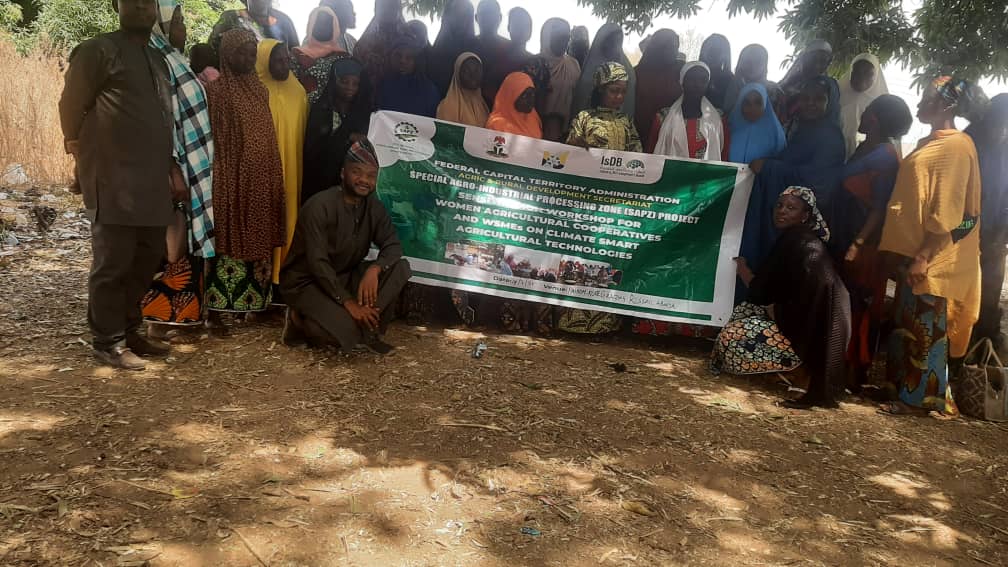
The Federal Capital Territory (FCT) Special Agro-Industrial Processing Zone (SAPZ) on Friday empowered 200 women on Climate-Smart Agriculture in Gwagwalada area council.
The FCT- Special Agro-Industrial Processing Zone (SAPZ) Coordinator, Hajiya Umma Abubakar who was represented by Rural Institutions Development Officer, Muhsin Gambo Lawal said the project aimed at empowering at least 15,000 direct beneficiaries and 35,000 indirect beneficiaries along the livestock and crop value chains.
According to her, a climate-smart agriculture training program for women Small and Medium Enterprises (SMEs) is currently underway in Paiko and Karshi grazing reserve, the training focuses on building the capacity of women cooperatives, with 154 groups identified for intervention.
She said, “The program covers climate-smart agricultural practices, storage, and processing techniques to improve productivity and reduce post-harvest losses.
The project coordinator said, the training is crucial in addressing the impacts of climate change on agricultural production and processing. “The effect of climate change on production and processing is alarming, and this training will help women SMEs improve their productivity, storage capacities, and reduce wastage.
She noted that the training has been well-received by participants, with a high level of understanding demonstrated between the trainers and participants while expressing optimism that the training will lead to improved economic outcomes, increased food security, and reduced post-harvest losses.
“The Nigerian population is growing rapidly, but food production is not keeping pace, Training programs like this are essential in addressing the scarcity of food production and promoting sustainable agricultural practices, she hinted.”
She also said that the training program is expected to have a positive impact on the output of women SMEs, with improved practices in production, processing, and storage leading to increased productivity and reduced wastage.
Also Speaking, The FCT-SAPZ Environmental Climate Change Officer, Larayetan Shadrach Olabode said SAPZ has yet again taken a significant step towards empowering women Small and Medium Enterprises (SMEs) in the agricultural sector.
He explained that the training program is brought together to equipped women SMEs with the knowledge and skills necessary to adopt climate-smart agricultural practices.
“The training, which focused on climate-resilient agricultural techniques, will enhance the productivity and competitiveness of women-led SMEs in the FCT”.
“We recognize the critical role that women play in agriculture, and we are committed to supporting them in adopting climate-smart practices.”
In the same vain, Halima Mahmoud, the Gender and social safety support staff said they are conducting the training program for women cooperatives, with focuse on medium-scale business management and climate-smart agriculture to improve their livelihoods and equip them with new technologies.
“To ensure the success of this initiative, we are implementing conflict resolution and Grievance Redress Mechanism(GRM). We have initially trained 200 women and plan to expand our reach by forming more groups”.
According to her, the training program covers various aspects, including; Climate-smart technology, Small-scale business management, Irrigation and Waste management, saying they have a structured process for accommodating interested women.
“We sensitize eight communities, profile those who express interest, and then provide training to enable them to benefit from the project. Our approach ensures that every woman who joins the program is empowered to grow their business and improve their life”.
One of the participants, Rukaya Manman from Paiko community said she find the program highly beneficial as it focuses on effective business management and maintenance, particularly for women who play a vital role in managing their households.
“The training has significantly increased my knowledge, and I’m committed to sharing this expertise with my fellow group members”.
According to her, “as a member of a women’s group, I plan to step down the training during our next meeting, ensuring that every member benefits from this valuable information. Our businesses are crucial in supporting our families, and I’m confident that this training will lead to significant improvements.
“I strongly advocate for the expansion of this program to reach more women, especially those who are not part of any group. Encouraging them to join a group will enable them to access this vital knowledge, ultimately leading to improved household management and economic empowerment.”
The Facilitator of the program, Mr Shaibu Samuel Enaharo, Faculty of Agric Education, Institute of education, University of Benin said he has started Witnessing Transformative Impact of the Training.
The facilitator noted that he has seen a significant increase in confidence and enthusiasm by merely interacting with the women, it showed a sense of embracement and camaraderie among them.
“As facilitator, I have started seeing the vast potential of the program in empowering women and reducing unemployment in the country. The women’s eagerness to learn and adopt new skills is palpable, and I believe that this initiative is an effective way to equip them with income-generating opportunities and we are confident that this program will have a lasting impact on their lives and contribute to reducing unemployment in the country.”