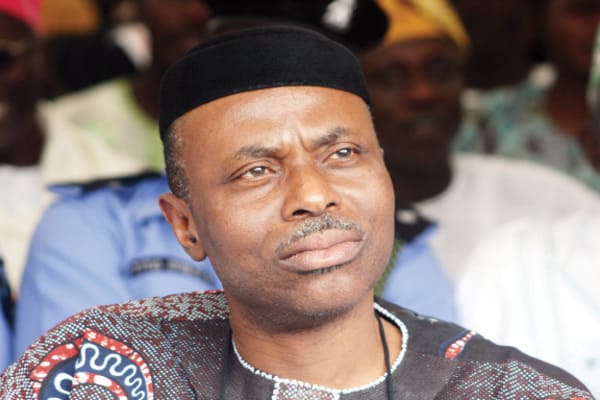
Former governor of Ondo State, Dr Olusegun Mimiko, has called on the Nigerian government to invest more in the health and educational sectors, stating that without such investments, Nigeria will remain underdeveloped.
Dr Mimiko stated this yesterday while delivering the maiden convocation lecture of Confluence University of Science and Technology, CUSTECH, Osara, titled: “Ill-Health and Illiteracy, Siblings’ Alliance Against Development.”
Mimiko said Nigeria has remained underdeveloped because it has not put in commensurate investments in the education and health sectors.
He specifically drew his position from the maternal health, life expectancy, government health and education expenditure, nutritional status, literacy rate and research output and patents.
”Nigeria, with less than three percent of the global population, accounted for 29 percent of global maternal deaths, translating to approximate maternal death of one every seven minutes. All these speak to the uncomfortable fact that Nigeria is indeed the most dangerous place in the world to give birth.”
On education, he said, “According to the September 2025 data from the UNESCO Institute for Statistics, UIS, Nigeria is one of the 10 countries that accounted for more than half of the world’s illiterate adults, with a figure of 43 million.
”According to UNICEF, one in three children is out of school: 10.2 million at the primary level and 8.1 million at the junior Secondary school level. It is instructive that Nigeria’s out-of-school population of 18.3 million accounts for 15 percent of the global total and it is instructive that this number is higher than the population of about 160 countries, as listed by Worldometer, 2025.”
Mimiko jokingly said if the country fails to address its educational and health gap, in 10 years time, it may not have professional health workers to rely on, but herb makers and native doctors.
”While one may not totally endorse SUU’s methodology or collective bargaining prowess, there is something fundamentally wrong with a wage structure that allocates a monthly salary of less than N500,000 to a professor, including those who have been at the academic career peak for upwards of 20 years. It is about time we, once and for all, and in a justifiable and sustainable way, tackle the issue of emoluments and funding generally, in our tertiary institutions. Apart from other obvious benefits, this will remain one of the viable toolkits for addressing the ‘JAPA’ phenomenon.”
He called on government at all levels to be intentional about the two critical sectors, urging the federal government to continue with its present educational policies such as NELFUND and digital literacy, to readdress these gaps.
“This is one compelling reason why we should be thinking of resuscitating the school feeding programme, albeit in a better packaged manner, with inbuilt transparency in implementation. I propose that even in this, the federal government should not be directly involved in implementation, but remain its guardian angel, prescribing standards and incentivising the sub-national government to mainstream the programme, while monitoring for compliance.
”Perhaps our free school meal programme should come with the irreducible minimum of one egg, one child, one day. This will make compliance and accountability easy to track. It will also have a catalytic effect on our livestock industry.
”Unquestionably, inadequate funding of health and education can lead to, among others, poor human capital development, resulting in a less skilled and less healthy workforce, reduced economic productivity and competitiveness, and increased poverty and inequality. On the other hand, socio-economic underdevelopment can lead to limited government revenue, making it difficult to allocate sufficient funds to health and education, among other critical sectors of the national economy.
”Childhood nutrition, which can straddle education, health and even agriculture, must be given particular attention. As it is expected from the federal government, so it is expected from the sub-national,” he said.