By Blessing Otobong-Gabriel
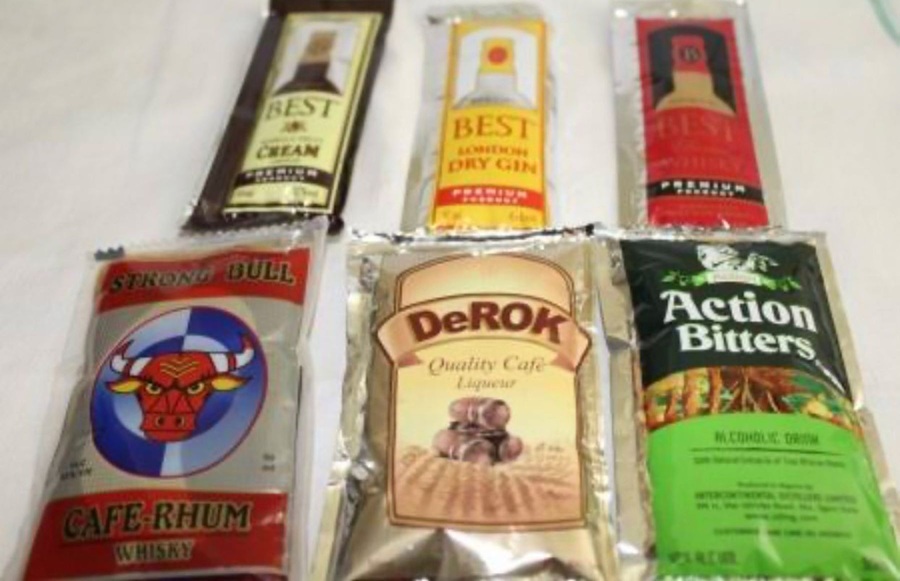
National Agency for Food and Drug Administration and Control, NAFDAC, has resumed its enforcement of the ban on the production and sale of alcoholic beverages in sachets and small-volume PET/glass bottles (below 200ml), in line with the recent directive of the Senate.
This decisive action, ordered by the Senate and backed by the Federal Ministry of Health and Social Welfare, underscores the agency`s statutory mandate to safeguard public health and protect vulnerable populations, particularly children, adolescents and young adults from the harmful use of alcohol.
This was disclosed in a statement igned by the Director-General of NAFDAC, Professor Mojisola Adeyeye.
Adeyeye noted that the proliferation of high-alcohol-content beverages in sachets and small containers less than 200ml has made the products easily accessible, affordable and concealable, leading to widespread misuse and resultant addiction among minors and some commercial drivers.
She stated that this public health menace has been linked to increased incidents of domestic violence, road accidents, school dropouts and social vices across communities.
According to her, placing a label `not for children` on the sachets and the small containers will not work, because of the peculiarity of the society.
She noted that many parents do not know that their children take alcohol in sachet because the pack size could be easily concealed and it is cheap.
She recalled the six years of moratorium given to manufacturers to reconfigure their product lines: In December 2018, NAFDAC, Federal Ministry of Health and the Federal Competition and Consumer Protection Commission, FCCPC, signed a five-year Memorandum of Understanding, MoU, with the Association of Food, Beverage and Tobacco Employers, AFBTE, and the Distillers and Blenders Association of Nigeria, DIBAN, to phase out sachet and small-volume alcohol packaging by January 31, 2024.
She explained that the moratorium was later extended to December 2025 to allow industry operators exhaust old stock and reconfigure production lines.
The agency emphasised that the current Senate resolution aligns with the spirit and letter of that agreement and with Nigeria’s commitment to the World Health Assembly Global Strategy Resolution to Reduce the Harmful Use of Alcohol (WHA63.13, 2010), to which it is a signatory since 2010.
It noted that the aim of the resolution is to protect the vulnerable population such as children and youths.