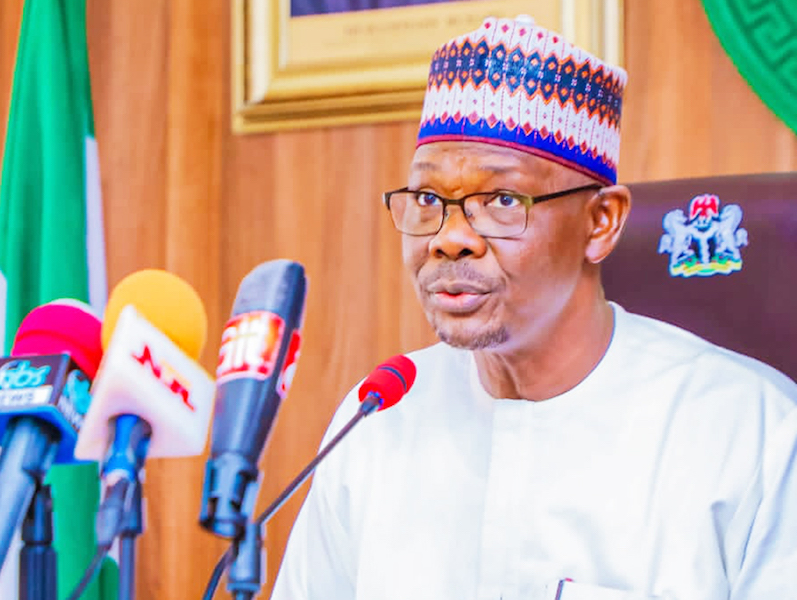
Nasarawa State Governor, Abdullahi Sule, has expressed hope that Nigeria will one day produce a Christian-Christian presidential ticket, saying he believes such a ticket would secure victory in a general election.
The governor made the remarks on Tuesday during an appearance on Channels Television’s Politics Today, while responding to concerns raised by the Nigeria Democratic Congress (NDC) vice-presidential candidate, Rabiu Kwankwaso, over the possibility of another same-faith presidential ticket in the 2027 elections.
Sule rejected claims that the All Progressives Congress (APC)’s Muslim-Muslim presidential ticket represented religious exclusion, insisting that Nigerians should not view leadership through the lens of religion alone.
According to him, the country is due for a Christian-Christian presidential ticket to determine whether it can enjoy the same electoral success previously recorded by Muslim-Muslim pairings.
“I pray that one day Nigeria will have a Christian-Christian ticket, and it will win. That’s what I pray to see,” Sule said.
The governor recalled that Nigeria had previously witnessed a Muslim-Muslim presidential ticket during the June 12, 1993 presidential election, when the late Chief Moshood Abiola contested alongside Babagana Kingibe.
He noted that same-faith presidential tickets had historically won elections in the country.
“You can see both elections have been clear that the Muslim-Muslim ticket has won,” he stated.
Sule said it was unsurprising that Kwankwaso, being a member of the opposition, criticised the APC’s ticket arrangement, arguing that opposition politicians are naturally expected to challenge decisions taken by the ruling party.
“I think it is normal for Senator Kwankwaso, who I respect a lot, to say that because he’s opposition. He cannot say anything good in that manner. So when he said that, it is expected of him to say that.
“I don’t think he will tell me today that another governor within the APC is going to tell you he’s awful. Another governor is going to tell you he’s an albatross,” he said.
The Nasarawa governor also cited Sections 14(3) and 15 of the 1999 Constitution, arguing that the provisions focus on inclusiveness, federal character and ethnic representation rather than religious balancing.
“It all actually happens in Section 14(3) of the constitution, where it’s talking about making sure that there is inclusiveness, there is representation, and all parts of the country, none of them is neglected, none of them is not carried along.
“That’s where federal character came in, following Section 15 of the same constitution that also talks about ethnicity. There is no place where it talks about religion. Section 14 didn’t talk about religion. Section 15 didn’t talk about religion,” he said.
When asked whether he currently has a Christian deputy governor, Sule answered in the affirmative, explaining that Emmanuel Akabe has served as his deputy throughout his administration.
“I’ve always had a Christian as a deputy. In Nasarawa State, it has always been a Christian,” he said.
Responding to a follow-up question on whether religion influenced his choice of deputy governor, Sule maintained that competence—not religious affiliation—guided the decision.
He added that political realities differ from one state to another and should not be compared directly with national politics.
“No, no, no, we thought it was important because Emmanuel Akabe is competent. Our state is different from Nigeria. You cannot take a particular state.
“Take Enugu, for instance, it has a Christian-Christian arrangement. Take Bayelsa, it’s Christian-Christian,” he said.