Mariam Sanni
A Federal High Court sitting in Abuja has ordered that hearing notices be served on the Inspector-General of Police (IGP), Kayode Egbetokun and Attorney General of the Federation ( AGF ) , Lateef Fagbemi in a fundamental rights enforcement suit instituted by human rights activist and former presidential candidate, Omoyele Sowore.
Sowore filed the ₦1.2 billion suit against the IGP, the Nigeria Police Force (NPF), the Commissioner of Police, Federal Capital Territory (FCT), and the Attorney-General of the Federation (AGF), over what he described as his illegal arrest, detention and violent assault by armed police officers.
The suit followed Sowore’s rearrest at the Kuje Magistrate Court on October 23, 2025, shortly after he had been granted bail, in connection with his participation in the #FreeNnamdiKanuNow protest.
In his application, Sowore contended that his arrest and detention over a peaceful protest amounted to a gross violation of his fundamental rights to freedom of movement and dignity of the human person, as guaranteed under the Constitution.
At the proceedings, Justice Umar directed that hearing notices be properly served on the IGP and Attorney General of the Federation who are the defendants in the case and adjourned the matter to March 10, 2026, for definite hearing.
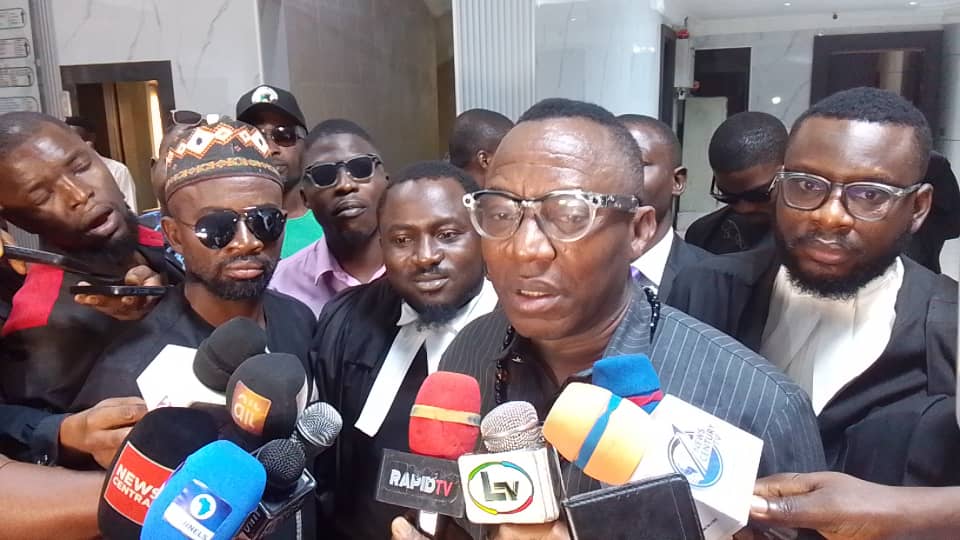
Sowore’s lead counsel, Abubakar Marshal, who announced his appearance, informed the court that the matter was scheduled for mention. He expressed surprise that none of the defendants was present in court or represented by counsel. Marshal urged the court to deem the matter as duly mentioned and to fix a date for definite hearing and adoption of processes, a request which the court granted.
When the case was called, Marshal again informed the court that all the defendants, despite being served with hearing notices, were absent and had provided no explanation for their non-appearance.
Speaking with journalists after the court session, Marshal accused the Nigeria Police Force of operating with impunity, insisting that the police have no legal authority to arrest, detain or prosecute citizens who have committed no offence.
He stressed that the powers of the police are clearly circumscribed by law and cannot be exercised arbitrarily, citing Supreme Court decisions which affirm that a person who has committed no crime is “free indeed” and should not be subjected to detention or prosecution.
Marshal further emphasised that protest is a constitutionally guaranteed right, noting that Nigerians are legally entitled to peacefully demand accountability and challenge policies they consider unjust or unlawful.
“A person who has committed no crime cannot be charged with violence simply for protesting,” he said.
He added that when citizens exercise their right to peaceful protest, security agencies, including the police and the Department of State Services (DSS), lack the authority to suppress or regulate such actions in a manner that infringes on fundamental freedoms.
Marshal disclosed that following the arrest of several protesters, the matter was taken to court to seek redress for what he described as unlawful and unjust detention.
The reliefs sought in the suit include ₦1 billion in punitive damages, ₦200 million in additional damages, the cost of litigation, as well as a public retraction and apology from the security agencies involved.
He also alleged that after Sowore’s release from custody in Ketu, the Commissioner of Police in Lagos State, Moshood Jimoh, declared him wanted—an action he described as a further abuse of power.
According to Marshal, the suit is aimed not only at securing justice for Sowore and other arrested protesters, but also at reinforcing the rule of law and safeguarding Nigerians’ constitutional rights to peaceful protest.