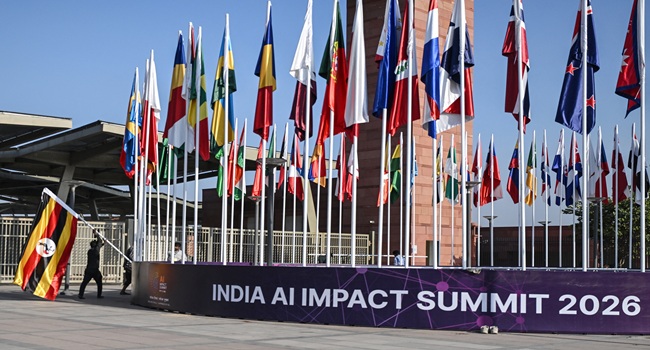
The first major global artificial intelligence summit of the year began in New Delhi on Monday, bringing together world leaders, tech executives, and experts to tackle pressing issues ranging from job displacement and child safety to environmental impacts and the need for international AI governance.
Indian Prime Minister Narendra Modi is set to inaugurate the five-day AI Impact Summit in the afternoon, with the event aiming to produce a “shared roadmap for global AI governance and collaboration.”
“This occasion is further proof that our country is progressing rapidly in the field of science and technology,” and it “shows the capability of our country’s youth,” he said in an X post on Monday.
Organizers describe this as the largest edition yet of the annual AI gatherings, following previous summits in Paris, Seoul, and Bletchley Park in the UK. The Indian government anticipates around 250,000 attendees, including 20 national leaders and 45 ministerial-level delegations.
High-profile participants include OpenAI CEO Sam Altman and Google CEO Sundar Pichai. Nvidia CEO Jensen Huang, however, has reportedly canceled his appearance due to unforeseen circumstances.
Modi is expected to hold bilateral discussions with leaders such as French President Emmanuel Macron and Brazilian President Luiz Inacio Lula da Silva to bolster global partnerships and position India as a key player in the “AI decade ahead.”
Despite the ambitious agenda organized around the themes of “people, progress, and planet” (referred to as three “sutras”), some experts caution that the broad scope may reduce the likelihood of binding commitments from governments and tech companies.
Amba Kak, co-executive director of the AI Now Institute and a former AI advisor to the US Federal Trade Commission, told AFP that previous summits have produced mostly narrow, self-regulatory frameworks that allow AI firms to “grade their own homework.”
AI safety continues to be a central concern, particularly the risks of misinformation through deepfakes and the generation of harmful content. Recent controversy surrounding Elon Musk’s Grok AI tool, which permitted users to create sexualized images of real individuals—including children—via simple text prompts, has intensified calls for stronger safeguards.
Kelly Forbes, director of the AI Asia Pacific Institute, highlighted the rising priority of child safety and digital harms, noting that generative AI has lowered barriers to producing problematic content.
“There is real scope for change,” although progress may not occur quickly enough, Forbes said, pointing to ongoing research into how countries like Australia are mandating platforms to address these issues.
The summit is also framed as the first hosted by a developing nation, with organizers emphasizing a vision for AI that benefits “the many, not just the few.”
India’s IT ministry has positioned the event as an opportunity to advance inclusive AI development. Last year, India climbed to third place globally in Stanford University’s AI competitiveness ranking, surpassing South Korea and Japan.
Experts note, however, that despite ambitious infrastructure plans and innovation goals, India still trails far behind the United States and China in core capabilities.
Seth Hays, author of the Asia AI Policy Monitor newsletter, predicted discussions would likely focus on establishing government guardrails without stifling development.
“There may be some announcements for more state investment in AI, but it may not move the needle much—as India needs partnerships to integrate on the international scene for AI,” Hays told AFP.