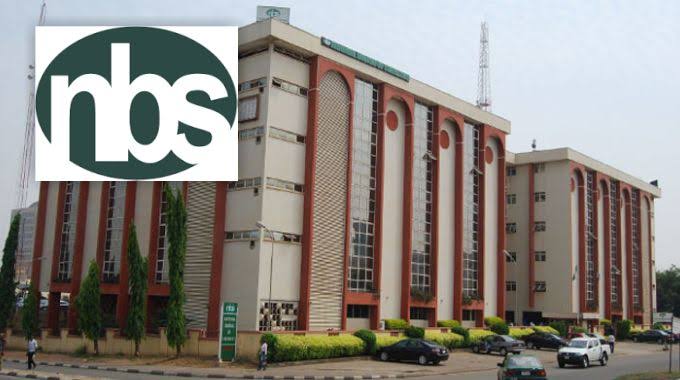
National Bureau of Statistics, NBS, has said that Nigeria’s Gross Domestic Product, GDP, grew by 3.13 per_ on a year-on-year basis in real terms in the first quarter of 2025.
The Statistician-General, SG, of the Federation, Adeyemi Adeniran, who made this known at a news briefing on the Rebased GDP Results released by the National Bureau of Statistics, NBS, in Abuja yesterday, said this growth rate was higher than the 2.27% recorded in the first quarter of 2024.
Adeniran, said the performance of the GDP in Q1 2025 was driven mainly by the services sector, which recorded a growth of 4.33 per cent and contributed 57.50 ✓🤣 to the aggregate GDP.
According to him, the agriculture sector grew by 0.07 per cent in Q1 2025 from the growth of -1.79 per cent recorded in the first quarter of 2024.
He said the Industry sector witnessed a growth rate of 3.42%, an improvement from 2.35 % recorded in Q1 2024.
The statistician-general, said in terms of share of the GDP, the services sector and industry sector contributed more to the aggregate GDP in Q1 2025 compared to Q1 2024.
He said in Q1 2025, aggregate GDP at basic price stood at N94,051,733.20 million in nominal terms.
“This performance is higher when compared to Q1 of 2024, which recorded an aggregate GDP of N79,505,265.15 million, indicating a year-on-year nominal growth of 18.30%.
The S-G gave a further breakdown of the rebased GDP results for 2019 to 2024 as follows:
In nominal terms, Nigeria’s economy was estimated at N205.09 trillion in 2019, N213.64 trillion in 2020, N243.30 trillion in 2021, N274.23 trillion in 2022, N314.02 trillion in 2023 and N372.82 trillion in 2024.
In 2019, the rebased nominal GDP at basic prices represented an increase of 41.7%, over the nominal GDP of 2019 of the old year of 2010.
“In 2020, it was 39.0 %, 38.7 in 2021, 36.1% in 2022, 34.6%in 2023 and 35.4% in 2024″.
In real terms, the GDP growth rate for 2020 stood at -6.96%, which was as a result of COVID-19.
“We came out of that negative growth in 2021 when we reported 0.95% growth. Higher growth rates were also reported in 2022, 2023, and 2024 at 4.32%, 3.04 per cent and 3.38%, respectively.
He said ranking economic activities based on the 2019 base year, crop production was first at 17.58% followed by trade at 17.42 p% and real estate at 10.78%
This was followed by telecommunications at 6.78 per cent and Crude petroleum and natural gas took fifth place at 5.85 per cent.
“Real estate ranked third, displacing crude oil and natural gas to the fifth position, which was usually in the third place before the rebasing.
“This is due to better coverage of the activities of the real estate informal sector, now putting it in third place.”
In terms of broad classification, the services sector remained the largest, contributing the highest to GDP at 53.09 per cent, as against 52.60 per cent before the rebasing.
This was followed by the agriculture sector at 25.83% and the industry sector at 21.08 %.
Adeniran said better coverage was given to the water transport sub-sector and the service sector, resulting in significant improvement in the sector.
“The economic activities in the service sector with the most notable changes include water transport; art, entertainment and recreation; transport services; administration and support services and human health and social services.
He said the coverage of the Agriculture sector was enhanced following the National Agricultural Sample Census and the National Agricultural Sample Survey conducted by the NBS.
Adeniran said the contribution of the informal sector to the GDP in 2019 was estimated at N86.85 trillion, which represents 42.5 per cent of the GDP, compared to 41.4 per cent recorded previously.
The last rebasing exercise was conducted in 2014 with 2010 as the base year.
However, the recent rebasing exercise which covered a period between 2019 and 2023, has 2019 as the new base year due to the relative stability of the domestic economy.
The rebased GDP also includes updated methodologies based on best practices and official statistical guidelines.