By Blessing Otobong-Gabriel
The Minister of Humanitarian Affairs and Poverty Reduction, Bernard M. Doro, has unveiled a sweeping reform of Nigeria’s humanitarian and poverty alleviation framework, aimed at addressing systemic inefficiencies and lifting millions out of poverty.
Doro, who assumed office on November 6, 2025, described his appointment as an opportunity to deepen a lifelong commitment to humanitarian service, stressing that the role goes beyond duty to a personal calling.
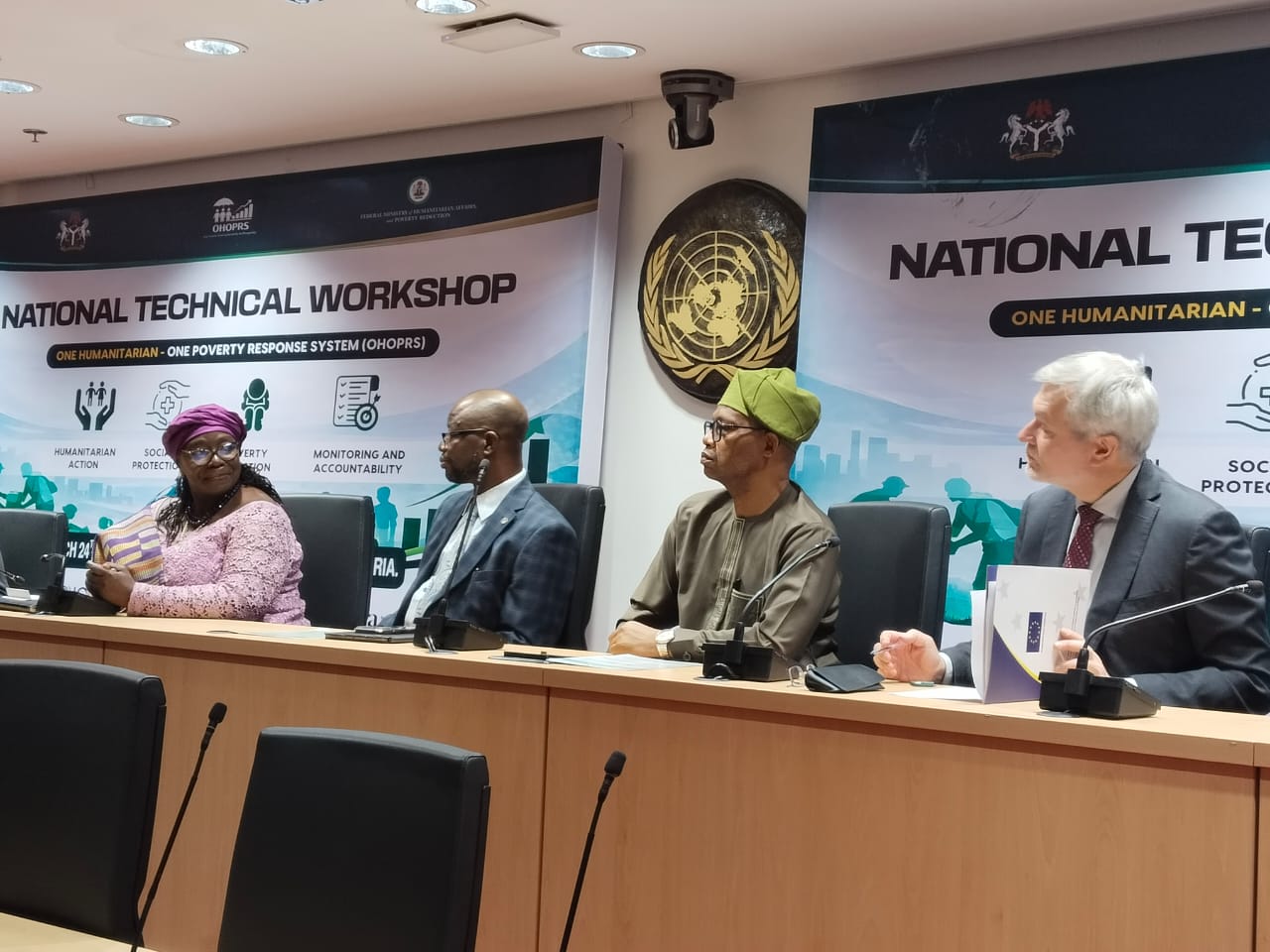
The Minister disclosed this at a workshop with the theme: One Humanitarian – one poverty Response System OHOPRS.
Speaking on the new direction of the ministry, the minister disclosed that a comprehensive review of the country’s poverty reduction architecture revealed deep structural gaps, particularly the lack of coordination among ministries, departments, and agencies (MDAs).
Citing data from the National Bureau of Statistics (NBS), he noted that more than 63 percent of Nigerians were living in multidimensional poverty as of 2022, a situation he described as alarming and unacceptable.
According to him, despite increased funding from government and development partners, the impact of interventions has remained limited due to fragmented operations, duplication of efforts, and weak tracking systems.
“Everyone is contributing in their own way, but the lack of coordination has reduced effectiveness,” Doro said.
He further highlighted what he termed a “visibility crisis,” explaining that there is insufficient clarity on beneficiaries, intervention locations, and measurable outcomes.
“The key issue is not a lack of interventions, but a lack of coordination. What we have been doing is managing poverty rather than ending it,” he added.
To address these challenges, the Federal Government has introduced the One Humanitarian – One Poverty Response System (OHOPRS), a unified national platform designed to integrate humanitarian assistance, social protection, and long-term development efforts.
The system will operate on core principles including a single national framework, a unified register of beneficiaries, and a centralised data platform to serve as a reliable “source of truth.”
Doro explained that the initiative will eliminate duplication and exclusion through a harmonised database, while also introducing structured exit plans to transition beneficiaries from dependency to economic self-reliance.
The new system will focus on skills development, livelihood support, mentoring, and access to productive assets as pathways out of poverty.
He outlined a multi-layered implementation strategy covering policy coordination, real-time data systems, programme delivery, and a blended financing model involving government, private sector, and development partners.
The National Social Register, he added, will form the backbone of the targeting process, supported by unified benefit and exit registers.
Doro said the reforms align with the Federal Government’s broader target of lifting 50 million Nigerians out of poverty by 2030 through improved coordination, digital accountability, and evidence-based interventions.
The Minister of State for Humanitarian Affairs and Poverty Alleviation, Tanko Sununu, noted that even individuals within structured sectors such as the military are not immune to poverty, as many still face significant economic hardship.
He explained that the proposed system is designed to align efforts across sectors and agencies, ensuring a coordinated response to the multiple crises affecting communities particularly conflict, displacement, and economic challenges.
According to him, one of the key benefits of the system is improved efficiency and reduced duplication in resource allocation, observing that many non-governmental organisations (NGOs) and development partners often operate in isolation, with little awareness of each other’s activities.
“With a unified response plan, data can be consolidated to support proper planning, execution, phasing, and tracking of interventions,” he said, adding that aligning humanitarian efforts with NGOs would strengthen overall impact.
Sununu emphasised that such a holistic approach is crucial for a country like Nigeria, where resources are limited and challenges such as climate change and environmental shocks are increasing.
The Statistician General stated that the National Statistical System plays a critical role in three key areas which is to ensure ensure data quality and standardisation.
He explained that the agency is committed to supporting the One Humanitarian, One Poverty Response System (OHOPRS) through robust statistical standards and principles. This includes harmonising data definitions, strengthening metadata documentation, and ensuring that all contributing datasets meet national quality benchmarks.
“We are not simply aggregating data,” he noted. “We must ensure that the data being integrated is accurate, properly structured, and meets the required standards. High-quality data is essential for precise targeting and for building public trust in the system.”
Mohamed Malick Fall of Senegal, UN Resident and Humanitarian Coordinator in Nigeria who was represented by the UN Women Representative to Nigeria and ECOWAS, Beatrice Eyong said For decades, global poverty was declining. Today, that progress is stalling—and in many cases reversing. Between 808 million and 831 million people are living in extreme poverty, and the goal of ending poverty by 2030 is increasingly out of reach without a significant shift in approach.
He said At the same time, global priorities reveal a stark imbalance. While approximately $2.7 trillion is spent annually on military expenditure, the humanitarian system struggles to mobilise just $33 billion to respond to urgent needs. This is not a question of resource availability, but of alignment and prioritisation.
Poverty is also becoming increasingly concentrated. Nearly 75 percent of the world’s extreme poor now live in sub-Saharan Africa or in fragile and conflict-affected settings. Conflicts are lasting longer on average twice as long as they did three decades ago—trapping populations outside systems of support.
He assured that the United Nations family stands firmly with the government and people of Nigeria in this effort as a partner, a convener, and a connector of global expertise and experience.