…As oil production witnessing major rebound – NUPRC
By Charles Ebi
Federal Government has commenced the verification of disputed and newly-drilled crude oil and gas fields across the Niger Delta to resolve ownership claims and ensure equitable revenue allocation to producing states.
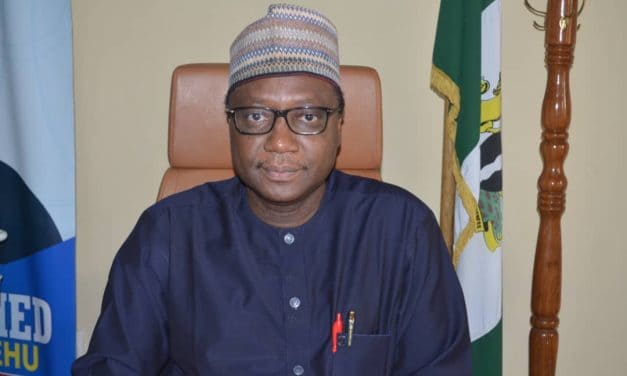
Speaking to journalists in Asaba, Dr. Mohammed Shehu, Chairman of the Revenue Mobilisation Allocation and Fiscal Commission ,RMAFC, said the exercise is mandated by law under paragraph 32(a), Part I of the Third Schedule of the 1999 Constitution (as amended).
“We announce the inauguration of the IATC and reaffirm our unwavering commitment to accurately identify the locations of crude oil and gas fields and wells within the disputed areas and the newly drilled crude oil and gas wells.
“The 1999 Constitution, as amended, empowers the RMAFC, among other functions, to monitor accruals into and disbursement of revenue from the federation account.
“This initiative is driven by former concerns expressed by the executive governors of some states, such as Anambra -Imo, Anambra -Delta, regarding the rightful ownership and territorial boundaries of specific crude oil and gas assets.
“Key among these is the Aneize oil field within OML 143; the Eyine and Ameshi fields. In Delta, we shall examine the identified locations and verify the coordinates of newly drilled oil and gas wells within the area spanning from 2017 to date”, he said.
The RMAFC boss said the verification exercise would be extended to Rivers, Akwa Ibom, Bayelsa, Ondo, Edo, and Anambra states in response to their complaints.
He said that the verification exercise would rely on geospatial data provided by the NUPRC, which would be validated and plotted while the Surveyor-Generals of the affected states would observe the entire process.
According to him, the goal is to ensure a fair and transparent allocation of oil revenue grounded in accurate data while addressing long-standing disputes over the location and rightful ownership of these vital energy assets.
“We are tasked with plotting the coordinates of newly drilled identified crude oil and gas fields and wells across recognized oil-rich regions.
“This decision reflects our unwavering commitment to support the commission in obtaining precise location data for these assets, ensuring that the 13 per cent derivation fund is equitably disbursed to the rightful boundary states among the oil-producing areas”, he stated.
Shehu noted that the exercise was a strategic and proactive measure by the Federal Government aimed at resolving long-standing disputes among the affected states.
“This initiative is essential to ensure that every oil and gas-producing state receives its rightful share of the resources to reduce tension and safeguard the integrity of the Federation Account.
“By promoting transparency and fairness, we are laying the groundwork for a more stable and conducive environment for continued exploration and development across the region”, Shehu said.
Shehu noted that the exercise was also informed by the various petitions by governors of Anambra, Delta, Imo, Edo, Ondo, and Rivers seeking to establish the rightful ownership and territorial boundaries of specific crude oil and gas assets.
According to Shehu, the assignment is to be carried out via the Inter-Agency Technical Committee ,IATC, comprising the RMAFC, Representatives of Nigerian Upstream Petroleum Regulatory Commission ,NUPRC, Office of the Surveyor General of the Federation ,OSGOF, and the National Boundary Commission ,NBC.
In a related development, the Nigerian Upstream Petroleum Regulatory Commission, NUPRC, says the country’s oil and gas industry is witnessing a major rebound in exploration and production activities with resultant increase in the number of rigs operating in the country.
The regulator reported that the country’s rig counts has risen from just 8 in 2021 to 43 as of September 2025, signaling renewed investor confidence in the country’s upstream sector.
The Chief Executive of NUPRC, Engr. Gbenga Komolafe, disclosed this at the Africa Oil Week in Accra, Ghana, attributing the surge to regulatory clarity, fiscal reforms, and decisive policies under President Bola Ahmed Tinubu’s administration.
“In nearly four years, the Commission has rolled out 24 transformative regulations, 19 of which are now gazetted to operationalize key provisions of the Petroleum Industry Act”, Komolafe stated.
“These reforms have dismantled barriers, unlocked opportunities, and created a more transparent, competitive operating environment”.
The NUPRC boss explained that the rise in rig activity underscores the effectiveness of Nigeria’s Regulatory Action Plan, RAP, which was designed to fast-track licensing, remove bottlenecks, and attract fresh capital into the upstream oil and gas sector.
He stressed that energy security remains at the heart of Nigeria’s strategy: “Energy security is the cornerstone of economic growth, national resilience, and shared prosperity in Africa. Nigeria’s upstream revival demonstrates that reforms, when implemented with discipline, can deliver measurable results”.
Highlighting the broader transformation under Tinubu’s Renewed Hope Agenda, Komolafe pointed to the approval of five major acquisition deals worth over $5 billion, alongside high-profile Final Investment Decisions, FIDs, such as the $5 billion Bonga North project and the $500 million Ubeta Gas Project.
“These FIDs, along with other expected projects like HI NAG Development, Ima Gas, Owowo Deep Offshore, and Preowei Fields, signal renewed long-term commitments from operators and affirm Nigeria’s competitiveness”, he said.
Komolafe further noted that bid rounds and concession awards, including the 57 Petroleum Prospecting Licenses awarded in 2022, the 2022 Mini-Bid Round, and the 2024 Licensing Round, were executed with “unprecedented transparency”, attracting exceptional investor participation.
According to him, Nigeria has deliberately optimized signature bonus requirements and widened accessibility to new entrants, resulting in 27 out of 31 blocks offered in 2024 being successfully awarded.
“With the Petroleum Industry Act as our foundation, reinforced by bold Presidential Executive Orders and transformative regulatory initiatives, we are not just opening our doors to investment; we are building a world-class upstream oil and gas environment that rewards ambition, innovation, and responsibility”, Komolafe declared.
He concluded that the combination of rising rig counts, record Field Development Plan approvals, and renewed investor confidence affirms that Nigeria’s upstream sector is “standing at the dawn of a new era defined by clarity, competitiveness, and confidence”.