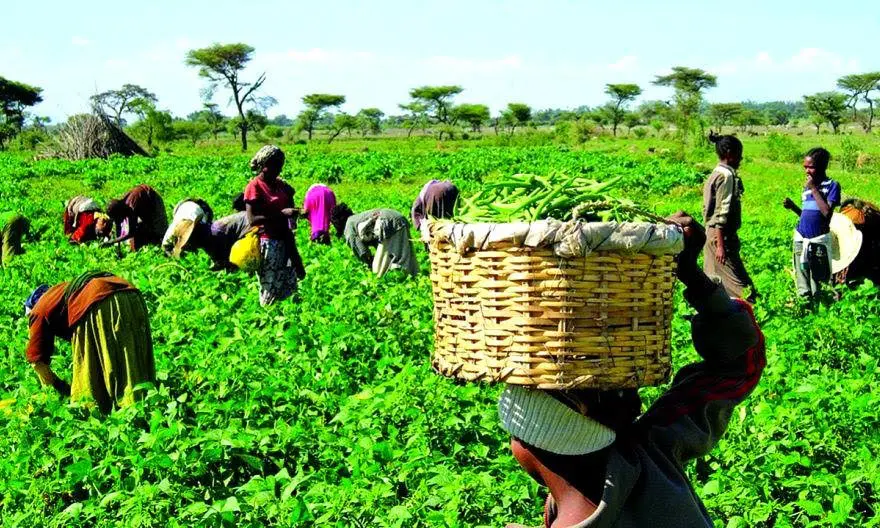
Farmers in Sokoto, Kebbi and Zamfara States have called on the federal and state governments to set aside dedicated emergency funds to uptake the excess harvest of agricultural produce to prevent post-harvest loses.
Speaking in an interview with the News Agency of Nigeria, NAN, in Sokoto, Chairman of Onion Producers and Marketers Association of Nigeria, Alhaji Aliyu Maitasamu said buying of excess harvest from farmers after a bumper harvest would stabilise prices of commodities.
“Buying of excess produce from farmers after a bumper harvest will reduce avoidable lowering of prices in the market, thereby encouraging farmers to remain in business.
“Mopping of excess harvest will also allow appreciable market flow, ensure strategic reserves apart from ensuring the stability of produce,” he noted.
Maitasamu, who is also the President of Cooperatives Federation, explained that government could return the procured commodities from storage facilities to the market when there is the need which would further stabilise prices.
“These will serve as one of the best ways to encourage more investments in agriculture in the country. Similar initiative is being practiced across the globe.
“At present, farmers are afraid to reinvestment because prices are too low, many farmers could not break even, a situation that is not only worrisome, but dangerous to the nation,” Maitasamu said.
He, however, commended the federal and some state governments for distributing free and subsidised seedlings, fertilisers, chemicals, working tools and other farm inputs to farmers as a way of addressing their challenges and encourage food security.
The chairman pleaded with government to continue to provide subsidised fertiliser and other farming inputs in order to sustain farming activities to complement the current low prices of commodities.
According to him, 250 tractors provided by Sokoto State government will encourage dry and rainy season farming, adding that garlic, onion, chilli pepper and other vegetables will soon spring up.
The Chairman of Cotton Farmers Association in Sokoto State, Alhaji Kabiru Hassan-Dange, called on government to prioritise the reactivation of agricultural processing industries that would buy the agricultural produce from farmers.
Hassan-Dange also urged the federal government to discourage the importation of agricultural produce which jeopardises local production and lowers the prices of commodities.
In Gusau, Sarkin Norman Mayanchi, Alhaji Kabir Ibrahim, said the current decline in the prices of foodstuffs is quite good, but farmers are running at a loss due to high price of labour and farm implements.
He advised government to provide incentives such as fertilisers and other farm implement at subsidised rates to encourage farmers and sustain production.
“I would like to advise government at all levels to invest in crop production, provide the necessary support to farmers and reintroduce Commodity Marketing Board to enable them remain in business,” he pleaded.
The Head of Economics Department, Federal University Gusau, FUGUS, Dr Mustapha Kanoma said the presidential directive on food importation is the major reason behind the low price of food items.
Kanoma said: “Although citizens are enjoying the policy as it eases hardship, it is important to have a homegrown policy on food production to sustain the country’s food security.
“It is not bad to have a short term plan in addressing socio-economic challenges, but we must deal with the critical indices to arrive at lasting solutions.”
According to him, no country can improve citizens wellbeing without homegrown economic policy on food security.
In Kebbi, prices of major food items had significantly reduced across markets.
A survey conducted in Birnin Kebbi indicated that the prices of grains, beans, rice and groundnuts recorded noticeable drop compared to two months ago.
The Secretary of Assorted Grains Sellers Association of Nigeria, Alhaji Ibrahim Gudi, observed that the reduction was due to improved harvest and increased market supply.
He said a 100kg bag of maize, which sold between N48,000 and N50,000 two months ago, now sells for between N38,000 and N40,000.
“A bag of millet that was sold for N60,000 now goes for N40,000, while guinea corn has also dropped from N60,000 to N40,000,” he said.
He added that a bag of white beans, formerly sold between N120,000 and N130,000, now sells for N110,000 and N115,000.
“Also, rice which was between N45,000 and N50,000 is now N30,000, while groundnut dropped from N45,000 -N50,000 to N35,000.
“Sesame has also reduced from N130,000 to N110,000,” he said.
A trader at Kebbi Central Market, Malam Aliya Jelani, said the arrival of new grains had eased pressure on demand.
“Once new harvest enters the market, prices go down naturally. The only challenge is sustaining it,” he said.
At the old market, Malam Nuhu Kardi said although the reduction is encouraging, food items remain relatively expensive.
An economist, Malam Bello Ibrahim from Waziri Umaru Federal Polytechnic, Birnin Kebbi, noted that
the trend might be seasonal unless supported by targeted government interventions.
He said government must address structural issues affecting food production and distribution.
“What we are seeing is mainly seasonal. For prices to remain stable or continue to fall, government must sustain security in farming areas, reduce transportation cost and support farmers with inputs,” he said.
Ibrahim urged government to invest in storage facilities, regulate transport cost, prevent hoarding and strengthen market monitoring mechanisms.
He also appealed for increased access to credit facilities for small-scale farmers and for the stabilisation of fuel prices to ease distribution cost. (NAN)