
Economic and Financial Crimes Commission, EFCC, has announced stronger collaboration with the Nigerian Army and the Department of State Services, DSS, in its efforts to curb illegal mining and related crimes in Kwara State.
The new Zonal Director of the EFCC, Ilorin Zonal Directorate, Victoria Ugo-Ali disclosed this when she paid strategic courtesy visits on Tuesday to the Commandant of 22 Armoured Brigade, Brigadier-General Nicholas Rume, and the State Director of the DSS, Michael Oganwu, in Ilorin, aimed at reinforcing inter-agency cooperation to tackle corruption, illegal mining, banditry and terrorism financing in Kwara State and neighbouring areas.
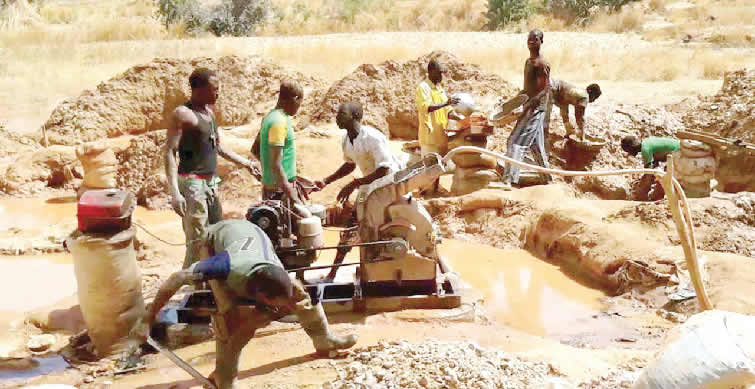
During her meeting with the army commandant, Ugo-Ali described illegal mining as a significant threat to Nigeria’s economic stability and national security, stressing the need for coordinated action.
“Illegal mining is not merely an economic offence; it constitutes a grave threat to national security. These operations are often orchestrated by organised criminal networks that circumvent regulatory frameworks and deprive the country of vital revenue,” she said.
The zonal director called for enhanced intelligence sharing, joint field operations and improved security around mining sites to dismantle illicit networks effectively.
Highlighting the connection between illegal mining and insecurity, Ugo-Ali pointed to evidence suggesting that proceeds from unlawful mineral extraction are sometimes channelled into financing violent and extremist activities.
“Disrupting illicit financial flows linked to mineral exploitation remains central to EFCC’s mandate. Achieving this objective requires robust collaboration with the military to dismantle entrenched criminal structures,” Ugo-Ali added.
In his response, Brigadier-General Rume commended EFCC’s proactive engagement and reaffirmed the Brigade’s commitment to support anti-corruption and economic crime operations within its jurisdiction.
“22 Armoured Brigade stands ready to sustain joint task operations, facilitate timely intelligence exchange and participate in coordinated capacity-building initiatives to enhance operational efficiency and curb economic sabotage,” he stated.
At the DSS office, Ugo-Ali underscored the importance of intelligence-driven collaboration in addressing corruption, economic crimes and the rising threat of banditry in parts of Kwara and neighbouring states.
She noted that corruption and illicit financial activities frequently serve as enablers of insecurity.
“Corruption and illegal financial dealings often provide funding streams for bandit groups and extremist elements. Cutting off these financial lifelines through joint investigations and strategic enforcement will significantly weaken criminal networks,” she said.
Responding, the DSS director assured EFCC of the Service’s full support, emphasising that confronting corruption, banditry and terrorism financing requires a unified security architecture.
“The fight against economic crimes and insecurity demands a united front. The DSS will continue to provide actionable intelligence and strategic collaboration to ensure effective enforcement and sustainable peace,” Oganwu affirmed.