Britain’s newly appointed Prime Minister, Andy Burnham, has announced his first major economic policy by cutting value-added tax (VAT) on household electricity bills in a move aimed at easing the country’s ongoing cost-of-living crisis.
The announcement came on Tuesday, barely a day after Burnham officially took office following the resignation of former Prime Minister Keir Starmer, and ahead of his first cabinet meeting at Downing Street.
Under the new policy, the current five per cent VAT on domestic electricity bills will be abolished from October, providing households with an estimated annual saving of about £45 (approximately $61).
Business Secretary Jonathan Reynolds described the measure as a significant milestone for the new administration.
Speaking during an interview with Sky News, Reynolds said the decision represented “a tremendous announcement for the first day of the new cabinet.”
According to the government, the initial cost of the tax reduction will be financed by scrapping plans to introduce a nationwide digital identification scheme, one of the flagship initiatives of the previous administration.
The announcement fulfils Burnham’s earlier pledge to provide immediate relief for families struggling with rising living costs.
Following his appointment by King Charles III at Buckingham Palace on Monday, Burnham promised to introduce policies that would restore stability, strengthen regional economies and improve public services across the United Kingdom.
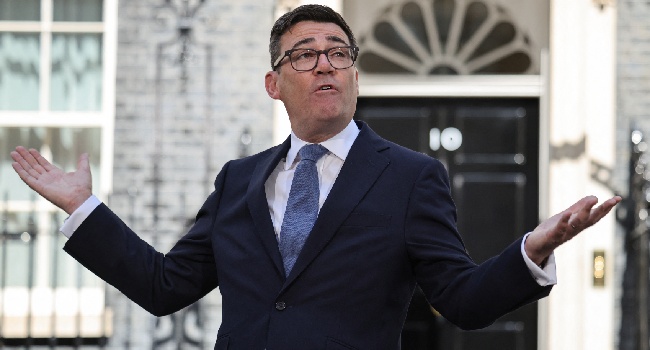
In his first address outside 10 Downing Street, the 56-year-old prime minister pledged to create what he described as “a new political model” while pursuing a long-term strategy to rebuild Britain’s economy.
He also vowed to promote industrial growth by supporting domestic manufacturing, decentralising political power away from Westminster and increasing investment in public housing.
Burnham further reaffirmed his commitment to tackling homelessness, making the eradication of rough sleeping one of his government’s immediate priorities.
On the international front, Burnham held his first telephone conversation with United States President Donald Trump, during which both leaders discussed defence cooperation, trade relations and maritime security, including developments in the Strait of Hormuz.
According to a spokesperson for the British government, Burnham reiterated the United Kingdom’s commitment to defence and security during the discussion.
Trump later described the conversation as productive, saying he looked forward to meeting Burnham in person in the near future.
I had a very good conversation,” Trump wrote on Truth Social, adding that the United States would continue working closely with Britain.
Burnham also spoke with Ukrainian President Volodymyr Zelensky, assuring him of Britain’s continued support for Ukraine in its ongoing war with Russia, Downing Street confirmed.
French President Emmanuel Macron also congratulated Burnham on assuming office, expressing hope that his leadership would strengthen cooperation between Britain and the European Union.
The new prime minister wasted little time reshaping his administration, removing several senior ministers associated with the Starmer government while promoting a number of political allies.
Former Defence Secretary John Healey was appointed Chancellor of the Exchequer to replace Rachel Reeves, while Ed Miliband assumed the role of Foreign Secretary.
Angela Rayner also returned to government, and Wes Streeting was appointed Defence Secretary after deciding not to contest the Labour Party leadership against Burnham.
Meanwhile, Shabana Mahmood retained her position as Home Secretary, where she is expected to continue overseeing reforms to Britain’s immigration and asylum policies.
Burnham acknowledged that his administration faces significant economic and political challenges, including sluggish economic growth, rising public debt, increasing welfare costs and continued pressure from illegal migration across the English Channel.
The government also faces additional uncertainty arising from global energy price volatility linked to tensions in the Middle East and changing diplomatic dynamics with Washington.
Burnham, who previously served as Mayor of Greater Manchester before returning to Parliament, has pledged to govern differently by focusing on regional development and long-term economic planning.
His appointment follows Keir Starmer’s resignation after two years in office, bringing an end to a premiership marked by political controversies, policy reversals and declining public confidence.
While Burnham enjoys Labour’s large parliamentary majority, opposition parties have questioned his political mandate and have called for an early general election.