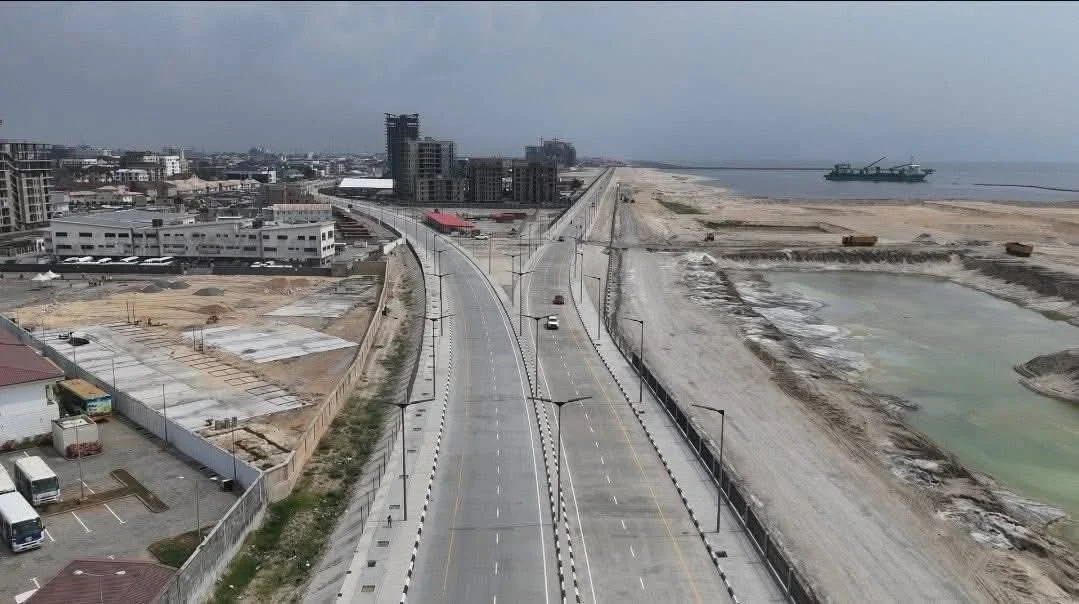
The Federal Government has officially renamed the Lagos-Calabar Coastal Highway as the President Bola Ahmed Tinubu Coastal Highway, describing the decision as a tribute to President Bola Tinubu’s long-standing vision for the project, which dates back to his time as Governor of Lagos State.
Minister of Works, David Umahi, announced the development on Thursday during a media briefing in Abuja, stating that the 750-kilometre coastal road was inspired by an idea Tinubu conceived nearly three decades ago.
Umahi explained that the decision to rename the project followed consultations within the Federal Ministry of Works, involving the Permanent Secretary, the Minister of State, directors and other senior officials.
“That highway is named President Bola Ahmed Tinubu Coastal Highway,” Umahi said.
“By the powers conferred on me as Minister of Works, in consultation with my Permanent Secretary, the Minister of State, directors and staff of the ministry, we decided to name it after him because of his dream for it.”
According to the minister, Tinubu first envisioned the coastal highway approximately 27 years ago while serving as governor of Lagos State.
He said bringing such a large-scale project to reality required not only vision but also leadership and determination.
“He had that dream about 27 years back as governor of Lagos State. It is one thing to dream and another thing to have the grace of God to actualise that dream. This is one man who dreams and has the grace and divine mandate to actualise that dream,” Umahi added.
Beyond the renaming of the highway, the minister disclosed that President Tinubu had approved the expansion of the Fourth Legacy Highway by an additional 400 kilometres, extending the proposed route from about 700 kilometres to roughly 1,100 kilometres.
Umahi also announced a series of fresh approvals aimed at improving the nation’s road infrastructure.
These include the reconstruction of the Lagos-Ibadan Expressway using reinforced concrete pavement, the completion of the long-abandoned Ibi Bridge in Taraba State, the construction of the 5.76-kilometre Lau Bridge, as well as the dualisation of another 400 kilometres of the East-West Road.
Providing updates on the Lagos-Calabar Coastal Highway itself, the minister said construction activities were progressing steadily across multiple states along the route.
He noted that the first section of the project, stretching from Victoria Island to Eleko Village in Lagos State, has become a model for modern highway construction in Nigeria.
According to him, the second phase of the project, running from Eleko to the Lagos-Ogun boundary, has reached approximately 60 per cent completion and is expected to be substantially delivered by November.
Umahi further stated that active construction work is also ongoing in Cross River, Akwa Ibom, Ogun and Ondo states as part of the broader coastal highway corridor.
He reiterated that the Federal Government remains committed to delivering the project as one of its flagship infrastructure initiatives, adding that the highway is expected to enhance connectivity, boost economic activities and improve transportation across Nigeria’s coastal region.