
All Progressives Congress on Saturday conducted its presidential primary election across Nigeria as the ruling party intensified preparations for the 2027 general elections.
According to the APC, the exercise took place simultaneously in all 8,809 wards across the country, with party members participating in the direct primary process to elect the party’s presidential candidate.
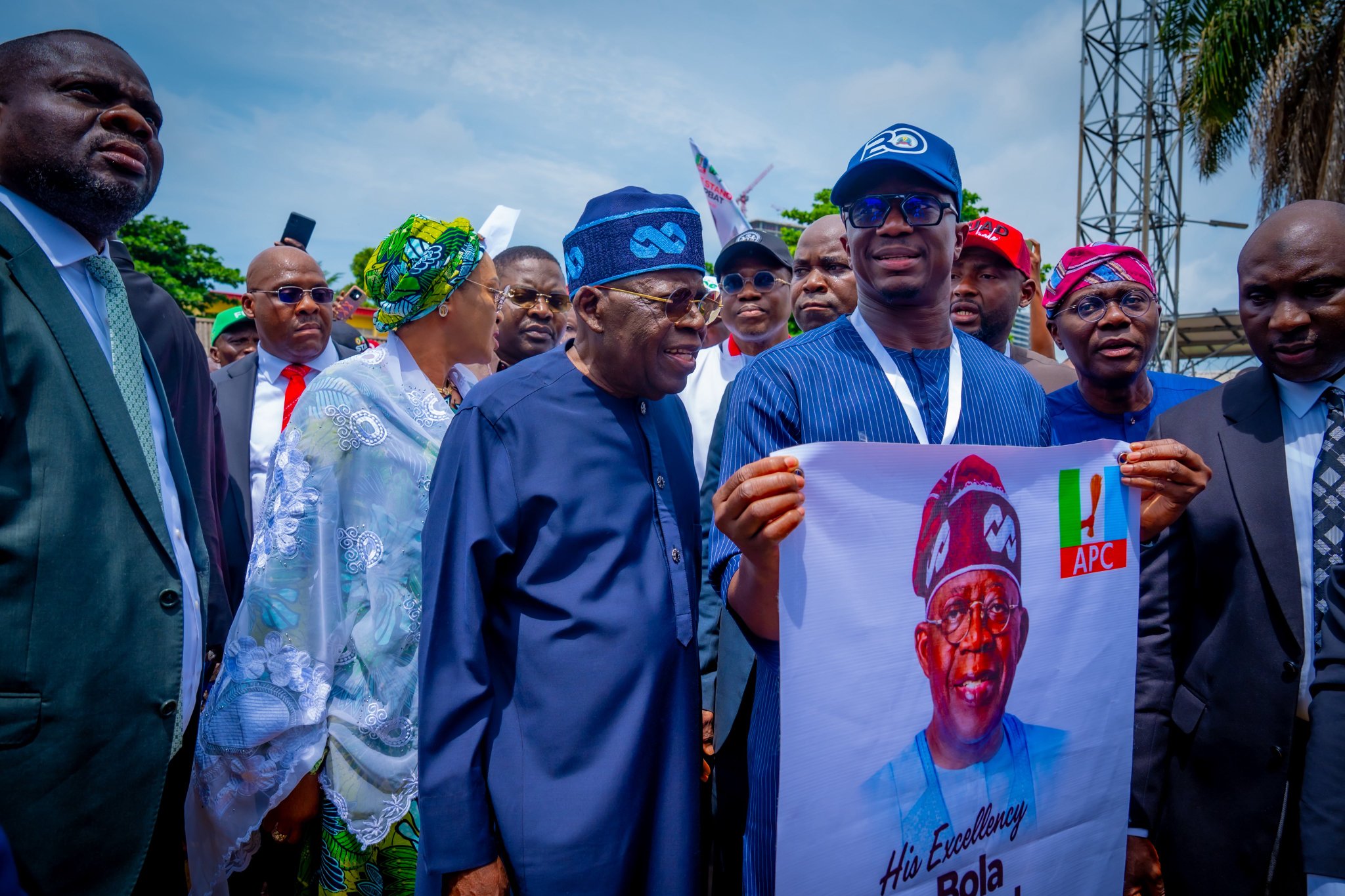
Two aspirants contested in the exercise — Bola Tinubu and Stanley Osifo — but Tinubu emerged with an overwhelming victory nationwide, further strengthening his bid to seek another term as Nigeria’s president in 2027.
President Tinubu and his wife, Oluremi Tinubu, voted at their ward in Ikoyi, Lagos State, alongside millions of APC members participating in the nationwide exercise.
Following the election, Tinubu stressed the importance of grassroots participation and democratic institutions in sustaining democracy.
“Today, I participated in the APC Presidential Direct Primary at my ward in Ikoyi, Lagos, alongside my dear wife, Senator Oluremi Tinubu, CON,” the president wrote on his official X account.
“Democracy is not sustained by noise, speculation, or borrowed platforms. It is sustained by citizens who show up, party members who believe, institutions that endure, the grassroots, and a political family rooted in the people.”
The APC National Chairman, Nentawe Yilwatda, also participated in the exercise in his hometown of Dungung, located in Kanke Local Government Area of Plateau State.
Governors, lawmakers, party officials, and other APC stakeholders equally took part in the exercise in different states across the federation.
In Rivers State, Tinubu secured 280,468 votes, while Osifo failed to record any vote across the local government areas announced.
Results from the state showed that Obio/Akpor Local Government Area recorded the highest number of votes for Tinubu with 28,680 votes. Port Harcourt City Local Government Area followed with 17,522 votes, while Khana Local Government Area delivered 17,085 votes.
A similar outcome was recorded in Kaduna State, where APC members across the 255 political wards in the state unanimously endorsed Tinubu as the party’s presidential candidate for the 2027 election.
The affirmation exercise attracted large numbers of party supporters and stakeholders who openly backed the president’s re-election ambition.
Officials of the Independent National Electoral Commission and party representatives monitored the exercise to ensure compliance with electoral guidelines.
In Akwa Ibom State, Tinubu secured 389,197 votes across the 329 wards in the state, while Osifo polled zero votes.
Governor Umo Eno, who served as the State Collation Officer for the primary election, announced the result on Saturday.
Speaking after the exercise, Eno praised party members for the peaceful conduct of the primaries and said the turnout demonstrated strong support for the APC and the president in the state.
Tinubu also won convincingly in Kogi State with 197,370 votes, while Osifo again recorded zero votes.
The result was announced at the APC secretariat in Lokoja by Ahmed Ododo, who served as the State Collation Officer.
According to Ododo, a total of 197,370 accredited party members participated in the exercise, with all votes cast in favour of Tinubu.
In Ogun State, the president polled 322,485 votes to defeat Osifo, who secured no vote.
Governor Dapo Abiodun, who chaired the election committee in the state, announced the result after the exercise conducted across the 236 wards in Ogun’s 20 local government areas.
Tinubu also secured more than 277,000 votes in Bayelsa State.
In Kebbi State, APC members reportedly turned out in large numbers to participate in the direct presidential primary election.
Governor Nasir Idris voted at his Nassarawa II polling unit alongside Atiku Bagudu.
The voting process at the polling unit was conducted through a voice vote arrangement, with Tinubu receiving 5,652 votes at the governor’s polling unit.
At Nassarawa Polling Unit II in the state capital, Tinubu also secured 2,825 votes.
Governor Hope Uzodimma urged opposition political parties to emulate the APC’s grassroots mobilisation strategy ahead of the 2027 elections.
Uzodimma spoke after voting at his Omuma ward in Oru East Local Government Area of Imo State.
According to him, Tinubu’s performance in office justified support for a second term.
“Well, it is no longer a democracy if there is no opposition. I also encourage opposition parties to work hard and do what the ruling party has done. And when, by the grace of God, it becomes their turn, they will elect their own president,” he said.
The governor also praised the APC’s electronic membership registration and validation process, noting that it had boosted grassroots participation.
“If you look at what is happening at the grassroots and how the grassroots has been stimulated, starting from the membership registration, which was done electronically, to the validation of members, you can see 35,000 human beings in just one ward in Oru East Local Government Area.
“It means that if only our party members vote for President Bola Tinubu, he has already won the election,” he added.
Meanwhile, Tinubu is expected to officially receive the APC Certificate of Return and the party’s flag as its presidential candidate for the 2027 election on Sunday.
Presidential spokesman Bayo Onanuga disclosed this in a statement issued on Saturday.
According to him, the APC Presidential Primary Elections Committee will present the certificate and flag to Tinubu at the Bola Ahmed Tinubu International Conference Centre in Abuja after the completion of the collation of results.
“APC governors, members of the National Executive Committee, the National Working Committee, and the National Assembly, along with party stalwarts, will attend the event,” the statement noted.
The APC primaries come shortly after the party conducted governorship, National Assembly, and state House of Assembly primary elections across the country.
The APC first came to power in 2015 after defeating the Peoples Democratic Party, becoming the first opposition party to remove a ruling party since Nigeria’s return to democratic rule in 1999.
However, opposition parties have continued to accuse the APC administration of poor governance and economic hardship, allegations the ruling party has repeatedly denied.