…Stakeholder call for import duty waivers ahead of CVFF disbursement
From Dickson Pat
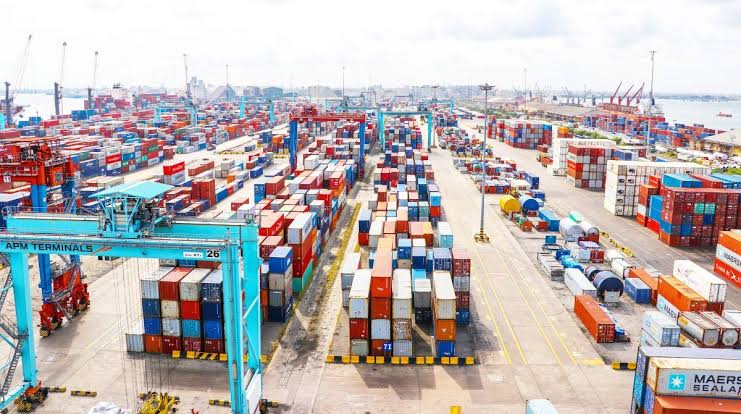
Despite ongoing reforms and efforts to construct new ports and rehabilitate existing ones, world powers including the United States and Russia are actively seeking to secure access to the Port of Lomé in Togo, which has emerged as a key maritime hub in the West African region.
The increase in volume of trade between Asia and West Africa has seen Lomé port transform into a key regional container port. Major ocean carriers, specifically MSC, have responded by redeploying ultra-large container vessels ,ULCVs, to the route. This has come as a major boost for liner connectivity of West African ports including Lomé.
In view of these trade advantages, the U.S has pledged to expand its African market access through Lomé port. Last week, the U.S Embassy in Lomé led by the Chargé d’Affaires Richard C. Michaels conducted a tour of the port facility. The delegation also held a meeting with the management of Lomé Container Terminal ,LCT, to explore commercial opportunities for U.S businesses.
“With advanced deep-water capabilities, cutting-edge equipment, and an annual throughput exceeding 30 million tons, Lomé offers U.S businesses unmatched access to African markets. Ongoing infrastructure expansion, including a dry-port and industrial zone further enhances the port’s role as a growing gateway”, commented U.S Embassy in Togo.
The port tour follows shortly after U.S President Donald Trump met five African leaders in Washington. The African leaders were largely from countries in West Africa including Gabon, Guinea-Bissau, Liberia, Mauritania and Senegal. The meeting with Trump concentrated on trade opportunities for both sides, at a time the U.S government is cutting aid in Africa and other regions.
Meanwhile, Russia has ratified its military cooperation agreement with Togo, which was initially signed early this year. As per the agreement, Russia and Togo will jointly hold military exercises, training exchanges and weapons and military equipment support. Notably, the agreement also covers support in hydrography, navigation and combatting piracy.
According to some observers, the agreement will give Russia unfettered access to Togo’s strategic seaport of Lomé. Visit by Russian military ships to ports in Togo is covered by the cooperation.
“Togo is considered the most organized and equipped in Tropical Africa. For example, the busiest seaport in the West African region is located on its territory”, said Vladimir Gruzdev, a member of the Russian Government Commission on Legislative Activity, which drafted the ratification law of the defense.
Recall that the Shipping Association of Nigeria, SAN, a group of foreign shipping lines operating in Nigeria had raised alarm over the loss of cargo to port of neighbouring countries due to the high cost of cargo operations in Nigeria.
In a statement by the Chairman of SAN, Boma Alabi noted that most cargo shipped to neighboring countries eventually ends up in Nigerian markets.
She explained that this practice not only results in the loss of cargo but also leads to missed opportunities across the cargo clearance value chain, including jobs, revenue, and other economic benefits.
Alabi also expressed concerns over the proposed addition of four Free On Board ,FOB, surcharges to the cost of clearing cargo at Nigerian ports, warning that such a move would further hinder trade and economic growth.
Meanwhile, Ahead of the planned disbursement of the Cabotage Vessel Financing Fund ,CVFF, maritime lawyers under the Nigerian Maritime Law Association ,NMLA, have called for the removal of import duties on Cabotage vessels to promote the growth of the indigenous shipping fleet.
Speaking at the 2025 NMLA Seminar held in Lagos last week, Barrister Boniface Igwe, former Director of Cabotage at the Nigerian Maritime Administration and Safety Agency ,NIMASA, argued that waiving import duties on such vessels would significantly lower procurement and operational costs.
He also said that eliminating these duties would give local shipowners a competitive advantage over foreign operators engaged in Nigeria’s coastal trade.
“It is high time NIMASA began engaging with the Nigeria Customs Service to consider waiving certain duties in support of Cabotage implementation”, Igwe stated.
He noted that effective and well-monitored Cabotage enforcement could boost Nigeria’s cargo tonnage, enhancing the country’s chances of securing a seat in Category ‘C’ of the International Maritime Organization ,IMO, Council.
Similarly, Mr. Fubara Anga, a Senior Advocate of Nigeria ,SAN, stressed the need for the NMLA to present a national strategy document to the government outlining a framework for the disbursement and implementation of the Cabotage Fund.
According to him, this would ensure the fund achieves its intended goals. Anga added that building local capacity would not only strengthen the domestic shipping sector but also increase government revenue.
In his remarks, former Executive Secretary of the Nigerian Shippers’ Council, Mr. Hassan Bello, described a well-structured Cabotage regime as a potential game changer for the local shipping industry.
He expressed optimism that, if properly managed, the CVFF disbursement could enable Nigerian shipowners to compete effectively with their foreign counterparts.