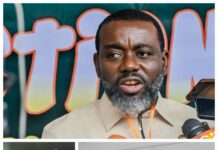


It appears tenures for political office holders has become one huge distraction for some governors. Only recently, Oyo State Governor, Seyi Makinde, advocated a single term of five or six years for elected political office holders across all levels of government in the country, against the current double term of four years each.
He postulated that a single term of five or six years is enough for any government to focus and serve the people and deliver on its mandate. On a contrary note was an unusual advocacy following shortly from Governor Douye Diri of Bayelsa State who is calling for a constitutional amendment to grant governors a third term in office.
The contrast between the two postulations is enormous. Makinde seeks a single term of six years while his Bayelsa counterpart advocates a third term of four years apiece.
Speaking during his “Thank-You Tour” at King Koko Square in Nembe, Gov Diri canvassed that the current two-term limit restricts governors from completing critical projects, citing his administration’s ongoing power plant initiative as an example.
Diri’s justification for extending gubernatorial tenures does not seem to add up as it ignobly suggests one has to be governor for eternity to produce results.
His contention that more time is needed to fulfill his promises, particularly the 60-megawatt power project meant to serve parts of Bayelsa is a needless defense. If eight years, a full two terms, are insufficient for a governor to make meaningful progress, then the problem lies not with the constitutional term limit but with the competence and the lack of vision to deliver the goods.
His position has been denuded as a call to fulfill personal ambition by many critics. For purpose of recapitulation, Diri became governor after the Supreme Court invalidated the victory of the All Progressives Congress ,APC, candidate, David Lyon, in 2020 .Seeking to extend his stay beyond the constitutional provision and democratic norm could just be assumed that he was not prepared ahead of the task.
Governance and political offices should be a continuum and not perpetual to any single leader and hence claims of not completing a project within the lifespan of his tenure should not be brought to bear. Democratic tenets demands periodic renewal of leadership, ensuring fresh ideas and accountability.
We urge that If governors cannot deliver within eight years, they should step aside to allow for more determined others to fit in.
Our leaders should focus on executing projects with clear, immediate impact—projects so vital that no future administration would dare discard them instead of making excuses for incompetence.
Our contemporary political history is still relevant as we have been in this same path before. In 2006, President Olusegun Obasanjo’s surreptitious push for a third term was met with fierce resistance and ultimately failed, marking a victory for democracy. Similarly, in 2019, President Muhammadu Buhari’s aides had to publicly deny rumors of a third-term agenda after speculative street demonstrations emerged. The fact that such attempts keep resurfacing shows how deeply entrenched the thirst for perpetual power is among Nigeria’s political elite. If Diri’s proposal gains traction, it could open the floodgates for other governors, and eventually presidents, to demand term extensions, eroding Nigeria’s already fragile democratic norms. The two-term limit exists precisely to prevent the kind of sit-tight syndrome that has plagued other African nations, where leaders amend constitutions to remain in power indefinitely. Nigeria must not tread that path.
It implies that the people cannot thrive without him, a notion that is both arrogant and undemocratic. Leadership is a privilege, not an entitlement. If Diri believes his work is unfinished, he should concentrate on delivering tangible results in the remaining years of his tenure rather than scheming for an unconstitutional extension.
We see his call as a distraction from more pressing constitutional issues currently before the National Assembly, and not self-serving tenure elongation for politicians who have no responses to the pressing needs of their people within their existing mandates.