

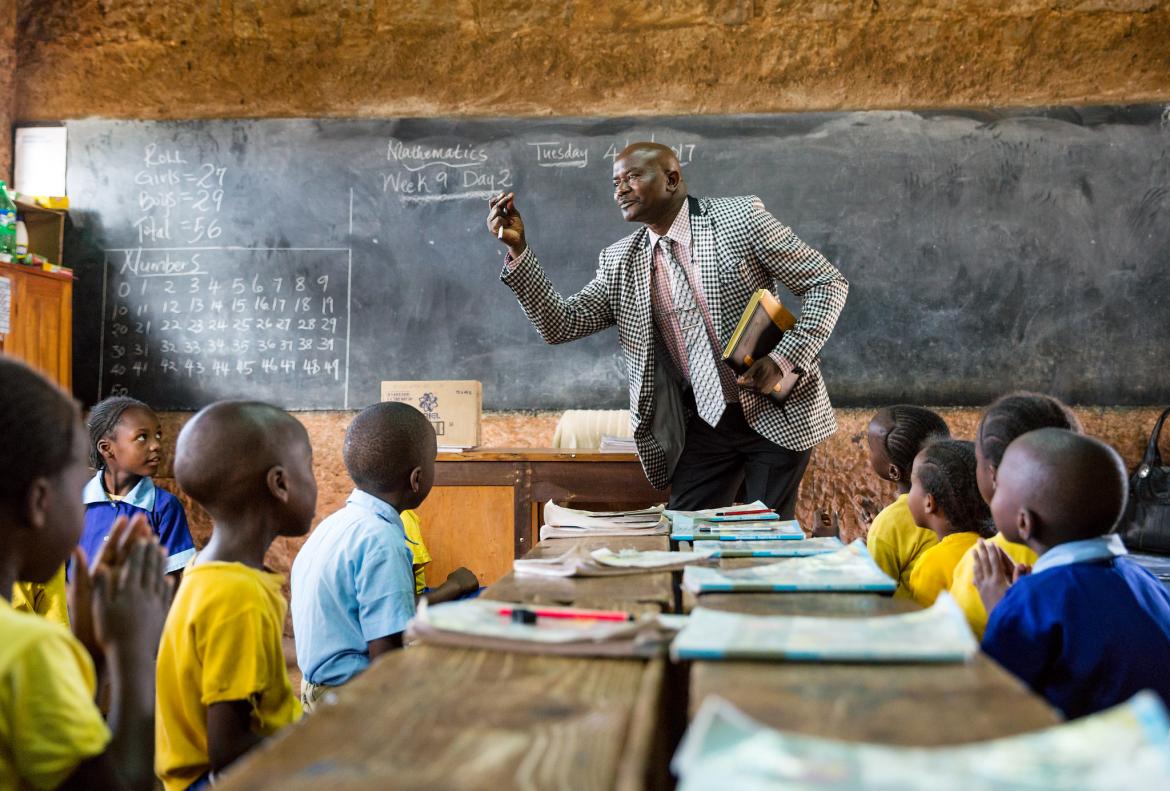
Another World Teachers’ Day turned around as stakeholders underscored the essence to transform the global education landscape for a greater tomorrow.
Major players in the education sector, including UNESCO, ILO, Education International, and UNICEF note that the theme of World Teachers’ Day “Recasting Teaching as a Collaborative Profession”, celebrated on 5th October is intended to enable teachers to “fully deploy their talent and vocation” towards achieving optimal results.
In line with the aforementioned, funding and welfare are critical to making teaching rewarding and results-oriented.
There is a clear paradigm shift to encourage the “teachers of the world” and other stakeholders to collaborate and rethink their contributions in order to transform education for improved and sustainable outcomes.
In spite of huge budgetary allocations to education in some countries including Nigeria, not much has been seen in terms of innovation and transformation expected to foster a new regime in the sector. It is even worrisome that much of financial allocations are most times fleeced by political actors and their cohorts in the wheel of administration.
Adopted in 1994, World Teachers’ Day, observed under various themes, seems to have achieved lesser than expected results because of the lack of political will by the various stakeholders to follow through with the rudiments in home countries.
Disturbingly, the World Bank paints a grim picture, stating that the global teacher deficit has reached 44 million, with the most severe shortages in Africa.
In July, the Universal Basic Education Commission reported that only 915,913 teachers are available for 31,771,916 pupils in public and private primary schools in Nigeria, a teacher-pupil ratio of 35:1. This falls short of the UNESCO recommendation of one teacher to 25 learners for Lower and Middle Basic levels (Primaries 1–3 and Primaries 4–6).
UNESCO is collaborating with countries “to assess teaching needs and develop strong, evidence-based policies in relation to teacher recruitment, deployment, management, and professional development”.
It is also “providing policy advice and technical assistance, including the development of tools and guidelines, and opportunities for knowledge exchange and policy learning in the nine domains of its Teacher Policy Development Guide” for member states. These are laudable efforts that must not be wasted away as it needs complementary efforts from various stakeholders.
Back home, funding remains a key issue. The Federal Government budgeted N1.54 trillion, or 6.39%, for education in 2023, and N2.18 trillion, or 7.9%, in 2024, far below UNESCO’s recommendation of 15 to 20% for developing countries. One exception is Enugu State Governor, Peter Mba, who allocated 33% to education in the 2025 budget.
MBA, also launched the Enugu Smart Project across the 260 wards in the state. The initiative is “aimed at revolutionising the state’s education landscape”.
The Federal Government and the states must follow this example by investing more in education.
Sadly, many states have not employed teachers in 10 years, shifting the burden to PTAs and alumni associations. The few teachers available are poorly trained. Such teachers are out of touch with contemporary teaching methods and cannot operate effectively within the “Recasting Teaching as a Profession” framework.
Consequently, asking the few overworked teachers and the poorly paid PTA teachers to engage in collaborative teaching is like asking the blind to lead the blind.
As of August, nine states had yet to implement the N70,000 minimum wage bill signed into law in July 2024. As of October 2024, 12 states were still paying teachers the N18,000 minimum wage approved in 2011. Another minimum wage ,N30,000, was approved by the Muhammadu Buhari administration in 2019.
The NUT lamented last year that 16 out of the 36 states did not recruit teachers between 2018 and 2022.
While Nigeria neglects its teachers, Finland has a robust policy for education and educators.
Governments must begin to place enormous value on teachers, emulating countries like Finland where they earn more respect than doctors, engineers, and other professionals. That is the way to give respectability to the profession as the ‘golden goose which lays the golden egg’ must not be thrown off its efforts.
AljazirahNigeria is of the view that continuous teacher education, befitting enumeration and dignified welfare packages should accompany any other efforts aimed at enhancing the teacher’s prestige.