The United States and Iran exchanged fresh military strikes on Monday as the renewed conflict entered another dangerous phase, with confirmed American military deaths rising to three and tensions escalating around the strategic Strait of Hormuz.
The latest hostilities pushed global oil prices to a one-month high, with Brent crude climbing above 91 dollars per barrel, its highest level since June 11, amid growing fears of disruptions to global energy supplies.
Since the conflict resumed on February 28, Iran has responded to US military operations by targeting American allies and military installations across the Middle East while tightening pressure on the Strait of Hormuz, a vital maritime route through which nearly one-fifth of global oil shipments previously passed.
Efforts to end the conflict through a preliminary memorandum of understanding have collapsed as both countries continue to confront each other over control of the strategic waterway.
On Monday, Iran’s Revolutionary Guards announced that two oil tankers attempting to transit the Strait of Hormuz exploded and were brought to a halt, according to a statement carried by the Tasnim News Agency.
The United Kingdom Maritime Trade Operations (UKMTO) also confirmed receiving reports from military authorities indicating that a vessel was on fire within the strait, although the cause of the blaze had not yet been independently verified.
Speaking on Sunday, United States Secretary of State Marco Rubio called on the international community to play a greater role in safeguarding commercial shipping through the Gulf.
“It’s clear that Iran, at least some people in Iran, want to control the straits and hold that as leverage against the world,” Rubio told reporters.
“The United States will do and continue to do what it needs to, to protect global shipping, but other countries need to begin to step up and provide, whether it’s hardware or finances, to help carry that burden,” he added.
Rubio maintained that Washington remained open to diplomacy despite the collapse of the earlier understanding with Tehran.
“I think we’re always open to diplomacy. It has to be real. It has to be a deal that they’re willing to live by,” he said.
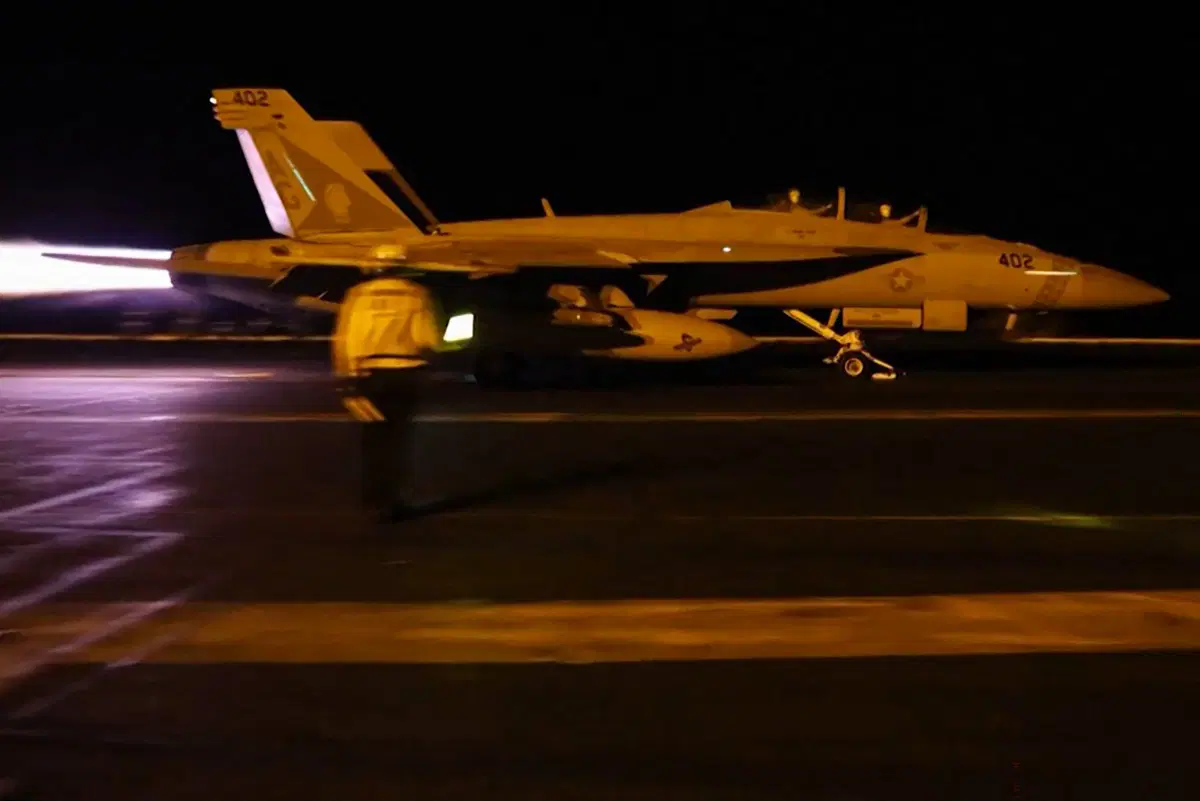
US Central Command (CENTCOM) disclosed that it had completed the ninth consecutive night of strikes against Iranian targets.
According to CENTCOM, the operations were intended to further reduce Iran’s capacity to threaten commercial shipping and civilian vessels navigating the Strait of Hormuz.
The renewed military operations followed the announcement over the weekend that three additional US service members had lost their lives.
Two personnel were killed during Iranian missile and drone attacks on Jordan on Friday, while another died in northern Iraq during the controlled detonation of unexploded ordnance recovered from a downed Iranian drone.
The latest casualties increased the number of confirmed American military fatalities since the conflict began to 17.
Reacting to the deaths, US President Donald Trump said the latest American strikes on Iran “hit them very hard,” describing the operations as a response to the loss of US personnel.
Iran’s Ministry of Health had earlier reported that 50 people were killed and more than 500 others injured in recent fighting.
Meanwhile, Iran’s Revolutionary Guards announced that they carried out overnight attacks on military targets in Syria, Jordan and Kuwait.
According to the Guards, Iranian forces launched what they described as “a surprise attack” on a US special operations command centre in Syria’s Al-Tanf region.
They also claimed to have targeted US military aircraft stationed at Aqaba Airport in Jordan with ballistic missiles, alleging that several aircraft sustained severe damage.
The Guards further stated that Iranian forces struck US military facilities in Kuwait, including an early-warning radar installation which they claimed had been completely destroyed.
Kuwait’s military confirmed early Monday that its air defence systems were actively engaging hostile drones following what it described as Iranian aggression.
In neighbouring Bahrain, authorities activated air raid sirens and urged residents to seek shelter in the nearest safe locations.
Iran’s Revolutionary Guards also said they intercepted four ships attempting to navigate the Strait of Hormuz.
According to the statement, two of the vessels were stopped after suffering explosions, while the remaining two abandoned their voyage.
Rubio argued that Iran’s recent actions were inconsistent with the memorandum of understanding signed last month.
“I think we’re always open to a diplomatic solution. We’ve tried multiple times with Iran, and we’ll continue to try,” he said before departing for the Philippines to attend a meeting of foreign ministers of the Association of Southeast Asian Nations (ASEAN).