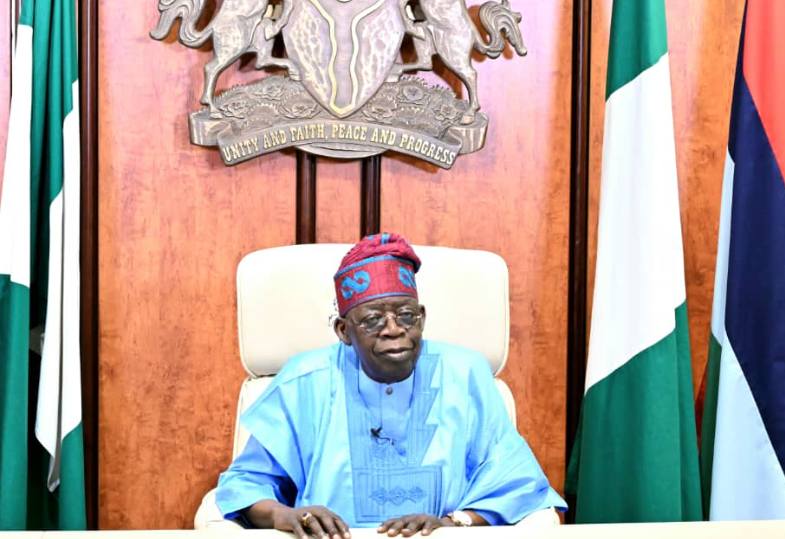
President Bola Tinubu has urged the Economic Community of West African States, ECOWAS, to designate resource theft, illegal mining and mineral smuggling as international crimes that threaten regional stability.
Tinubu made the call yesterday in Abuja at the seventh Annual General Assembly of the Network of Anti-Corruption Institutions in West Africa, NACIWA.
The theme of the 2025 meeting of the Assembly is ‘A United ECOWAS Against Corruption: Strengthening Regional Collaboration for Asset Recovery and Exchange of Information.’
Tinubu, who was represented by the Secretary to the Government of the Federation, SGF, Senator George Akume, said the theme of the conference was apt.
According to him, the recovery of stolen assets is indeed at the core of the region’s fight against corruption.
He noted that West Africa’s post-independence economic and political trajectory was blighted by corruption, manifest in the theft and stashing of our commonwealth abroad by corrupt officials.
He noted that even now, illicit outflows remain an odious development.
“Stealing of mineral resources is on the rise in the region, fuelling the proliferation of small arms and light weapons, and other violent crimes such as kidnapping and banditry.
“They have exacerbated our security challenges and worsened the development outlook of the region.
“I believe that the time has come for ECOWAS to designate resource theft (illegal mining and stealing of minerals in the region) as an international crime that threatens the stability of the region
“It should also galvanise the world against trade in stolen minerals from West Africa.”
The president emphasised the need for collective action to combat illicit financial flows and corruption in the region.
His proposal highlighted the importance of regional cooperation in tackling corruption and its manifestation.
He noted that no country could single-handedly win the battle against illicit flows and NACIWA offers a platform for ECOWAS to harness regional efforts.
He stressed that under Nigeria’s anti-corruption strategy, significant progress had been made in tracing and recovering stolen assets.
He said the Economic and Financial Crimes Commission, EFCC, led by Ola Olukoyede, had been instrumental in recovering stolen assets, with notable successes over the past two years.
He emphasised the need for a paradigm shift from rhetoric to taking deliberate measures to actualise the vision of ECOWAS founding fathers for collective prosperity and good governance across the region.
The Attorney General of the Federation and Minister of Justice, Lateef Fagbemi (SAN) also urged ECOWAS to unite against corruption, stressing that it is a moral, legal and cultural imperative.
Fagbemi emphasised the need for collective action to combat corruption, which he said fueled poverty, instability and undermined development in the region.
He urged West African nations to domesticate the ECOWAS Protocol on Corruption, noting that this would ensure that corrupt officials find no safe haven within the sub-region.
”Let us domesticate the ECOWAS Protocol on Corruption so that thieves have no hiding place.”
Fagbemi also proposed the establishment of an ECOWAS Regional Task Force on Asset Recovery, to be supported by NACIWA to coordinate investigations and intelligence sharing among member states.
He also emphasised the importance of independence and resources for anti-corruption institutions and engaging citizens, media and the civil society in the fight against corruption.
He warned against under-funding anti-corruption agencies, noting that such could make them vulnerable to compromise.
“If we starve our institutions, they will be unable to resist corruption,” he said.
He proposed other measures to strengthen regional collaboration and asset recovery efforts, including building trusted information channels and equipping investigators, prosecutors and judges with the necessary skills.
The Chairman of the Economic and Financial Crimes Commission, EFCC, Olu Olukoyede said the fight against corruption in West Africa must be viewed within the broader context of political stability and social justice.
The NACIWA president, who is also the chairman of the EFCC, highlighted the challenges facing the network to include political transitions, security concerns and governance challenges in member states.
He emphasised the need for NACIWA to remain a stabilising moral force, championing transparency, accountability and institutional integrity.
The EFCC chairman called on member institutions to reaffirm their commitment to NACIWA’s founding principles of solidarity, mutual assistance and institutional integrity.
He urged the network to consolidate its achievements, address institutional and financial sustainability challenges, and ensure that cooperation transcends political cycles and national boundaries.
Present at the occasion were the Chairman, Senate Committee on Anti-corruption and Financial Crimes, Senator Emmanuel Udende; Chairman, House of Representatives Committee on Anti-Corruption and Financial Crimes, Ginger Onwusibe, represented by a member of the committee, Nnamdi Eze.
Others included the EU Ambassador to Nigeria, Gautta Mignot, Vice President of ECOWAS Commission, Damtien Tchintchibidja, UNODC’s Country Representative, Cheikh Toure, represented by an official, Princess Chifiero, among others. (NAN)