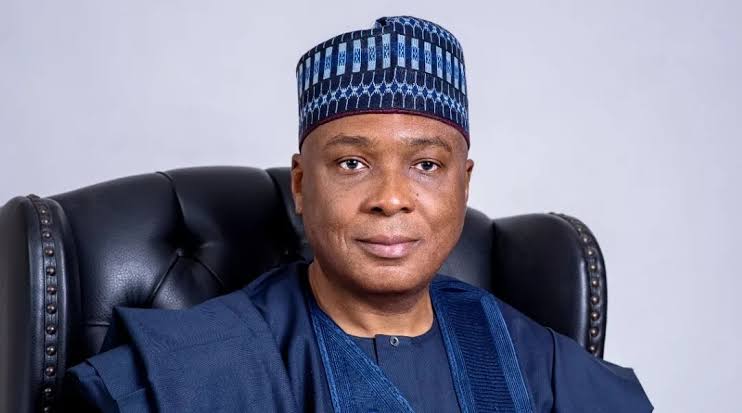
Former Senate President Bukola Saraki has renewed calls for a truly independent legislature, stressing that the survival and growth of Nigeria’s democracy depend on a National Assembly capable of holding the executive arm of government accountable.
Speaking at the 2026 Democracy Day edition of The Platform, a public policy forum organised by The Covenant Nation, Saraki argued that lawmakers must retain the freedom and authority to thoroughly examine government proposals rather than merely approving them without scrutiny.
Reflecting on his experience as Senate President, Saraki said one of the most important lessons he learned was that a legislature must be willing to challenge executive decisions when necessary.
“A legislature that cannot say no is not a legislature at all,” he said.
According to him, any parliament that simply receives proposals from the executive, approves them without proper examination and moves on has failed to discharge its constitutional responsibilities.
He warned that when lawmakers abandon oversight duties and become mere endorsers of executive decisions, democracy becomes vulnerable.
“It has merely performed a ceremonial function. It’s an echo. A democracy made only of echoes is only one election away from becoming something else entirely,” he stated.
The former governor of Kwara State maintained that the greatest threat to democratic governance is not weak leadership but authority that operates without adequate checks and accountability.
Saraki explained that the architects of Nigeria’s Constitution intentionally divided governmental powers among three separate arms—the executive, legislature and judiciary—to ensure that no institution becomes too powerful.
According to him, the system was designed to create healthy institutional tension that protects citizens’ freedoms.
He said the constitutional arrangement was never intended to produce unquestioning cooperation between branches of government but rather constructive oversight and accountability.
“They built friction into the system on purpose; it was not a mistake. That friction is not dysfunction; it is the very thing that guarantees your freedom,” he said.
Addressing concerns often raised by citizens about disagreements between the executive and legislative branches, Saraki argued that such tensions are a necessary feature of democracy.
He explained that checks and balances only function effectively when institutions are willing to challenge one another where appropriate.
The former Senate President further described the legislature as a critical safeguard against democratic backsliding.
Drawing lessons from the annulled June 12, 1993 presidential election, Saraki said Nigeria’s democratic setback at the time occurred largely because institutions responsible for protecting the people’s mandate were not strong enough.
“We did not lose democracy in 1993 because the people failed; we lost it because the institutions that should have defended the people’s verdict were too weak to do so,” he said.
He added that strengthening democratic institutions remains essential to preserving democratic governance and ensuring citizens’ voices are heard through lawful channels.
According to Saraki, societies that fail to provide institutional platforms for addressing grievances risk seeing public frustration spill into the streets.
“Political tension does not vanish when suppressed—it accumulates,” he noted.
He argued that the legislature serves as an important platform where public concerns can be debated, addressed and resolved before they escalate into broader crises.
Saraki Recalls Alleged Fuel Subsidy Irregularities
To illustrate the importance of legislative oversight, Saraki recounted how lawmakers uncovered alleged irregularities in Nigeria’s fuel subsidy programme during his time in the National Assembly.
He explained that investigations into subsidy payments revealed instances where importation claims were allegedly backed by questionable documentation.
According to him, some subsidy claims were linked to vessels that were reported to have delivered petroleum products to Nigeria but were, in reality, located elsewhere.
Saraki said he personally examined shipping records and discovered that one vessel listed as being in Lagos was reportedly located in Colombia at the time payment was processed.
“I could see that the vessel that was supposed to be in Lagos port was somewhere in Colombia,” he said.
He noted that the discovery demonstrated the value of a legislature equipped with the capacity and resources to conduct effective oversight and verify government transactions independently.
According to him, strong legislative institutions are essential not only for preventing abuse of public funds but also for ensuring transparency and accountability in governance.