Joel Ajayi
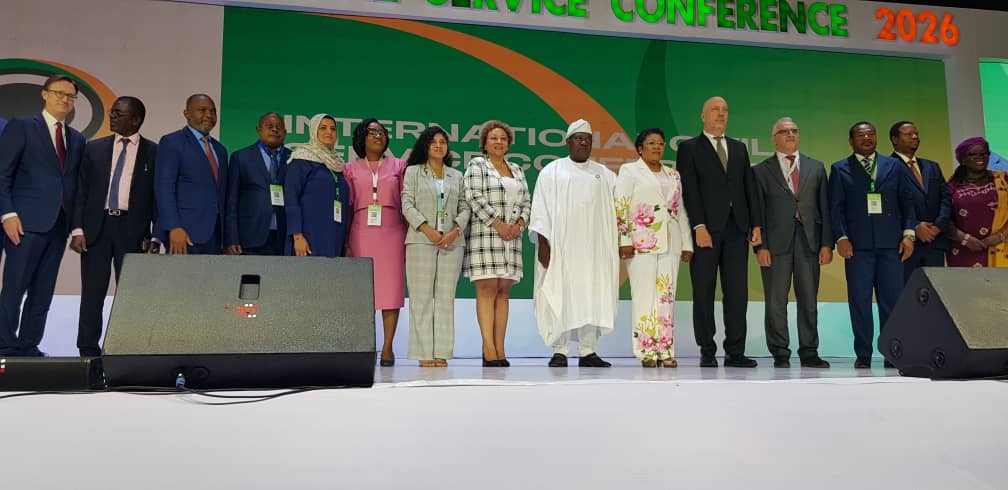
President Bola Ahmed Tinubu, GCFR, on Wednesday declared open the International Civil Service Conference (ICSC) 2026 in Abuja, with a strong call on Ministries, Departments and Agencies (MDAs) to deepen digital reforms and embrace technology-driven governance for improved service delivery.
Speaking during the opening ceremony of 2026 International Civil Service Conference, held at Eagle Square, on Wednesday in Abuja, a conference that brought together over 5,000 participants, including delegates from 16 countries across Africa, Europe, Asia and North America, Tinubu Charges MDAs on Digital Reforms.
This year edition have its theme: “Reforms, Resilience and Results.”
President Tinubu who was represented by the Secretary to the Government of the Federation (SGF), Senator George Akume, said the Nigerian Civil Service had moved beyond policy declarations to measurable impact under the Renewed Hope Agenda of his administration.
According to him, the public service has demonstrated resilience in the face of global economic challenges and increasing citizens’ expectations, stressing that the Civil Service remains the engine room of national transformation.
The President disclosed that 38 Ministries and Extra-Ministerial Departments have successfully transitioned to secure, paperless and end-to-end electronic workflow systems, describing the achievement as a major milestone in Nigeria’s public sector reform agenda.
“When we spoke of digitalisation in 2025, some considered it an ambition for the distant future. Today, Nigeria is building a public service that enables progress,” Tinubu stated.
He noted that the ongoing Personnel Audit and Skills Gap Analysis initiated during the last conference would help government identify workforce gaps, strengthen competencies and ensure that the right personnel are deployed to strategic positions for effective governance.
Tinubu also highlighted Nigeria’s digital infrastructure initiative, Project BRIDGE — Building Resilient Digital Infrastructure for Growth — which he recently presented at the Africa CEO Forum in Rwanda.
He explained that the project is expected to support innovation, create jobs, improve public service efficiency and expand digital connectivity for millions of Nigerians.
The President consequently directed all Ministries and Extra-Ministerial Departments to sustain and deepen digitalised work processes, while urging agencies to adopt modern technology across their operations and service delivery systems.
“The era of manual inefficiency must give way to a culture of speed, transparency, data-driven decision-making and citizen-centred service,” he declared.
President Tinubu further commended the Head of the Civil Service of the Federation, Mrs. Didi Esther Walson-Jack, for what he described as exemplary leadership in driving the Federal Civil Service Strategy and Implementation Plan 2021–2025.
He praised the introduction of innovative tools such as the Service-Wise GPT platform, noting that it reflects visionary leadership and disciplined implementation of reforms within the Federal Civil Service.
Earlier in her welcome address, the Head of the Civil Service of the Federation, Mrs. Didi Esther Walson-Jack, said the conference was convened not merely to repeat promises made in 2025, but to demonstrate concrete progress achieved within eleven months.
She disclosed that all 38 Federal Ministries and Extra-Ministerial Departments successfully digitalised their operations ahead of the December 31, 2025 deadline.
According to her, the Service-Wise GPT platform, designed to assist civil servants in navigating service rules and institutional knowledge, has already recorded over 50,000 conversations.
“These are not vanity metrics. They are evidence that technology, when it solves real problems, gets adopted,” she said.
Walson-Jack also stressed the importance of responsible artificial intelligence in governance, noting that AI must complement human judgment and improve service delivery, especially for vulnerable citizens.
The Head of Service revealed that this year’s conference features eight strategic stages — Aspire, Innovate, Activate, Accelerate, Accomplish, Rejuvenate, Transform and Impact — designed to reflect the journey of sustainable reform from vision to implementation and measurable outcomes.
She added that special roundtables would focus on the future of work in the public sector, partnerships and collaboration, as well as financing reforms amid fiscal pressures.
One of the major highlights of ICSC 2026, according to her, is the Deal Room initiative, where stakeholders are expected to formalise partnerships and sign Memoranda of Understanding aimed at strengthening public sector reforms and innovation.
She urged delegates to actively participate in discussions and leave Abuja with actionable commitments that would strengthen governance and institutional reforms across their respective countries.
The conference is expected to generate practical reform strategies, foster global collaboration and deepen conversations around innovation, resilience and efficient public service delivery in Nigeria and beyond.