Pope Leo XIV on Saturday travelled to Lampedusa, the Italian island that has become one of Europe’s main arrival points for migrants attempting the dangerous sea journey from North Africa, in a visit widely viewed as a strong humanitarian message amid tightening migration policies in the United States and Europe.
The visit by the Catholic Church’s first American pope coincided with the United States’ 250th Independence Day celebrations on July 4 and comes against the backdrop of his previous disagreements with the administration of Donald Trump over immigration policies.
It also followed the European Union’s recent approval of new migration regulations that expand detention powers and permit the establishment of deportation centres outside the bloc.
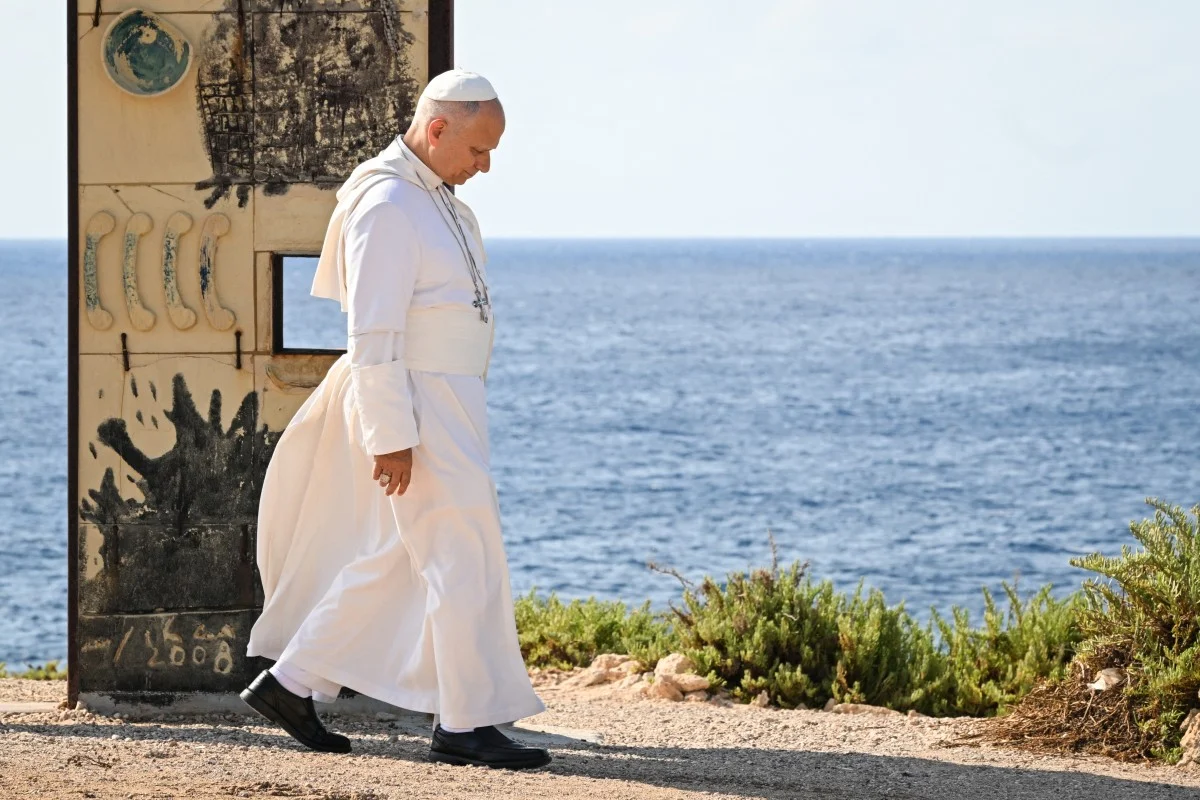
The pontiff began his visit by praying at a cemetery where unidentified migrants are buried in numbered graves, paying tribute to those who lost their lives while attempting to reach Europe.
He later visited the “Door of Europe,” a monument dedicated to migrants, where he briefly met with a migrant family.
Since assuming the papacy, Leo has consistently made the protection of migrants a central focus of his ministry, continuing the approach of his predecessor, Pope Francis. He has repeatedly praised humanitarian workers assisting vulnerable people while criticising large-scale deportation policies in the United States.
During his half-day visit to the Mediterranean island, the 70-year-old pope was expected to renew calls for safer and legal pathways for migration.
Filippo Ungaro, spokesperson for the United Nations High Commissioner for Refugees, said the visit carried significant symbolic importance.
According to him, “sends a clear message at a time when the global political debate on migration is often framed around borders and deterrence rather than protection and shared responsibility.”
Situated about 90 miles (145 kilometres) from the Tunisian coastline, Lampedusa has become internationally recognised not only for its tourism but also for receiving thousands of migrants rescued at sea and recovering the bodies of those who did not survive the journey.
One of the island’s darkest moments occurred in 2013 when more than 360 people died in its deadliest recorded migrant shipwreck, with many more fatalities recorded in subsequent years.
Leo has previously commended the compassion shown by the island’s residents, whose community of about 6,000 people has repeatedly assisted migrants arriving on its shores.
After visiting the cemetery and the “Door of Europe,” the pope proceeded to the island’s pier, where migrants rescued by the coastguard and humanitarian organisations are typically brought ashore.
He was also scheduled to bless a commemorative plaque dedicated to Pope Francis, who made Lampedusa the destination of his first official pastoral visit after becoming pope in 2013, before celebrating Mass at a nearby sports ground.
Among those present was Vanda Mainardi, who travelled from northern Italy to witness the visit.
She said, “Lampedusa is a place of particular significance… We are here to testify to its commitment to welcome those seeking a better place (to live).”
Lampedusa is the second major European migration hotspot visited by Pope Leo after his recent trip to the Canary Islands, where he criticised human trafficking networks.
The pope has consistently opposed harsh measures aimed at undocumented migrants and has previously described the treatment of immigrants by the United States government as “inhuman.”
Speaking on Friday during commemorations marking America’s 250th Independence Day, Leo appealed for “moderation” in public debate within the United States and reflected on the important role successive generations of immigrants have played in shaping the nation.
According to the International Organization for Migration, the Central Mediterranean route remains the world’s deadliest migration corridor.
The agency estimates that approximately 1,330 people either died or disappeared while attempting the crossing last year.
Salvatore Sortino, Director of the IOM Coordination Office for the Mediterranean, said the figures highlight the urgent need to strengthen search-and-rescue operations.
He noted that “tremendous need to increase search and rescue efforts.”
The route continues to be monitored by a limited number of rescue vessels operated by humanitarian organisations, many of which have repeatedly argued that European authorities should do more to prevent migrant deaths at sea.
According to the UNHCR, more than 14,000 migrants arrived in Italy during the first six months of the year, with most departing from Libya.
Nearly 60 per cent of those arrivals entered Europe through Lampedusa.
Although the numbers remain significant, they are still considerably lower than the unprecedented influx witnessed in 2011 during the Arab Spring, when regional instability led to the arrival of tens of thousands of migrants within a few months.