…says taxing poor Nigerians undermines growth, prosperity
… Adedeji alerts security on planned tax law protests
By Charles Ebi
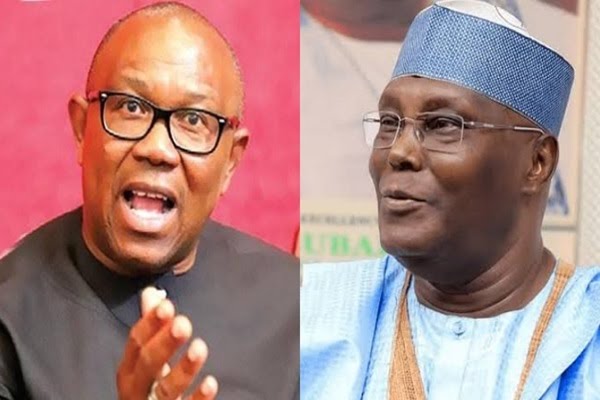
Former presidential candidates in the 2023 presidential election, Peter Obi and Atiku Abubakar, have sounded the alarm over Nigeria’s current approach to taxation, describing it as “a tool of confusion and burden rather than a mechanism for growth and development relating to economic conditions of Nigerians.
In a statement, Obi argued that taxation must be rooted in transparency, fairness, and concern for citizens’ welfare, cautioning that the ongoing controversy over the National Assembly’s manipulated tax law threatens economic growth and public trust.
Despite recent controversies, the new tax laws regime has officially kicked off.
“For the first time in Nigeria’s history, a tax law has reportedly been forged. The National Assembly itself has admitted that the version gazette is not what was passed into law”, he said.
“Yet citizens are being asked to pay higher taxes under this manipulated framework, without transparency, without explanation, and without corresponding benefits”.
Obi stressed that “taxing poverty does not create wealth; it deepens hardship”. urging the government to focus instead on empowering small and medium-sized enterprises, which he said are critical for job creation, income growth, and the natural expansion of the tax base.
“You cannot tax your way out of poverty, you must produce your way out of it”, he noted, calling for a lawful, fair, and people-centered tax system that supports production, rewards enterprise, protects the vulnerable, and restores trust between government and citizens.
“Nigeria needs a fair, lawful, and people-centred tax system, only then can taxation become a true tool for unity, growth, and shared prosperity”, Mr Obi concluded in the statement posted on his official X handle.
On his part, Mr Abubakar, a former Vice President, warned that policy failures under President Tinubu are deepening business distress, accelerating job losses, and pushing the country toward economic collapse.
In a New Year message to Nigerians, he described 2025 as “one of the most punishing years in our recent history”, marked by what he called “economic suffocation” and governance devoid of empathy.
He said the Tinubu-led administration presided over months of fiscal drift, borrowing heavily while businesses struggled to survive.
“The past year exposed, in stark terms, the incompetence and policy bankruptcy of President Bola Tinubu”, Mr Atiku said, adding that the government governed “for months without a functional budget, relying on propaganda while borrowing recklessly”.
From a business perspective, Mr Atiku, who was the candidate of the Peoples Democratic Party ,PDP, in the last presidential poll, warned that the operating environment for enterprises deteriorated sharply, with small and medium-sized businesses bearing the brunt of inflation, weak consumer demand, and policy uncertainty.
“Industries shut down. Workers were sent home. Hunger spread. Suffering became normalized”, he said.
He also questioned the credibility of the government’s reform agenda, citing what he described as a scandal involving a forged tax law.
“Nothing better captures the decay of this government than the scandal of a forged tax law, shamelessly branded a ‘reform’”, Mr Atiku, who has also now defected to the ADC, said, warning that “a government that begins reform with forgery cannot end with prosperity”.
Mr Atiku further dismissed official claims of revenue performance, arguing that worsening insecurity and debt accumulation were eroding investor confidence.
“While drowning the nation in debt, the government falsely claimed to have met revenue targets”, he said, noting that kidnappings and violent crimes had disrupted livelihoods and economic activity nationwide.
He said unemployment, labour unrest and collapsing enterprises defined the year, contradicting repeated assurances of economic recovery.
“Small businesses, the backbone of job creation, are collapsing. Workers are losing jobs”, Atiku said, arguing that policies demanding sacrifice from citizens were unjustified.
He warned, however, that weak institutions and disregard for due process could undermine future economic stability and elections. “A government capable of forging or tampering with laws cannot be trusted to conduct free and fair elections in 2027″, he said.
Calling for civic engagement, Mr Atiku urged Nigerians and the business community to organize for change through democratic means. “Democracy gives the people the power to change a failing government, peacefully and decisively, through the ballot”, he said.
He concluded with a call to action: “Let us vote out hunger, insecurity, unemployment, dishonesty, corruption, abductions, lies, and propaganda. Nigeria deserves better. Nigerians deserve dignity”.
Both Mr Obi and Mr Atiku are planning to work with other politicians to oust Mr Tinubu in the 2027 general elections through the ADC.
Meanwhile, the Chairman of the Nigeria Revenue Service ,NRS, Mr Zacch Adedeji, has asked security agencies to be on alert over planned nationwide protests against the new tax laws, which have officially commenced.
“I’m using this time to call all the security agencies to be on alert”, he said while speaking in an interview on Arise Television on Sunday.
The NRS chief stressed that the reform was for the interest of the poor, but met strong opposition from certain quarters, warning that those pushing anti-tax agitations are unpatriotic elements determined to derail the country’s fiscal reforms.
“Those people you see promoting all this rumour, all this misinformation are those people that are avoiding taxes, that there is no way out for, based on the digitalisation that we brought on board”, he said.
The National Association of Nigerian Students ,NANS, declared January 14, 2026, as a National Day of Action to protest the planned implementation of the controversial tax reform laws, accusing the federal government of ignoring public concerns and constitutional processes.
Mr Adedeji said tax reform was a clear campaign promise of President Bola Tinubu and a necessary response to what he described as a fragmented tax system that could not sustain the level of development the President envisaged.
“Tax reform is one of the promises made by Mr President from his inaugural speech,” he said. “From the beginning, he made it his point of duty that we need to start early to reform the tax system, which is the real foundation for any sustainable economy in the world”.
He recalled that the President set up a committee headed by Mr Taiwo Oyedele, which, according to him, spent a year consulting stakeholders and preparing recommendations that were then processed by the National Assembly through public hearings and regional engagements before the President assented to the bill in June 2024.
Speaking on the recent issues around the gazetted version of the Nigeria Tax Administration and Other Matters Act differed, Mr Adedeji dismissed the allegations as baseless.
“No, like I said earlier, I don’t want to delve into those rumours”, he said. “For example, all these comparisons that you are mentioning now, honestly, I don’t know where you find them because nobody, except the National Assembly, has the right to the vote book. They are the ones to give us the gazette law as passed, which… they’ve released… as passed, which is the only thing we have”.
He insisted that the only document relevant to the NRS is the gazette Act transmitted by the legislature.
“I don’t even need to see the harmonised bill. I don’t need to see any of those things,” he said. “The only thing I need to see is the gazette bill, which they have given to me. All these processes are internal processes of the National Assembly, which is purely a separation of powers”.
Mr Adedeji notes that the tax authorities had no role in altering any legislation and said the executive had “no place in the law” to tamper with bills passed by parliament.
He also clarified that while the law took effect from June, some rate changes were delayed to give companies time to adjust.