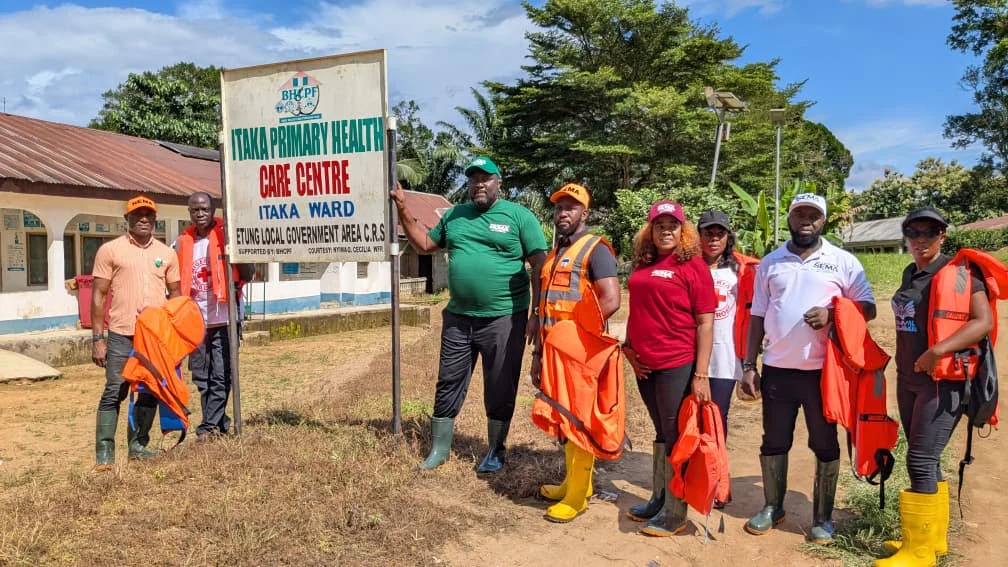
The National Emergency Management Agency (NEMA) and the Cross River State Emergency Management Agency (CR-SEMA) have carried out a joint damage and needs assessment in flood-affected riverine communities in Etung Local Government Area of Cross River State as part of efforts to facilitate humanitarian assistance for impacted residents.
The assessment, conducted on Thursday in partnership with the Nigerian Red Cross Society, focused on determining the extent of destruction caused by recent flooding, particularly its impact on cocoa plantations and the livelihoods of local farming communities.
The delegation, led by the Acting Head of Operations for NEMA’s Akwa Ibom and Cross River Operations Office, Awoji Austin, alongside the Director-General of CR-SEMA, Efa Nyong, travelled by boat to the affected settlements, which can only be accessed through waterways.
Addressing residents during the visit, Austin explained that the exercise was part of a broader damage and needs assessment aimed at gathering accurate information to support humanitarian intervention and long-term recovery planning.
“This visit is very essential. It forms part of our comprehensive damage and needs assessment designed to generate reliable information for humanitarian assistance and recovery planning to all the communities affected by flood,” he said.
He assured residents that the findings from the field exercise would be submitted to the appropriate authorities to ensure victims receive the necessary support.
“We are here to make findings. Our job is to ensure we forward the information we have gathered to appropriate authorities for necessary actions to the affected victims. Be assured that NEMA in collaboration with our sister agencies will do everything to assist in one way or the other,” Austin added.
Also speaking, the Director-General of CR-SEMA, Efa Nyong, said the mission was designed to obtain firsthand information on the level of destruction caused by the flooding and provide the state government with credible data to guide intervention efforts.
“We are here to carry out assessment and obtain firsthand information on the level of damage caused by the flood that ravaged several communities. We will then send this credible data gathered in the field to the Cross River State government for appropriate intervention,” he stated.
Nyong also encouraged residents to promptly report disaster incidents and actively support disaster risk reduction initiatives within their communities.
During the exercise, the Disaster Management Officer of the Nigerian Red Cross Society, Agbor Okim, educated residents on disaster preparedness, the importance of early reporting of emergencies, and community participation in disaster risk reduction programmes.
The assessment team first visited Itaka Community, where the Clan Head, Ntufam Patrick Eteta, commended the agencies for making the difficult journey to the remote community despite the challenging terrain.
Eteta disclosed that the recent flooding had devastated large sections of cocoa plantations, which serve as the primary source of income for many families, leaving numerous farmers facing severe economic hardship.
The delegation later proceeded to Mkpot Community, where the Clan Head, Ntufam Innocent Akim, also expressed appreciation to the agencies for reaching the area to evaluate the impact of the disaster.
Officials inspected flood-damaged cocoa farms and held discussions with affected farmers to determine the scale of losses and identify priority areas for humanitarian support and recovery assistance.
Flooding remains a recurring challenge in several parts of Cross River State, especially during the rainy season. Riverine communities in Etung Local Government Area are among the worst affected, with repeated floods destroying cocoa plantations, farmlands and homes, disrupting the livelihoods of residents who depend largely on agriculture.
Authorities say they will continue to assess affected communities, provide relief where necessary and strengthen awareness campaigns on disaster preparedness and early warning systems to minimise the impact of future flooding.