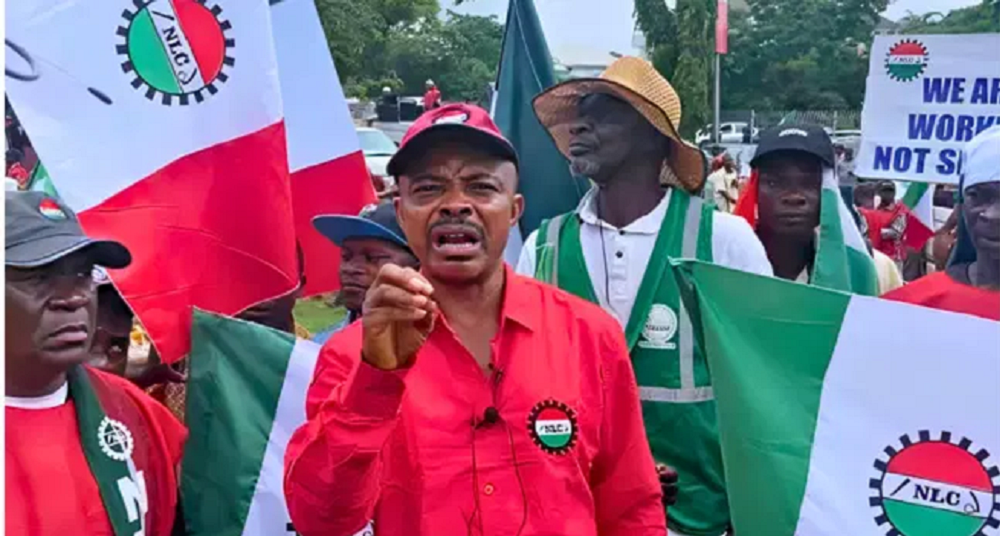
Nigeria Labour Congress, NLC, and federal government workers have demanded an urgent review of the national minimum wage, insisting that the current ₦70,000 is no longer sustainable.
They made the demand, following the bold steps taken by several states to increase minimum wage of their workers above the N70,000 benchmark, in response to the prevailing economic realities.
The labour unions and workers who spoke to the News Agency of Nigeria, NAN, in separate interviews, contended that, in the face of galloping inflation, rising cost of food, transportation, housing and other essential services, N70,000 minimum wage can no longer sustain them.
It would be recalled that President Bola Tinubu signed the new National Minimum Wage Bill into law in July 2024, raising the minimum wage from N30,000 to N70,000.
The amended law applies to the entire country, including the federal government, states, local governments and the private sector.
However, in August 27, 2025, Imo State increased the minimum wage from N70,000 to N104,000, along with corresponding increase in the entire salary structure for civil servants.
Governor Hope Uzodinma had said that the salary review, arrived at, during a meeting with organised labour, was part of efforts to improve the welfare of workers.
NAN also reports that before the bold and applauded step by Uzodinma, some states have implemented higher minimum wage for their workers.
On October 16, 2024, Lagos State governor, Babajide Sanwo-Olu announced minimum wage increase to ₦85,000, with a promise to further raise it to N100,000 in 2025.
Rivers State equally approved ₦85,000 minimum wage on October 18, 2024, while Bayelsa, Niger, Enugu and Akwa Ibom States approved N80,000 for their workers
Ogun and Delta States are implementing N77,000 minimum wage, Benue and Osun States raised the wage to N75,000, while Ondo State pegged its own to N73,000
Acting General Secretary of the NLC, Comrade Benson Upah, told NAN in Abuja, yesterday, that inflation has eroded the value of the N70,000 minimum wage, leaving many workers unable to meet basic needs.
“The truth is that ₦70,000 is not sustainable under the present economic situation.
“Workers are under immense pressure and unless government responds quickly, the crisis of survival will only worsen.
“We have since engaged the federal government on this matter at different times and fora.
“It is our hope that it would see the economic and moral obligations to do so expeditiously,” he said.
Upah added that while labour would continue to pursue dialogue, industrial action may be considered if negotiations fail.
He also urged workers to remain united and active in union activities to strengthen the collective struggle.
In the same vein, President of the Association of Senior Civil Servants of Nigeria, ASCSN, Mr Shehu Mohammed, commended governors who had revised their minimum wage.
Mohammed described the move as a welcome development and an eye-opener.
He said the steps by the sub-national governments should serve as a signal to the federal government.
“Right from the beginning, during the negotiation, our demand was for a living wage and we submitted ₦250,000 as a reasonable benchmark.
“We told government that anything short of that, only takes a worker to the gate of the office, not back home,” he said.
The ASCSN president explained that with high electricity tariff, transportation and food prices skyrocketing, ₦70,000 has lost its value.
“Let us be realistic. Even if you pay electricity bills out of ₦70,000, what remains cannot sustain a family for 10 days.”
Mohammed urged the federal government to complement wage increase with broader policies to reduce the cost of living, including affordable housing, healthcare and subsidised transport.
A cross-section of federal government workers who spoke to NAN also expressed concern over the harsh economic situation.
A civil servant, Mrs Kemi George, said the economic realities are becoming increasingly frustrating.
“By the time I pay transport to work and buy food, nothing is left. Rent and school fees are almost impossible to cover.
“It is only God that has been sustaining us because our take-home pay is nothing compared to what we spend in a month,” she said.
Another worker, Mr Obi Chimaobi, described the situation as unbearable, saying the harsh economy has pushed many families into hardship.
He said it was nearly impossible for the average worker to survive on the current minimum wage of ₦70,000.
“Things are no longer affordable. A bag of rice is now like gold, transport fares keep rising daily, and with ₦70,000, you are already in debt before the month even ends.
“The federal government must act very fast in reviewing workers’ wages.
“It must also recognise that reviewing the minimum wage is not merely about appeasing labour unions.
” It is about restoring dignity to work and reaffirming the social contract between government and the governed,” he added.
Speaking in the same vein, another civil servant, Mrs Bola Akingbade said “a well-paid workforce is a motivated workforce”.
She reiterated that when workers are financially secure, they are more productive, committed and less susceptible to corrupt tendencies.
According to her, increased minimum wage will not only improve the living standards of workers, but enhance efficiency and service delivery across ministries, departments and agencies.
On his part, Mr Jeremiah Okon noted that if states with limited revenue allocation could recognise the need for upward wage adjustments, it has become imperative for the federal government to do better.
Okon said it will be fair and equitable if for the federal government and the others states to adjust the minimum wage from N70,000 to, at least, N150,000.
He urged government at all levels not to see increased minimum wage as a burden, but a tool for economic revitalisation.
According to him, increased wage will percolate through increased spending on goods and services, thereby stimulating local businesses and boosting the economy. NAN