By Paul Effiong, Abuja
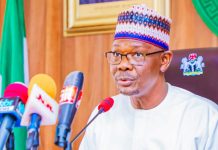
Deputy Speaker of the House of Representatives, Benjamin Kalu has advocated for the immediate removal of all barriers working against women’s political advancement in Nigeria.
Kalu stated this yesterday in a welcome address at the International Legislative Dialogue on Women and Constitution Amendment in Nigeria organised by the House Committee on Constitution Review in collaboration with Policy and Legal Advocacy Centre, PLAC, with support from the European Union, EU, in Abuja.
The deputy speaker noted that giving women opportunities to participate in parliamentary activities and in the governance process will not only birth a legislature that reflects the diverse makeup of the citizenry and values, but also bring immense benefit to the general society.
Kalu, who is also the Chairman of the House Committee on Constitution Review, bemoaned the poor number of women fielded as candidates in the last general elections.
According to him, having 1,552 women in the election that produced 15,307 candidates by 18 political parties was not encouraging in any way.
The deputy speaker called for massive support towards gender bills which are currently before the parliament to ensure that women are given the opportunity to make their contributions to the political development of the country.
“I am honored to lead the House Committee on Constitution Review, where we have proposed bills aimed at correcting the gender imbalance within government at all levels. One of such critical bills, ‘A Bill for an Act to Alter the Provisions of the Constitution of the Federal Republic of Nigeria, 1999 to Provide for
Seat Reservation for Women in the National and State Houses of Assembly (HB 1349),’ alongside four other gender justice bills, are under consideration.
“This proposed legislation is designed to remedy the low representation of women by creating additional seats specifically for female candidates in national and state legislatures.
“The bill reflects a pragmatic approach by proposing a temporary measure—an approach that has worked effectively in other countries to fast-track women’s representation in governance. These reserved seats are
not a permanent fix, but are structured as a ‘Temporary Special Measure,’ subject to review after four general election cycles or 16 years. At that time, stakeholders will assess whether the measure should continue, be adjusted or phased out based on the progress made.
“We see this approach as essential within Nigeria’s electoral system, which
is largely based on a First-Past-the-Post model. Unlike proportional systems where party-based gender quota can result in direct outcomes, our model presents challenges in implementing such quota effectively.
“Special seats, therefore, offer a feasible solution in ensuring that women not only participate as candidates, but are also represented meaningfully within our legislative institutions. Furthermore, we must view the financial investment in women’s inclusion as a direct investment in Nigeria’s future.
“Countries with higher women’s
representation in governance consistently show higher rate of progress in health, education and economic stability. Our society, therefore, stands to gain immensely from a legislature that reflects the diverse makeup of its citizenry and values contributions from all perspectives.
“The popular saying that women belong in all places where decisions are being made resonates strongly within this context. We must ensure that the National and State Houses of Assembly are inclusive and welcoming to women. This is not just about seats or numbers; it is about recognising the
invaluable perspectives that women bring to the table, which in turn strengthens our democracy and makes it more resilient.
“As we gather here today, I urge each of us to look beyond the challenges and see the transformative potentials of a Nigerian democracy that embraces its entire population.
“On behalf of the House Committee on
Constitution Review, I implore that the discussions and resolutions should
focus on how we can best support the path towards gender inclusivity within
our legislative framework.
“Let us champion these amendments, advocate for the adoption of temporary special measures and work to remove
barriers that hinder women’s political advancement,” Kalu averred.