By Paul Effiong, Abuja
Federal Government has appealed to all Nigerians irrespective of tribe, religion or political persuasions that now is the time to speak with one strong and united voice to eradicate terrorists, bandits and extremists insurgents completely from “our national borders”.
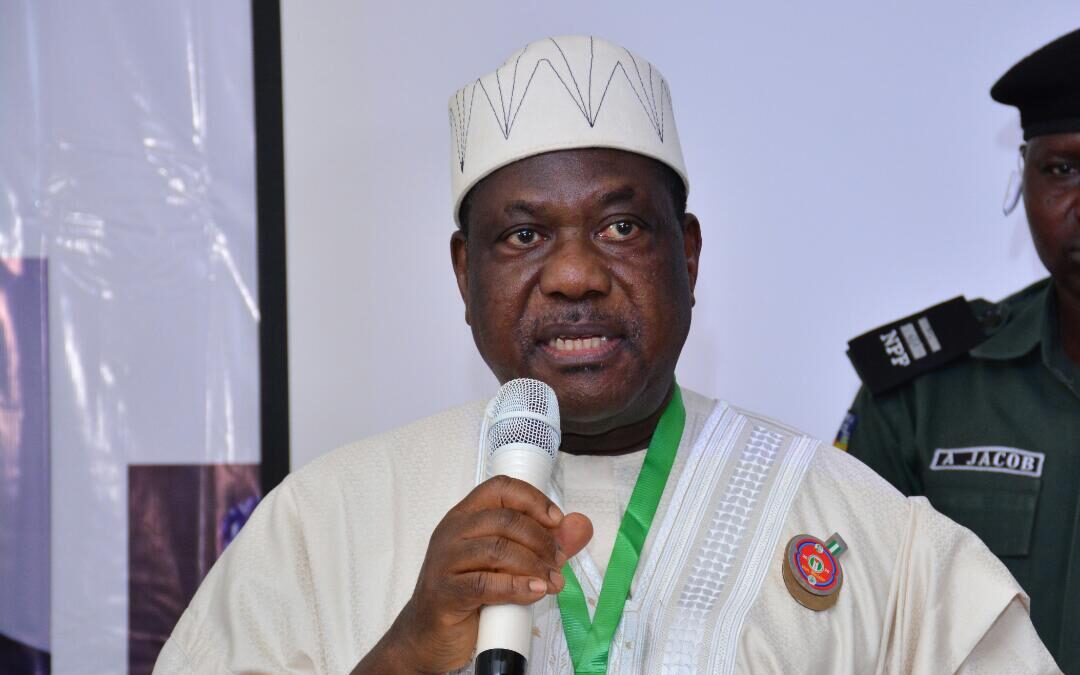
Secretary to the Government of the Federation, SGF, Senator George Akume, made the call at a press briefing in Abuja, yesterday.
Akume, who described terrorists and bandits as “common enemy”, also called on citizens to support the government’s effort to flush them out of the country, adding that steps are being taken by the federal government to stabilise the country.
The SGF then stressed that while Nigeria faces serious challenges from insurgents and criminal networks, claims that the violence constitutes a genocide against Christians are false, misleading, and dangerous.
In this vein, he explained that Nigeria’s insecurity has evolved along two distinct fronts: the ideological insurgency in the North East and economically motivated banditry in the North West.
Boko Haram and ISWAP emerged from global extremist movements, while the banditry crisis is rooted in competition for resources, illegal mining, cattle rustling, kidnapping-for-ransom and territorial control, he noted.
Akume further emphasised that both Christians and Muslims have suffered immensely from these attacks.
According to him: “No credible international organisation has ever designated this crisis as genocide against Christians or any group”.
He, however, warned that mischaracterising the violence as religious could escalate tensions and embolden extremist groups seeking sectarian conflict.
The SGF also placed Nigeria’s security crisis within a broader regional context, pointing to the destabilisation caused by the 2011 uprisings in Libya and Egypt.
He said the collapse of the Libyan state opened the Sahel to traffickers linked to Al-Qaeda in the Islamic Maghreb, AQIM, who dispersed sophisticated weapons across West Africa.
Tracing the evolution of Boko Haram from its founding by Mohammed Yusuf in 2002 to the rise of ISWAP after allegiance to ISIS in 2015, Akume also highlighted how the insurgency has been shaped by global terrorist movements from Al-Qaeda’s ideological influence to ISIS’ organisational restructuring.
The SGF further recalled major atrocities committed by the group to include church and mosque bombings, the UN Building attack, and the abduction of Chibok schoolgirls.
Banditry in the North West, Akume clarified is driven entirely by economic pressures rather than religion.
Judging from the aforementioned, he cited desertification, competition for grazing routes, illegal gold mining, arms smuggling, kidnapping-for-ransom, and the taxation of rural communities as the core drivers.
He said: “These factors, not religion, explain the persistence of the conflict”.
The SGF also addressed the mass-casualty attack in Yelewata, Guma LGA of Benue State, where over 100 people were killed between June 13 and 14, 2025 prompting President Bola Ahmed Tinubu to dispatched him immediately to the affected area with relief materials, after which Tinubu personally visited victims in hospitals.
In addition the Federal Government approved a census of all losses and funding for rebuilding destroyed communities.
Besides, Akume issued a detailed rebuttal of international narratives suggesting that Nigerian Christians are being targeted for genocide.
He stressed that Boko Haram and ISWAP attack churches and mosques indiscriminately, while bandits target anyone they can extort or abduct.
He equally warned that promoting false religious narratives undermines Nigeria’s security efforts and creates diplomatic friction with global partners.
On the capability of the Nigerian Armed Forces, Akume said they remain highly professional and experienced, having reclaimed vast territories once occupied by insurgents.
He, therefore, emphasised that Nigeria does not need foreign troops but requires advanced intelligence support, technology and equipment from allies, especially the United States.
The SGF also criticised recent statements from certain U.S. bodies, saying they unintentionally emboldened violent groups seeking global attention.
He explained that insurgent structures had been significantly degraded before these pronouncements but that renewed narratives have encouraged isolated actors to carry out opportunistic attacks.
Reaffirming the Federal Government’s official position, Akume said Nigeria rejects any labelling of the crisis as genocide.
He stressed that the nation is secular, with no state religion, and that government appointments reflect the country’s diversity. Members of both faiths hold key positions across the Federal Executive Council and the National Security Council.
Looking ahead, SGF outlined a robust roadmap for restoring stability.
Priority actions, according to him include strengthening nationwide security operations, deepening intelligence-sharing with the U.S., intensifying financial tracking of illegal mining and transnational criminal activities, enhancing border governance, and enforcing human-rights safeguards across all operations.
Akume said Nigeria and the United States Africa’s and the world’s largest democracies respectively—share a responsibility to work together to protect global stability. He called for deeper diplomatic ties and renewed cooperation based on mutual respect and reciprocity.