Joel Ajayi
Just over a year after President Bola Ahmed Tinubu dissolved the Federal Ministry of Sports and reconstituted the National Sports Commission (NSC) as the country’s apex sports authority, Nigeria’s sports sector is enjoying a remarkable revival. Under the stewardship of NSC Chairman, Mallam Shehu Dikko, and Director-General, Hon. Bukola Olopade, the industry has recorded unprecedented gains in unity, athlete welfare, international performance and economic impact.
A New Climate of Peace and Cooperation
One of the Commission’s most notable achievements has been the restoration of harmony across sports federations. For years, disputes, litigation and factionalism hampered progress and undermined institutional stability. That culture has now given way to collaboration and cohesion.
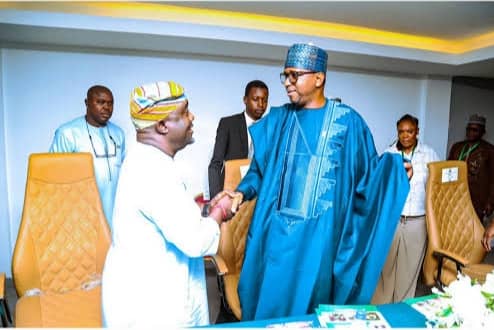
For the first time in recent memory, federation elections were conducted seamlessly, without controversy or disruption, reflecting the technocratic leadership guiding the NSC. Longstanding disputes have been resolved through dialogue, creating an enabling environment for federations to grow and thrive.
Federations that once struggled to stage even a single annual competition are now attracting private sector support, boosting both participation and visibility. Sports such as swimming, tennis, volleyball, wrestling, badminton, handball and weightlifting are gaining increasing global recognition—an outcome widely credited to the strategic partnership between Dikko and Olopade.
Investing in Athletes, Investing in Success
Athlete welfare has remained central to the Commission’s agenda. Recently, the NSC disbursed more than ₦200 million in training grants to 26 elite athletes preparing for the 2026 Commonwealth Games in Glasgow. This marked the second such disbursement within six months, benefiting both home-based and overseas athletes in disciplines including athletics, wrestling, weightlifting and para-sports.
“These grants are meant to support training and preparation so that our athletes can perform at their best on the world stage,” Hon. Olopade said. “When we take care of our athletes, they take care of the country by winning medals.”
The grants were channelled through the Elite and Podium Board, a scientific and institutional framework designed to sustain peak performance and safeguard athlete welfare at major international competitions.
Global Success and Economic Returns
Guided by the RHINSE Blueprint between 2024 and 2025, Team Nigeria recorded outstanding success, winning 373 medals worldwide—197 gold, 119 silver and 77 bronze—across multi-sport games, continental championships and international competitions. These achievements have strengthened Nigeria’s standing as a leading sports nation on the African continent.
Beyond podium success, the NSC’s reforms have delivered tangible economic benefits. The sports sector mobilised ₦50 billion in private capital—the highest ever recorded through the Sports Investment Promotion Office—and contributed 1.2 per cent to Nigeria’s Gross Domestic Product by the third quarter of 2025. Major sporting events also generated more than 140,000 direct and indirect jobs nationwide.
President Tinubu underscored the broader significance of sport to national development, describing it as one of Nigeria’s strongest national brands—one that unifies citizens, inspires belief and fosters a sense of community across age, language, ethnicity, religion and social class.
The period also witnessed historic milestones, including Nigeria’s ascent to world No. 1 in Scrabble and its debut in the Bobsleigh World Cup, highlighting the sector’s growing reach beyond traditional sporting disciplines.
Laying the Foundations for Sustainable Growth
At the heart of this transformation has been the introduction of a unified sports funding architecture, approved at the presidential level, which has removed bureaucratic bottlenecks and ensured more efficient and transparent resource allocation across federations.
“From grassroots competitions to continental and global platforms, the evidence is clear: when talent is supported with structure and preparation, Nigeria delivers,” President Tinubu remarked.
With these reforms, the NSC has positioned sports as both a high-performance enterprise and a viable economic sector, generating long-term benefits for athletes, institutions and the wider economy. Under the leadership of Dikko and Olopade, Nigeria’s sports sector is not only achieving international excellence but also driving employment, attracting private investment and strengthening national unity.