The United States launched a fresh wave of military strikes against Iran on Tuesday, while President Donald Trump announced plans to reimpose a naval blockade and impose new restrictions in the Strait of Hormuz, prompting Tehran to retaliate with attacks across the Gulf region.
Despite the renewed military escalation, Trump insisted that a diplomatic agreement with Iran remained possible, even as both countries intensified hostilities to levels not witnessed since the ceasefire reached in April.
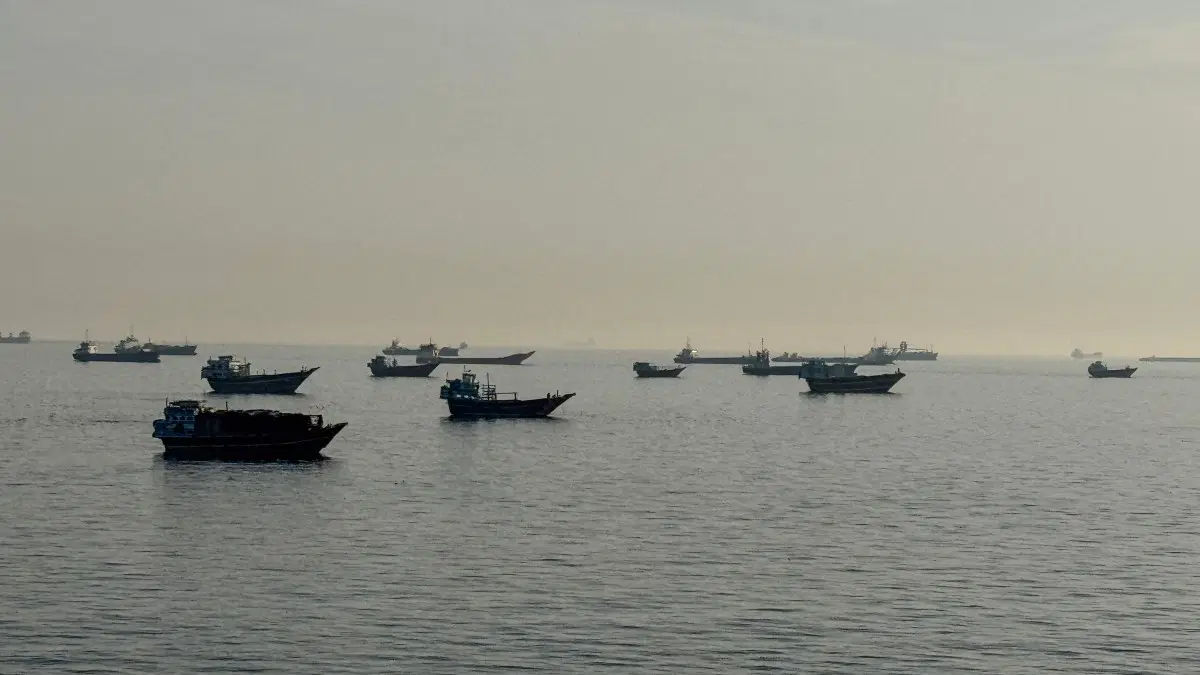
The latest confrontation comes after Iran reportedly attacked two commercial vessels navigating the strategic Strait of Hormuz, killing one crew member and injuring others, according to authorities in the United Arab Emirates.
The United Kingdom Maritime Trade Operations (UKMTO) also confirmed on Tuesday that another oil tanker was struck by a missile while passing through the Strait of Hormuz near Oman’s coastline.
Earlier, the United States military disclosed that its latest operation lasted approximately five hours and targeted several locations across Iran, including the coastal cities of Bushehr and Bandar Abbas.
According to the US military, the objective of the operation was to weaken Iran’s capability to launch attacks against commercial shipping routes in the Gulf.
Reports from Iranian media and official sources indicate that renewed American strikes since last week have resulted in the deaths of at least 28 people across various parts of Iran.
Following the US bombardment, Iran’s Revolutionary Guards announced retaliatory missile and drone strikes targeting Bahrain, including facilities housing American military personnel.
Bahrain later confirmed that its air defence systems intercepted multiple aerial attacks launched from Iran, accusing Tehran of deliberately targeting civilian areas after explosions and air raid sirens were reported in Manama.
The latest military exchanges have further undermined hopes of restoring lasting peace between Washington and Tehran after both countries reached a preliminary agreement in June.
Iran initially restricted movement through the Strait of Hormuz after US-Israeli military operations in February, while Washington responded by tightening restrictions on Iranian ports before both sides agreed to ease measures during negotiations.
President Trump announced on Monday that the United States would assume responsibility for securing the Strait of Hormuz and introduce a 20 percent levy on cargo transported through the strategic waterway.
US Central Command (CENTCOM) also announced that Iranian ports located along the strait would be subjected to a naval blockade beginning at 2000 GMT on Tuesday.
The announcement sent shockwaves through global energy markets, with crude oil prices surging more than nine per cent on Monday before extending gains on Tuesday amid concerns over disruptions to global energy supplies.
Iran also expanded its retaliation by launching attacks toward other US allies in the Middle East, including Jordan, where authorities confirmed that four Iranian missiles were intercepted before reaching their intended targets.
Iran’s Revolutionary Guards said the strikes targeted US military facilities in Jordan and urged the country’s citizens to demand the removal of American military bases from the region.
Although Iranian officials insist their military operations are aimed solely at US interests, a spokesperson for Iran’s armed forces warned that any Gulf nation assisting the United States would be regarded as participating in acts of war.
The White House also confirmed that President Trump had formally notified the US Congress of the renewed military campaign against Iran, granting the Pentagon an additional 60 days to continue operations without further congressional approval.
Beyond the blockade, Trump threatened military action against Pickaxe Mountain, a heavily fortified underground nuclear facility near Natanz that Western intelligence agencies suspect is being used for undeclared uranium enrichment.
“Tell the Iranians to be ready. Let them know we’re coming (and) there’s not a damn thing they can do about it,” Trump reportedly said during an interview with conservative radio host Hugh Hewitt.
He later declared on Truth Social that the United States would become “THE GUARDIAN OF THE HORMUZ STRAIT,” while maintaining that countries using the waterway would continue to enjoy unrestricted passage, except for Iran.
Iranian Foreign Minister Abbas Araghchi mocked Trump’s proposal, saying that while compensation for guaranteeing safe passage might be reasonable, a 20 per cent charge was excessive.
Meanwhile, Iran’s parliament has begun considering legislation aimed at regulating activities in the Strait of Hormuz, according to the chairman of its parliamentary security committee.
Although international law generally prohibits countries from imposing tolls on international waterways such as the Strait of Hormuz, Tehran has continued to defend its right to regulate activities in the area.
Despite the worsening conflict, Trump maintained that negotiations with Iran were still achievable.
However, Iranian Foreign Ministry spokesman Esmaeil Baqaei said the memorandum of understanding reached in June had entered a critical stage, warning that Tehran would no longer honour its obligations if Washington continued to violate the agreement.
Baqaei disclosed that discussions were still ongoing through mediators from Qatar, Pakistan and Oman in an effort to prevent the conflict from escalating further.
Analysts believe both Washington and Tehran remain interested in ending the confrontation but are unwilling to compromise on key demands, making a permanent resolution increasingly difficult to achieve.