By Lois Sambo
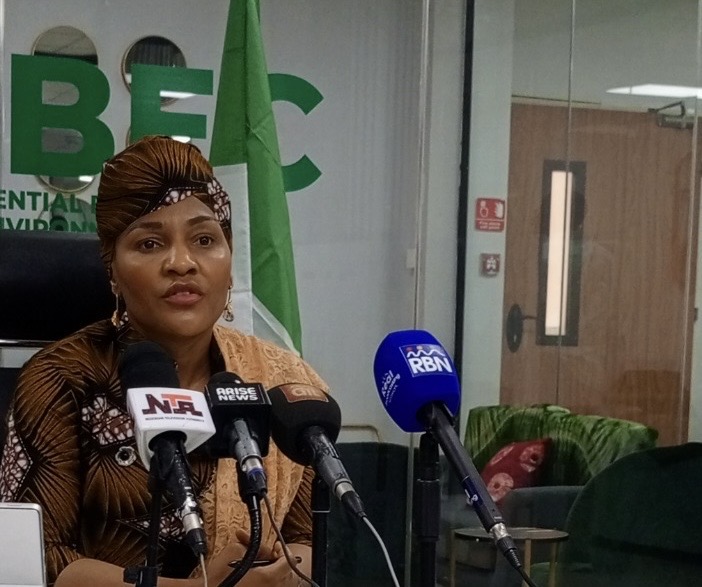
The Director-General of the Presidential Enabling Business Environment Council, PEBEC, Princess Zara Mustapha Audu, has said the Federal Government is making significant progress in improving Nigeria’s business environment, revealing that 98 per cent of the 69 Ministries, Departments and Agencies, MDAs, under the Council’s assessment are now meeting key responsiveness standards.
Speaking during a media briefing in Abuja today, Audu said the milestone followed PEBEC’s 90-day Business Environment Assessment Accelerator Programme, launched after gaps were identified in the 2025 Business Environment Assessment Report.
She stressed that the Council’s approach was centred on reform rather than criticism. “PEBEC is not a name-and-shame council. We are here to fix the challenges that currently plague our business environment. When we identify the gaps, we provide technical assistance to agencies to create solutions that improve the ease of doing business,” she said.
According to her, the programme has significantly strengthened accountability across business-facing MDAs, with agencies now responding promptly to enquiries and delivering services within prescribed timelines.
Audu commended the Nigeria Customs Service, Nigerian Ports Authority, National Information Technology Development Agency, NITDA” and the National Pension Commission for their outstanding performance, noting that they exceeded expectations by simplifying procedures and shortening service delivery timelines.
“Our objective is not about rankings. It is about the impact on businesses and investors and the experience they have when they interface with government regulators,” she stated.
She disclosed that PEBEC would continue its “mystery shopping” initiative, through which officials anonymously assess government services from the perspective of ordinary users ahead of the release of the 2026 Business Environment and Compliance Report.
The PEBEC boss also announced plans to integrate digital platforms across government agencies to eliminate repetitive documentation for businesses. “If a business has already provided its basic information to one agency, it should not have to submit the same information repeatedly when dealing with another agency. That is the kind of seamless system we are working towards,” she added.
Addressing concerns over multiple taxation, Audu described the recently enacted tax reforms as one of President Bola Ahmed Tinubu’s most significant policy achievements, expressing confidence that more states would align with the new framework.
On insecurity, she argued that perception often outweighed reality. “We shouldn’t assume that because we have pockets of insecurity, the entire country is insecure. Perception is very important, and it is also important for the media to clearly articulate the issues,” she said.
She acknowledged that small and medium-sized enterprises (SMEs) continued to face challenges but said PEBEC was collaborating with state governments and development institutions to improve access to finance and remove regulatory bottlenecks.
Audu further disclosed that the Council was developing the EnableHub initiative to prepare Nigerian businesses for the African Continental Free Trade Area, AfCFTA, with the North-East being considered for the pilot phase.
She reaffirmed the Council’s commitment to sustaining reforms, saying: “We are trying to institutionalise these processes, make them the norm and reframe the conversation around ease of doing business in Nigeria.”