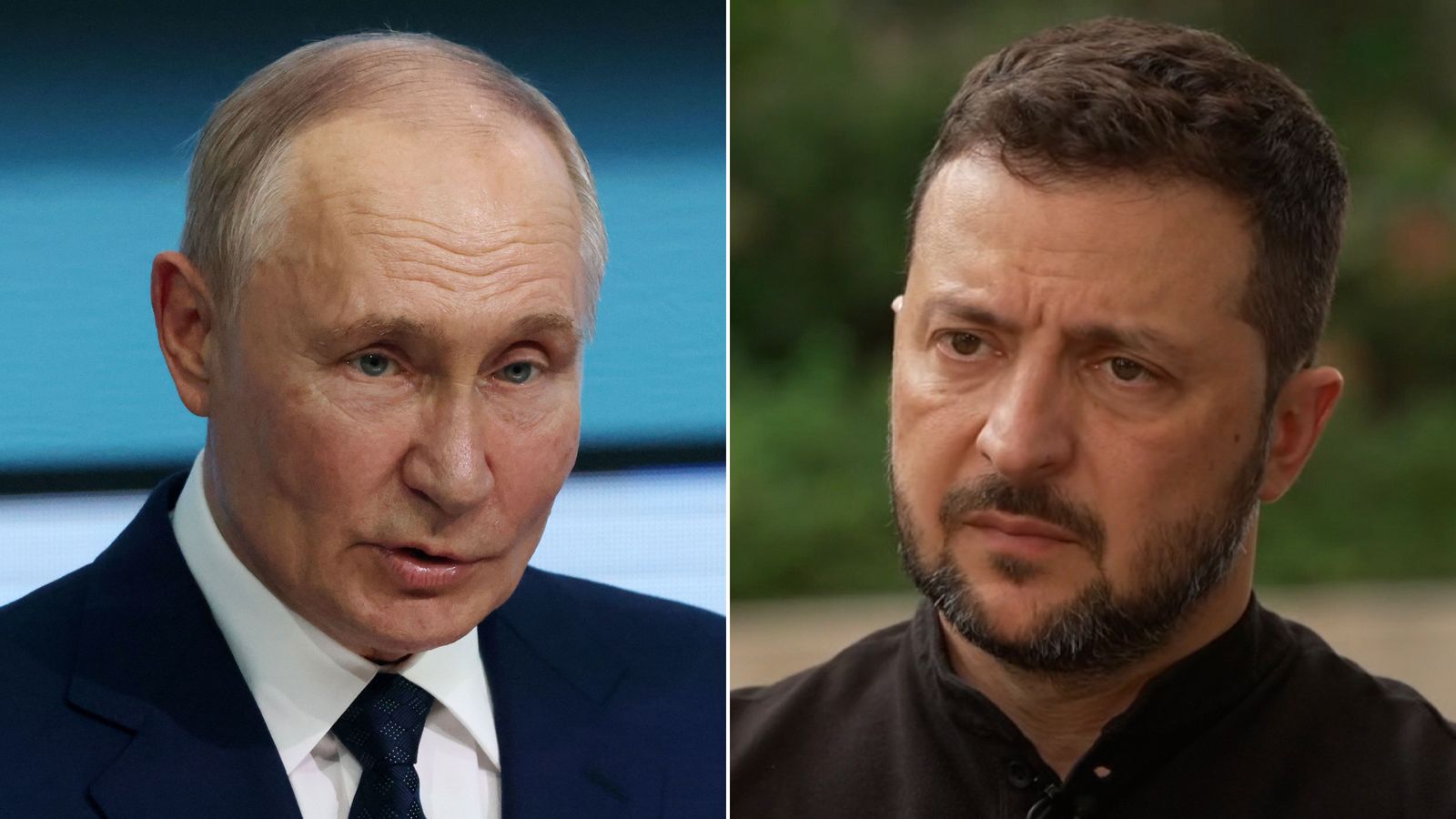
Russian President Vladimir Putin has dismissed the possibility of holding direct talks with Ukrainian President Volodymyr Zelensky in the near future, insisting that any meeting between the two leaders would only be meaningful after negotiators have reached agreements on the key terms of a potential peace settlement.
Putin made the remarks on Friday while speaking at the St. Petersburg International Economic Forum (SPIEF) in Russia’s second-largest city, a day after Zelensky publicly appealed for a face-to-face meeting aimed at finding a pathway to end the war that has continued for more than four years.
The Russian leader stated that he does not believe a summit with Zelensky would be productive at this stage, arguing that experts and negotiators should first work on resolving the major issues dividing both countries before any high-level engagement takes place.
He further reiterated Russia’s determination to continue its military campaign in Ukraine until all objectives set by Moscow have been fully achieved.
Russia has consistently maintained demands that include control of Ukraine’s eastern Donbas region, alongside a range of political and military conditions that Kyiv and its Western allies have repeatedly rejected, describing them as unacceptable concessions that would undermine Ukraine’s sovereignty.
Despite several rounds of international diplomatic efforts, including talks facilitated by the United States, both sides remain far apart on the core issues required for a comprehensive peace agreement.
On Thursday, Zelensky had issued a direct invitation to Putin, proposing a personal meeting between both leaders as a means of breaking the diplomatic deadlock and advancing peace efforts.
“Ukraine proposes ending this war through direct engagement between us — and you. I am proposing a meeting,” Zelensky said in his message.
“I propose to set a clear date for such a meeting,” he added.
However, Putin rejected the proposal during his address at the economic forum.
“I see no point in meeting. It only makes sense for the Ukrainian side to stop the advance of our armed forces. That’s it. And we need agreements,” Putin said.
“Let the experts work, develop some solutions, and then we can meet,” he added.
The Russian president has repeatedly questioned Zelensky’s legitimacy as Ukraine’s leader, a position that has further complicated prospects for direct negotiations between the two sides.
The conflict, which began with Russia’s full-scale military operation in February 2022, has resulted in hundreds of thousands of casualties and widespread destruction across large parts of eastern and southern Ukraine.
Millions of people have also been displaced during a conflict that many analysts initially believed Moscow expected to conclude within a matter of days.
Zelensky has consistently argued that direct discussions between himself and Putin are necessary to resolve the most sensitive issues surrounding any future peace agreement.
His latest proposal for a leaders’ summit received support from several international partners, including US President Donald Trump and French President Emmanuel Macron.
The Ukrainian president is also expected to hold talks with Macron, British Prime Minister Keir Starmer and German Chancellor Friedrich Merz in London as part of efforts to build fresh diplomatic momentum toward ending the war.
While rejecting the proposed meeting, Putin maintained that military operations would eventually come to an end once Russia had secured the objectives it set at the beginning of the conflict.
“Military actions will end some day, we assume. Without a doubt, they will end once we have achieved the goals we have set for ourselves,” he told participants at the forum.
Beyond the conflict, Putin also addressed concerns about Russia’s economy, dismissing claims that the country is facing severe economic decline due to wartime spending and Western sanctions.
Russia has experienced increasing economic pressure in recent years, with rising inflation, higher taxes and elevated borrowing costs affecting businesses and households.
Official figures showed that the Russian economy contracted by 0.2 per cent during the first quarter of 2026, marking its first quarterly decline in three years.
Nevertheless, Putin insisted that reports predicting economic collapse were exaggerated.
“We, of course, hear criticism from all sides that everything has collapsed,” he said.
He argued that Russia’s economic performance remains comparable to conditions experienced in several European countries and stressed that Moscow is pursuing what he described as a sovereign economic model.
Responding to questions about the state of the economy during a separate engagement, Putin referenced American author Mark Twain’s famous remark, saying, “Rumours of my death have been greatly exaggerated,” as he dismissed suggestions that Russia was approaching a major economic crisis.
This year’s SPIEF gathering has also reflected the broader impact of the ongoing conflict, taking place shortly after Ukrainian drone attacks targeted areas around St. Petersburg.
Ukraine has increasingly expanded strikes against Russian energy facilities, including oil depots, refineries and export infrastructure, in an effort to weaken one of Moscow’s most important sources of revenue.
The forum, once regarded as Russia’s equivalent of the World Economic Forum in Davos, has undergone significant changes since the outbreak of the war.
While Western investors and business leaders were once prominent participants, recent editions have seen stronger representation from countries such as China and Saudi Arabia.
Visitors at this year’s event observed displays featuring advanced technology, including domestically produced humanoid robots, while investment opportunities in territories annexed by Russia from Ukraine featured prominently.
Attendance from Western nations was limited, with a small number of guests including actor Steven Seagal, political commentator Candace Owens and representatives of Germany’s Alternative for Germany party among those present.