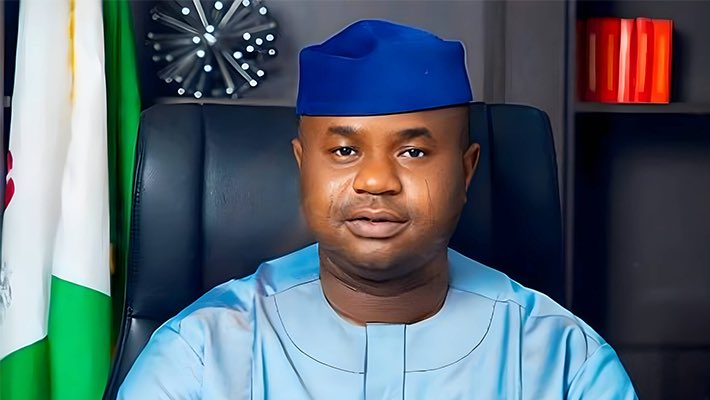
At a crucial moment in Nigerias fiscal renewal under the Renewed Hope Agenda of President Bola Ahmed Tinubu, Zacch Adelabu Adedeji stands out as a steady and purposeful architect of institutional transformation and reform credibility, writes GEORGE EMINE.
At defining moments in a nations evolution, the true test of leadership lies not in eloquent declarations but in the capacity to convert policy vision into durable institutional progress. Within the framework of Nigerias fiscal renewal under President Bola Ahmed Tinubus Renewed Hope Agenda, one individual has distinguished himself with remarkable purpose and visibility at the forefront of reform implementation: Zacch Adelabu Adedeji.
Following a rigorous nationwide nomination process and careful editorial evaluation, AljazirahNigeria Newspapers is persuaded that Dr Adedeji stands out as the most compelling candidate for the Personality of the Year (Fiscal Reform Architect), 2025 Award, not merely for administrative performance, but for institutional redesign of historic consequence.
His stewardship of Nigerias revenue modernisation programme reflects something rarer than routine public service achievement: it reflects structural leadership at a moment of national necessity.
Every enduring reform begins with preparation long before responsibility arrives. Dr Adedejis journey into fiscal leadership was shaped by intellectual discipline, professional structure, and early exposure to enterprise realities within southwestern Nigerias commercial culture.
Born on January 8, 1978 in Iwo-Ate near Ogbomoso in Oyo State, he grew up within an environment where agricultural commerce, particularly cocoa trading, instilled practical lessons about planning discipline, market volatility, and productivity accountability. These early influences later matured into a technocratic philosophy grounded in predictability rather than improvisation.
His academic trajectory reinforced that foundation. After earning his National Diploma in Accountancy from the Federal Polytechnic, Ede, he proceeded to Obafemi Awolowo University, graduating with a First-Class degree in Management and Accounting. He later obtained both a Masters degree and a Doctorate in Accounting from the same institution, completing his PhD shortly before assuming leadership of Nigerias primary revenue authority.
Such alignment between scholarship and governance remains rare in public finance administration and positioned him uniquely to bridge theory with execution.
Modern fiscal leadership increasingly demands systems thinking rather than procedural familiarity alone. Dr Adedejis participation in executive training at the Harvard Kennedy School broadened his perspective on how taxation interacts with infrastructure financing, investment flows, and macroeconomic stability.
Equally formative was his decade-long professional experience with Procter & Gamble, one of the worlds most structured multinational environments. There, he held strategic financial management responsibilities including Corporate Finance Manager for West Africa and leadership roles in enterprise resource planning implementation.
Exposure to globally harmonised compliance frameworks, digital financial platforms, and performance-driven planning systems would later prove decisive as Nigeria accelerated its transition toward data-driven revenue administration.
When Dr Adedeji assumed leadership of the Federal Inland Revenue Service (now the Nigeria Revenue Service) in September 2023, expectations extended far beyond improving collection totals. Nigeria required not merely higher revenue, but a smarter revenue system.
For decades, fiscal volatility driven by oil dependence constrained long-term national planning. Reform therefore demanded institutional reinvention: integrating digital intelligence into compliance systems, widening the tax base, strengthening enforcement credibility, and rebuilding trust between citizens and the state.
Within months of his appointment, the Service exceeded its annual revenue targetan achievement that signalled early administrative momentum at a time when markets, investors, and development partners were closely observing
Repositioning Revenue Administration as a Development Institution
One of the most consequential contributions of Dr Adedejis leadership has been conceptual rather than procedural: redefining the role of the revenue authority itself.
Historically, tax agencies in many developing economies functioned primarily as collection platforms. Under the emerging reform framework, Nigerias evolving revenue architecture is being repositioned as a development institutionsupporting fiscal stability, investment confidence, and national planning coherence.
This shift reflects a deeper recognition that taxation is not merely about government income; it is about economic structure.
Across advanced revenue systems globally, digitalisation now distinguishes reactive administration from predictive governance. Under Dr Adedejis stewardship, technology has become central to Nigerias compliance modernisation strategy.
Integrated digital platforms are expanding taxpayer visibility, automating reporting processes, reducing discretionary bottlenecks, strengthening audit intelligence, and minimising leakages.
More importantly, digitalisation improves fairness. Transparent systems produce predictable compliance expectations. Predictable compliance strengthens voluntary participation.
For Nigerias expanding entrepreneurial ecosystem, particularly small and medium-scale enterprises, this clarity represents a turning point in the relationship between citizens and the tax system.
Perhaps one of the most sophisticated elements of Nigerias emerging fiscal strategy under the Renewed Hope Agenda is its emphasis on inclusion rather than coercion.
Instead of relying primarily on higher tax rates, the reform programme focuses on widening the tax net, integrating informal economic activity, harmonising compliance frameworks across jurisdictions, and strengthening corporate reporting structures.
This approach reflects a fundamental policy principle: sustainable revenue growth must come from participation, not pressure.
Given the scale of Nigerias informal economy, one of the largest in Africa, such an approach represents both realism and reform maturity.
Legislative Foundations for a New Fiscal Order
Institutional reform achieves permanence only when supported by legislative clarity. Nigerias new tax regime therefore represents one of the most ambitious fiscal restructuring efforts undertaken since the countrys return to democratic governance in 1999.
Four landmark statutesthe Nigeria Tax Act, the Nigeria Tax Administration Act, the Nigeria Revenue Service Establishment Act, and the Joint Revenue Board Reform Acthave collectively redesigned the architecture of national taxation.
Before their enactment, Nigerias tax environment operated within a fragmented framework shaped by overlapping amendments and jurisdictional ambiguities. Businesses encountered multiple collection points, inconsistent enforcement standards, and avoidable compliance complexity.
Simplification, as reform history repeatedly demonstrates, is the most powerful multiplier of compliance.
Under Dr Adedejis stewardship, legislative transformation has been matched by administrative coordination, ensuring that reform is not merely announced, but implemented.
Restoring Confidence in the Tax System
Revenue reform ultimately succeeds not inside institutions but within society itself.
Citizens comply voluntarily when they believe the system is fair, transparent, predictable, and responsibly managed. One of the quieter yet most consequential achievements of the evolving Nigeria Revenue Service under Dr Adedejis leadership has therefore been the rebuilding of taxpayer confidence through engagement, communication, and service delivery improvements.
When taxation shifts from obligation to partnership, compliance becomes culture.
And when compliance becomes culture, development becomes sustainable.
Nigerias tax transformation is not a narrow administrative exercise. It is a strategic pillar of national renewaldesigned to reduce dependence on oil revenues, strengthen fiscal predictability, expand investment confidence, and deepen the social contract between citizens and government.
Within this broader national trajectory, Dr Zacch Adedejis leadership represents a convergence of intellectual preparation, corporate systems discipline, legislative coordination, digital innovation, and institutional execution.
His impact is measurable not only in revenue outcomes, but in structural clarity, administrative coherence, and the repositioning of taxation as a developmental instrument.
In recognising him as Personality of the Year (Fiscal Reform Architect), 2025, AljazirahNigeria Newspapers acknowledges a reformer whose work is helping to redefine Nigerias fiscal futurenot through rhetoric alone, but through systems capable of sustaining national progress.
History rarely celebrates those who merely administer institutions. It remembers those who rebuild them, and Dr Zacch Adedeji belongs firmly in the latter category.