
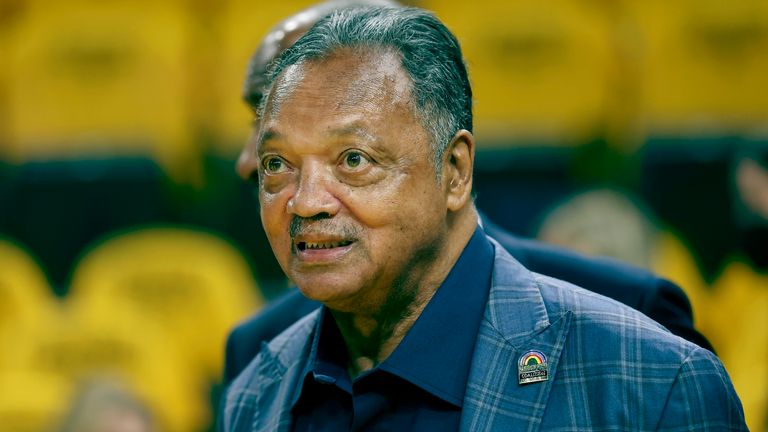
Reverend Jesse Jackson, the veteran American civil rights activist, Baptist minister, and influential political figure who spent more than six decades expanding opportunities for African Americans on the national stage, passed away on Tuesday. He was 84.
His family confirmed the news in a heartfelt statement, describing him as a servant leader whose life was dedicated to uplifting the oppressed, the voiceless, and the overlooked worldwide.
“His unwavering belief in justice, equality, and love uplifted millions, and we ask you honor his memory by continuing the fight for the values he lived by,” the family said.
“Our father was a servant leader – not only to our family, but to the oppressed, the voiceless, and the overlooked around the world,” the statement continued. “We shared him with the world, and in return, the world became part of our extended family.”
Jackson stood at the heart of many defining moments in the long struggle for racial justice in the United States. He was present in Memphis in 1968 when Dr. Martin Luther King Jr. was assassinated; he openly wept in the crowd as Barack Obama celebrated his historic 2008 presidential victory; and he stood in solidarity with George Floyd’s family in 2021 after a jury convicted the former police officer responsible for Floyd’s murder.
“My constituency is the desperate, the damned, the disinherited, the disrespected, and the despised,” Jackson famously declared during his address to the 1984 Democratic National Convention.
He first rose to national prominence in the 1960s as a key leader in Dr. King’s Southern Christian Leadership Conference (SCLC). In 1971, he founded Operation PUSH (People United to Save Humanity), followed by the National Rainbow Coalition in 1984. The two organisations merged in 1996 to form Rainbow/PUSH, which continued his work in social justice, economic empowerment, and political advocacy.
Jackson’s two presidential campaigns in 1984 and 1988 brought African American issues to the forefront of the Democratic Party platform. In 1984, he finished third in the Democratic primaries behind Walter Mondale and Gary Hart, marking the most successful Black presidential bid until Barack Obama’s victory years later. Mondale went on to lose decisively to Ronald Reagan in the general election.
In 1988, Jackson returned to the convention stage after placing second to nominee Michael Dukakis. His electrifying speech called on Americans to find “common ground” and sharply criticised what he described as the “reverse Robin Hood” policies of the Reagan administration, which he said enriched the wealthy while leaving the poor behind.
While his oratory elevated his profile and inspired millions, the nation’s gradual shift toward conservative politics limited his long-term national influence.
Jackson’s legacy was also marked by controversy. In 1984, he referred to New York City as “Hymietown,” a derogatory term for Jews, drawing widespread condemnation. One of his sons, former US Congressman Jesse Jackson Jr., served prison time after pleading guilty in 2013 to misusing approximately $750,000 in campaign funds for personal purposes.
Jackson’s own life began in hardship. Born Jesse Louis Burns on October 8, 1941, in Greenville, South Carolina, to an unwed teenage mother and a former professional boxer, he later took the surname of his stepfather, Charles Jackson. “I was not born with a silver spoon in my mouth. I had a shovel programmed for my hands,” he once reflected.
He excelled in his segregated high school and earned a football scholarship to the University of Illinois before transferring to the predominantly Black Agricultural and Technical College of North Carolina, where he graduated with a degree in sociology.
In 1960, he participated in his first sit-in in Greenville. He later joined the Selma-to-Montgomery marches in 1965, where he caught Dr. King’s attention and became one of his closest associates.
Beyond domestic civil rights, Jackson emerged as a mediator and international envoy. He advocated fiercely for ending apartheid in South Africa and served as President Bill Clinton’s special envoy for Africa in the 1990s. He undertook missions to secure the release of US prisoners in Syria, Iraq, and Serbia.
In 2005, he met Venezuelan leader Hugo Chávez, and he later spoke at Chávez’s funeral in 2013, drawing criticism from some quarters.
Jackson announced in 2017 that he had been diagnosed with Parkinson’s disease, leading him to scale back public appearances. Nevertheless, he remained active in key moments, standing with George Floyd’s family in April 2021 after the conviction of Floyd’s killer. Reflecting on the verdict, he told the Australian Broadcasting Corporation that it brought “relief, but not a time for celebration.”