By Paul Effiong, Abuja
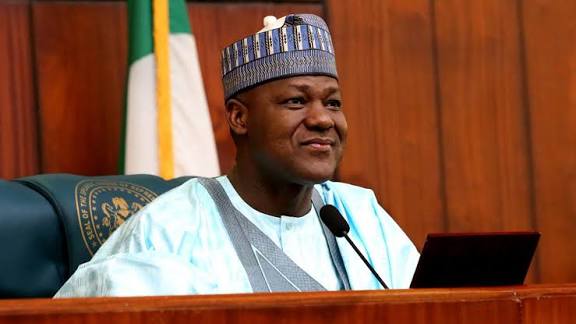
Former Speaker of the House of the Representatives, Yakubu Dogara has commended President Bola Tinubu for the Tax Reform Act, describing it as a deliberate and bold attempt to reset Nigeria’s fiscal framework.
The former speaker gave the commendation yesterday during the inaugural edition of the Distinguished Parliamentarian Lecture organised by the House of Representatives Press Corps at the National Assembly Complex in Abuja.
Speaking under the theme, ‘Navigating Tax Reform in Nigeria: Insights on President Tinubu’s Policies,’ Dogora, who is currently the Chairman of the National Credit Guaranteed Limited, NCGC, dissected the origins and scope of the Tax Reform Act in Nigeria.
He projected positive impact of the sweeping reforms encapsulated in the Nigeria Tax Act, NTA, 2025, and related legislation.
Dogara called on government at all levels to step up measures that would guarantee transparency, fairness
and consistent implementation in order to win the trust of Nigerians, as well as secure long-term economic stability.
According to him, President Tinubu had, upon assumption of office in 2023, inherited an economy weighed down by excessive deficit financing, dual exchange rates that enriched privileged few Nigerians.
“By the time Tinubu took office, N22.7trillion had been printed and injected into the economy, destroying the value of the naira,” he said.
He emphasised that urgent reforms were necessary to avert total economic collapse in the country.
The former speaker observed that the reforms had consolidated 16 federal tax statutes into four principal laws, the Nigeria Tax Act, NTA, 2025, Nigeria Tax Administration Act, NTAA, 2025, Nigeria Revenue Service Establishment Act, NRSEA, 2025, as well as the Joint Revenue Board Establishment Act, JRBEA, 2025, stressing that they have streamlined Nigeria’s complex tax regime, as well as aligning it with global standards.
Dogora, who was a keynote speaker at the event, equally highlighted some key issues raised by the new Tax Reform Act which include a 15 percent minimum effective tax rate for large companies, unified Taxpayer Identification Number system, simplified filing for low-income earners, as well as the creation of a tax ombudsman’s office.
Dogara equally stressed that the reforms were pro-poor, maintaining that it had also provided an exemptions for small businesses with turnover below N100 million, rent reliefs for salaried workers, tax credits for upstream oil operators and full income tax exemption for individuals earning N800,000 or less per annum.
Giving clarification on concerns over the controversial five percent fuel surcharge, he explained that it merely reaffirmed an existing FERMA Act and would exclude kerosene, cooking gas and compressed natural gas.
The former speaker warned against misinterpretation, stressing the urgency of technology, as well as the manpower development and short-term compliance costs.
While commending government for pragmatic measures to ensure workability of the new laws, he called for transparent use of tax revenues in order to build infrastructure, power industries, as well as improve healthcare and education for Nigerians.
In his welcome address, Speaker Tajudeen Abbas hailed the tax reforms, even as he described President Tinubu’s action as a decisive step towards simplifying compliance and reducing the tax burden on ordinary Nigerians.
Abbas, who was represented by the Chairman of the House Conmittee on Media and Public Affairs, Akin Rotimi, also announced the harmonisation of tax collection, as well as readiness for the new law to take effect from January 2026.