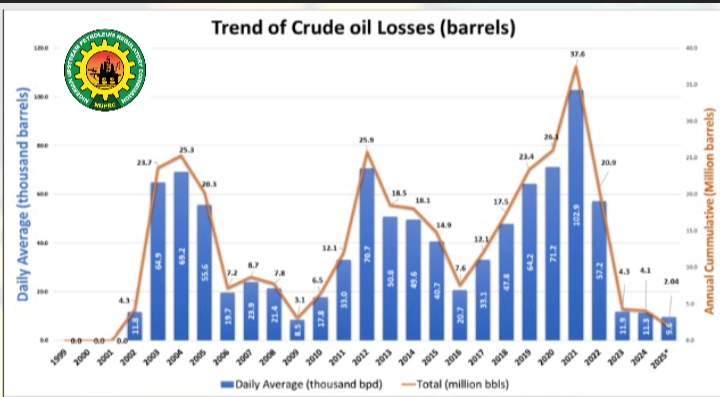
Crude oil losses in Nigeria have fallen to their lowest level in 16 years, with daily theft and metering losses dropping to 9,600 barrels per day in July 2025, according to the Nigerian Upstream Petroleum Regulatory Commission (NUPRC).
Aljazirah Nigeria reports that the decline, captured in the Commission’s latest data of crude oil losses year-to-date July 2025, reflects a significant turnaround in the upstream sector, showing losses at their lowest since 2009 when the country recorded 8,500 barrels per day.
The development comes against the backdrop of persistent struggles with oil theft and system inefficiencies that have historically cost the country billions of dollars in lost revenue. Crude losses peaked in 2021 at 37.6 million barrels, averaging 102,900 barrels per day, making it the highest in over two decades.
Read also: NUPRC Moves To Secure Divestments, Guarantees Seamless Oil Asset Transition
According to NUPRC’s report, between January and July 2025, Nigeria lost 2.04 million barrels, averaging 9,600 barrels daily, a 50.2 percent reduction compared to the 4.1 million barrels lost in the whole of 2024. The report also shows a staggering 94.57 percent decline compared to 2021 losses.
“This progress marks a major leap forward in the Commission’s relentless drive to eliminate all forms of crude losses across Nigeria’s oilfields and pipelines.
“By comparison, the entire 2024 calendar year recorded 4.1 million barrels lost at a daily average of 11,300 barrels. Remarkably, in just the first seven months of 2025, losses were cut by 50.2%, with only 2.04 million barrels lost over the period.
“The figures for the period ending July 2025 also represent a dramatic 94.57% drop in crude oil losses compared to the full year of 2021, when Nigeria lost a staggering 37.6 million barrels at a daily average of 102,900 barrels,” the NUPRC said in its report.
So far in 2025, only 2.04 million barrels have been lost, a reduction of 35.56 million barrels compared to the peak losses of 2021. This underscores the level of progress made within four years since the passage of the Petroleum Industry Act.
“Since the implementation of the Petroleum Industry Act in 2021, Nigeria has recorded steady progress in reducing crude oil losses. In 2021, losses stood at 37.6 million barrels, averaging 102,900 barrels per day. By 2022, this dropped to 20.9 million barrels at a daily average of 57,200 barrels.
“The downward trend continued in 2023, with losses reduced to 4.3 million barrels at 11,900 barrels per day. Even more progress was made in 2024, as losses were further contained to 4.1 million barrels, averaging 11,300 barrels per day,” the report further stated.
The Commission said it has combined both security collaborations and regulatory measures to drive the turnaround, working with security agencies, oil operators, and host communities. At the same time, it has plugged systemic loopholes through audits and regulatory checks.
“The Commission has adopted a balanced mix of kinetic and non-kinetic strategies in tackling oil losses. On the kinetic front, the Commission has continued to collaborate closely with security agencies, operators and communities.
“On the non-kinetic front, NUPRC has implemented strategic regulatory measures to close systemic loopholes. One key initiative is the metering audit across upstream facilities to ensure accurate measurement of production and exports.
“To further strengthen control, the NUPRC under the leadership of Engineer Gbenga Komolafe approved 37 new crude oil evacuation routes to combat oil theft,” the NUPRC said.