
…Nigeria maintains OPEC’s 1.5m bpd output quota in July
By Charles Ebi
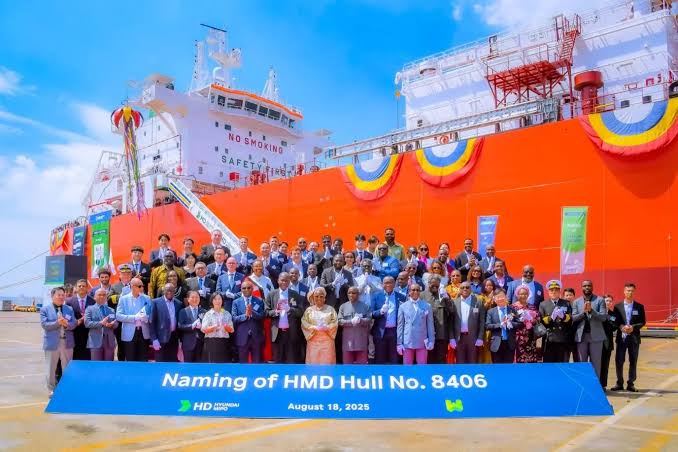
Nigerian National Petroleum Company ,NNPCL, Sahara Group, and WAGL Energy Limited ,formerly West African Gas, have announced an expansion of their joint venture fleet capacity, now surpassing 160,000 cubic meters.
In a post released on its official X (formerly Twitter) handle on Monday, NNPC said the fleet expansion strengthens WAGL Energy’s position as one of the leading suppliers of Liquefied Petroleum Gas ,LPG, on the continent.
According to NNPC, the move is consistent with its vision of ensuring sustainable and affordable energy solutions for homes, businesses, and industries.
“WAGL Energy Limited, a joint venture between the Nigerian National Petroleum Company ,NNPC, Limited and the Sahara Group, now boasts a robust fleet exceeding 160,000 cubic meters. WAGL Energy Limited is driving Africa’s access to reliable and clean energy through sustainable LPG supply, extending its impact across the continent and beyond”, the statement on X said.
WAGL Energy Limited, the JV company between NNPC and Oceanbed ,a Sahara Group Company, is driving NNPC’s five-year $1 billion investment plan to accelerate the decade of gas and energy transition agenda over the period.
West African Gas was incorporated in March 2013 as a joint venture company. It was formed by the Nigerian National Petroleum Corporation LNG Ltd, a wholly-owned subsidiary of the Nigerian National Petroleum Corporation ,NNPC, and Ocean Bed Trading Ltd, an established oil and gas trading company.
The primary purpose of the company is to serve as a vehicle for the offtake, marketing, and trading of NLNG NGLs under the equity lifting scheme.
This focus allows the company to efficiently manage and market natural gas liquids.
In July 2024, NNPC Limited secured a maintenance agreement with WAGL Energy for a major Nigerian crude oil terminal located in Delta State.
According to the national oil company, Nigerian Pipelines and Storage Company Limited ,NPSC, one of its downstream subsidiaries, signed an agreement with WAGL for the provision of Operation and Maintenance ,O and M, Services to the Escravos Crude Oil Terminal Facility.
In May 2022, NNPCL and Sahara Group took delivery of two 23,000 cubic meters ,CBM, Liquefied Petroleum Gas ,LPG, vessels at the Hyundai MIPO Shipyard, a manufacturer of mid-sized carriers, in Ulsan, South Korea.
According to Sahara Group Limited, the new vessels, MT BARUMK and MT SAPET, increased NNPC and Sahara Group’s joint venture ,JV, investment to over $300million, as part of moves to attain their $1 billion gas infrastructure commitment by 2026.
The initiatives, the LPG Penetration Framework and LPG Expansion Plan, are geared toward encouraging the use of gas in households, power generation, auto-gas, and industrial applications to attain 5 million metric tonnes of LPG consumption by 2025.
Interestingly, for the second consecutive month, Nigeria maintained its crude production quota of 1.5 million barrels per day in July 2025.
According to the August 2025 Monthly Oil Market Report ,MOMR, released by the Organisation of the Petroleum Exporting Countries ,OPEC, Nigeria was able to sustain its crude oil production for two months straight.
As part of efforts to avoid oil glut, which refers to having too much oil supply in the global market, and keep prices stable to help economies grow, OPEC provided every member country with a production cap.
For Nigeria, it has not been able to reach the level in recent times until January 2025, when it recorded the highest output of 1.54 million barrels per day.
However, it dropped below the 1.5 million barrels daily mark in February until May.
Momentum picked up again when the country’s average daily oil production rose to 1.505 million barrels per day in June.
It has now sustained this again with data showing Nigeria produced 1.507 million barrels per day in July.
Prior to this, production averaged 1.453 million barrels per day in May.
Crude production dropped to 1.46 million barrels per day in February, 1.40 million barrels per day in March, 1.48 million barrels per day in April and 1.45 million barrels per day in May.
Nigeria is actively boosting crude oil production by reactivating dormant fields, fast-tracking regulatory approvals, and enhancing operational efficiencies across the upstream value chain.
With the country’s production picking up, the Group Chief Executive Officer ,GCEO, of the Nigerian National Petroleum Company ,NNPCL, Mr Bashir Bayo Ojulari, noted that this could lead the country to ask for a higher output benchmark from OPEC.
Oil accounts for over 60 per cent of Nigeria’s foreign earnings and a higher output quota will help boost the country’s foreign reserves and reduce the need to borrow to fund the N54 trillion budget for 2025.