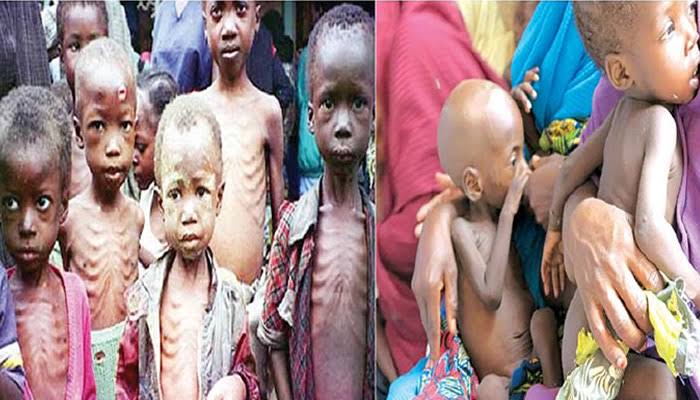
* Has second-highest burden of stunted children globally
* Northern part of country worst hit
* Over 650 die in Katsina in six months
- The acute malnutrition crisis bedeviling Nigeria is a huge burden on the nation, DAUDA ISMAIL writes.
About two million children are said to be suffering from severe acute malnutrition in Nigeria, with only 20 per cent receiving nutritional and other treatments they desperately need. Acute malnutrition is now contributing to nearly half of child deaths under five in the affected areas, with the North-East and North-West regions of the country hardest hit..Millions of children and pregnant women are facing malnutrition due to poor food access, unsafe water, and the secondary effects of ongoing conflict, according to the Nigerian Red Cross Society which is on ground providing vital health, nutrition, and protection services.
The situation is exacerbated by factors like conflict, climate change, and rising food prices, leading to widespread hunger and food insecurity. While efforts are underway to address the crisis, a significant gap remains in reaching those in need with treatment and support.
According to the United Nations Children’s Fund, UNICEF, an estimated 5.44 million children in Nigeria’s North-East and North-West regions are malnourished, including 1.8 million with severe acute malnutrition, SAM, and approximately 800,000 pregnant or lactating women are also affected.
Malnutrition contributes to a substantial portion of child deaths in Nigeria, with 45% of all under-five deaths directly or indirectly linked to malnutrition.
Northern Nigeria is currently grappling with a severe malnutrition crisis, Médecins Sans Frontières, MSF, warned on Friday.
In a statement, MSF’s Field Communication Officer, Abdulkareem Yakubu, reported that in Katsina State—where the organisation has been active since 2021—there is a growing influx of malnourished children in its therapeutic feeding centres. The cases are increasingly severe, with rising mortality rates.
Earlier this week, the World Food Programme announced it would be forced to halt emergency food and nutrition aid for 1.3 million people in Northeast Nigeria by the end of July, citing critical funding shortages.
A food security assessment conducted in Kaita Local Government Area, Katsina State, prior to the 2025 lean season, revealed that over 90% of households had reduced their daily meal intake.
MSF also stated that, in coordination with local authorities, emergency interventions and nutritional supplement distributions have begun for 66,000 children in Mashi LGA.
Excluding new facilities opened in the state this year, the number of children treated represents an increase of around one-third compared to 2024. Alarmingly, cases of malnutrition with nutritional oedema—the most acute and deadly form—rose by 208% between January and June 2025, compared to the same period last year.
Tragically, 652 children have died in MSF facilities since the start of the year due to delayed access to care. MSF noted with concern that adults—particularly women, including those pregnant or breastfeeding—are also increasingly affected, underscoring the worsening scale of this public health emergency.
The country representative of MSF in Nigeria, Ahmed Aldikhari, explained that, “The year 2024 marked a turning point in northern Nigeria’s nutritional crisis, with an increase of 25 per cent from the previous year.
The country representative of MSF in Nigeria, Ahmed Aldikhari, explained that, “The year 2024 marked a turning point in northern Nigeria’s nutritional crisis, with an increase of 25 per cent from the previous year.
UNICEF added that, “Nigeria has the second highest burden of stunted children in the world, with a national prevalence rate of 32 percent of children under five. An estimated 2 million children in Nigeria suffer from severe acute malnutrition, SAM, but only two out of every 10 children affected is currently reached with treatment. Seven percent of women of childbearing age also suffer from acute malnutrition.”
A Professor of Agronomy at the Ahmadu Bello University, Zaria, Ibrahim Abubakar, explained that mechanised farming, that is, large-scale farming using machinery, could help local farmers prevent losses due to climate change.
He said, “Mechanised farming may have a role because, if you are practising precision agriculture, you are likely to rely on weather forecasting, which guides you on how to escape either drought or flood.
“If you have a forecast that indicates a dry spell, you can avoid planting your crops during that period, which is likely not to affect your yield. For floods, you are likely to know when and where they will occur, helping you to avoid losses.
“Weather changes not only affect rainfall; they also affect temperature. For example, wheat during the dry season does not require high temperatures. If you have the forecast, you can plan your planting dates to avoid periods of high temperatures, minimising the impact on your crops.”
According to the National Agricultural Technology and Innovation Policy 2022-2027, Nigeria ranks among the lowest globally in terms of agricultural mechanisation.
The Federal Ministry of Agriculture and Rural Development indicated that Nigeria’s mechanisation is at 0.027 hp/hectare, which is far below the FAO’s recommendation of 1.5 hp/hectare.
The Federal Government launched the $1.2bn Green Imperative Programme in 2020, which intended to revolutionise agriculture in Nigeria. This initiative was expected to address many of the challenges facing the sector.
“Despite all the efforts made by the Federal Government and it’s partners, acute malnutrition remains a cancer worm that has continued to silently eat deep into the nation’s food security masterplan.
“That is why those saddled with the responsibility of steering the country out of the muky waters of malnutrition have to do much more in revolutionising agriculture and food production in order to achieve this,” Shuna Fakum, a public affairs analyst stated.