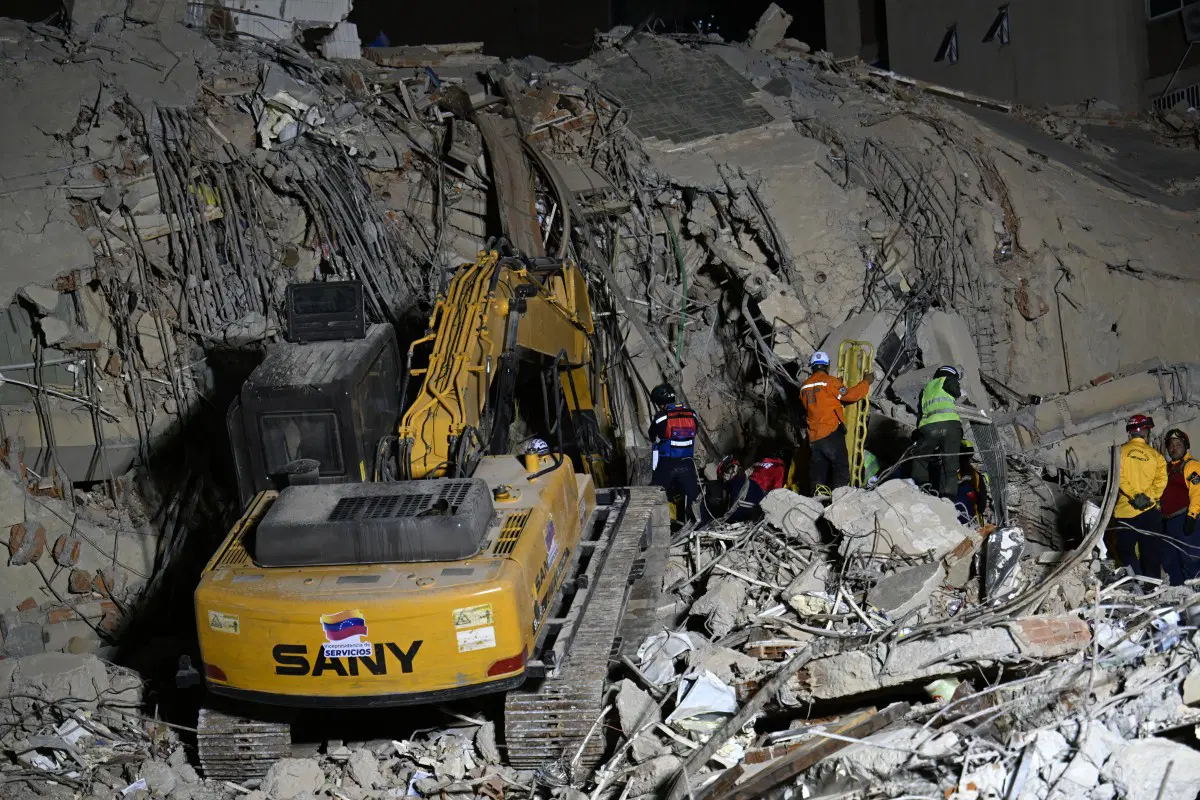
The death toll from the twin earthquakes that struck Venezuela has risen to 920, while more than 50,000 people are still unaccounted for as international rescue teams intensify efforts to locate survivors trapped beneath collapsed buildings.
The powerful earthquakes, measuring 7.2 and 7.5 in magnitude, struck within one minute of each other on Wednesday evening, leaving widespread destruction across northern Venezuela.
The coastal state of La Guaira, close to the capital Caracas, suffered the worst devastation, with residential buildings, commercial structures and public facilities reduced to rubble.
Anger continued to grow among residents over what many described as the government’s slow response to the disaster.
Interim leader Delcy Rodriguez faced hostile reactions during a visit to one of the affected communities in Caracas, where grieving residents accused authorities of failing to provide adequate emergency assistance.
United Nations Emergency Relief Coordinator Tom Fletcher told AFP that rescue officials estimated more than 50,000 people remained missing following the disaster.
Authorities announced that access to the disaster zone would be restricted from 8:00 p.m. on Friday to allow emergency personnel to carry out search and recovery operations more effectively.
International rescue teams have begun arriving in the country to support local efforts.
A Chilean search and rescue unit deployed to one of the worst-hit residential complexes in La Guaira, where four high-rise apartment buildings housing hundreds of families collapsed almost completely.
According to the team’s leader, Nadiomar Polanco, hopes of finding additional survivors at the site were fading.
“Unfortunately, the collapse is total, and there is little chance of finding survivors. Efforts are now focused on recovering the bodies of the deceased,” Polanco said.
Across several affected neighbourhoods, desperate relatives, neighbours and volunteers continued searching through debris with their bare hands, complaining about the lack of heavy equipment and official assistance.
One distraught resident, Marjosly Salazar, said she was searching for her five-month-old son, Gael, who remains trapped beneath the rubble.
“I am looking for my little Gael… he was only five months old,” she said.
Salazar explained that her 16-year-old daughter had already been confirmed dead, while both her infant son and a cousin were still missing.
“Please, we need support here. We need machinery to start lifting the columns,” she pleaded.
“We haven’t seen any government officials here, none at all.”
Similar scenes unfolded in Caracas, where emergency workers attempted to break through collapsed concrete using sledgehammers while periodically calling for complete silence in hopes of hearing survivors beneath the debris.
Fletcher described the rescue mission as an extremely difficult operation.
“It’s a very, very complex emergency response,” he said, warning that the number of fatalities was likely to increase significantly as search efforts continued.
He added that persistent aftershocks and unstable structures continued to endanger both survivors and rescue personnel.
The disaster has further compounded Venezuela’s humanitarian challenges after years of economic crisis that weakened public infrastructure, healthcare facilities and emergency services.
Millions of Venezuelans have already fled the country over the past decade due to worsening economic conditions.
The earthquakes also come only six months after the United States removed former President Nicolas Maduro from power, leaving the country in a politically fragile transition.
International humanitarian assistance has continued to increase.
The United Nations Office for the Coordination of Humanitarian Affairs said search-and-rescue teams from at least 17 countries were being mobilised to assist Venezuela.
Rescue teams from Spain, El Salvador, Switzerland, Colombia and Mexico have already joined operations on the ground.
Rodriguez also disclosed that she received a telephone call from United States President Donald Trump and Secretary of State Marco Rubio, who pledged Washington’s support for relief efforts.
According to Rodriguez, the United States committed to sending rescue workers, specialised equipment, temporary shelter assistance and humanitarian aid for affected families.
Earlier, Washington announced the deployment of more than 250 emergency response personnel, including specialised urban search-and-rescue teams equipped with trained rescue dogs.
A senior United States military official has also arrived in Caracas to coordinate American humanitarian support.
Humanitarian agencies warned that the disaster could significantly worsen existing conditions.
“Even before the earthquakes, millions of people across Venezuela were facing food insecurity, collapsing health services, protection risks, and limited access to basic services,” the United Nations and partner agencies said in a joint statement.
“The international community must not allow this emergency to deepen into a larger human tragedy.”
Authorities also confirmed that several foreign nationals were among those killed in the disaster.
The victims include 28 Portuguese citizens, five Spaniards, seven Chinese nationals, five Brazilians, one Chilean and one Italian-Venezan.
Portugal reported that 85 of its citizens remain missing, while Spain said 119 of its nationals are still unaccounted for.
The twin earthquakes are the strongest to strike Venezuela since a magnitude 7.7 earthquake occurred offshore in 1900.
The country’s northern coastline lies along the boundary between the Caribbean and South American tectonic plates but has experienced few major earthquakes in recent decades, with the last significant event occurring in 1997.
As a mark of respect for those who lost their lives, a minute of silence was observed before Friday’s FIFA World Cup 2026 matches around the world.