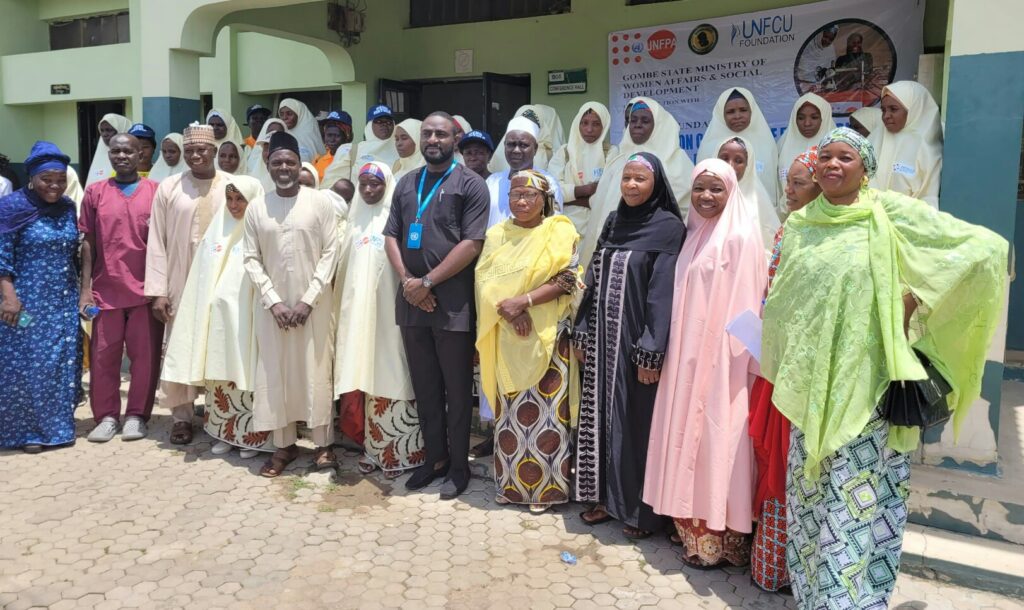
United Nations Population Fund, UNFPA, has empowered 50 rehabilitated survivors of Vesico Vaginal Fistula, VVF, in Gombe State.
The empowerment programme is being implemented in partnership with the UN agency and the Government of Norway.
Sexual Reproductive Health Analyst, UNFPA, Dr Bajowa Lanre, said this during the graduation ceremony of the 50 fistula survivors yesterday in Gombe.
Lanre said UNFPA remains committed to ending obstetric fistula, describing it as an abnormal connection between the rectum and vagina.
He added that one of UNFPA’s transformative agenda is to end maternal mortality under any circumstance.
According to him, UNFPA has been providing life-transforming surgery to women suffering from obstetric fistula and severe perinatal tears in Nigeria.
“We know that in our environment, obstetric fistula is not acceptable, because it contributes to the death of women in the course of pregnancy.
“We strongly believe that no woman must go through that experience because it brings stigma, shame and so many debilitating impact on survivors of obstetric fistula”, he said.
Lanre said UNFPA with support from the Norwegian government had supported the treatment and repair of fistula amongst women in the state.
He said the empowerment of survivors of obstetric fistula and also reintegrating them back to their families and communities would help them better.
The UNFPA official urged the women to complement the efforts towards ending the menace in their communities.
Gombe State Commissioner for Women Affairs and Social Development, Ms Asmau’u Iganus, said the support would provide a means of livelihood to the survivors, as well as improve their social and economic wellbeing.
Represented by Mrs Abu Hassan, the Director, Social Welfare in the ministry, Iganus reiterated the state government’s commitment to improve the lives of citizens.
On his part, the Founder and Executive Director, Fistula Foundation Nigeria, Dr Musa Issa, commended UNFPA, Government of Norway and the state government for collaborating to bring succour to fistula patients.
Issa, whose foundation was involved in the treatment and rehabilitation of the women, said the stories of the survivors treatment and empowerment would make them role models in their communities.
He warned the beneficiaries against diversion of the items and urged them to ensure effective utilisation to empower themselves.
On her part, a fistula survivor, Mrs Safiyanu Moses said her journey from being a fistula patient to survivor was a miracle, adding that the intervention had given her hope of a better future.
“I was ignored because of smell but today I am fine like everyone, this is a source of joy and we will remain grateful.
“This empowerment will help us tackle unemployment and make us more useful to our society and immediate households,” she said.
She lamented the high level of stigmatisation which she said often makes fistula patients hide their ailment.
“From today, I will become an ambassador to help others get treatment”, she said.
Some of the items distributed include sewing, grinding and popcorn processing machines, as well as a token for transportation. NAN