By Caleb Ishaya, Abuja
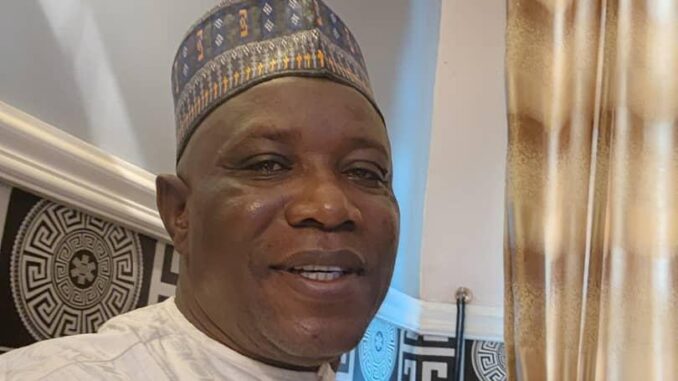
As the debate over the need for state police gains momentum, an All Progressives Congress, APC, aspirant for Guyuk/Shelleng Federal Constituency of Adamawa State, Ahmad Ibrahim, has made a case for the decentralisation of the Nigeria Police Force to tackle the growing insecurity in the country.
Speaking recently during an interview with select journalists, Ibrahim described the current policing structure as overstretched and lacking the capacity to effectively secure the country.
He said, “Nigeria ought to have adopted state police because the federal government lacks the capacity to reform the Nigeria Police Force as a body to police the entire country.
“The police is the biggest institution in Nigeria that has the highest personnel. And if you look at their budget, it is too low.”
For Ibrahim, the call for state police is not just about structure, but effectiveness at the grassroots. He argued that decentralised policing would replace the loosely organised vigilante groups with a more professional and community-rooted system.
He said, “Now, when states are given an opportunity to form their own police, I think it is a good idea. It will comprise the indigenes of the state. Because of non-adoption of state police, some of these states introduced what they call vigilante.”
Ibrahim, however, raised concern about the limitations of such informal arrangements. “These vigilantes some of them are not educated.”
Despite widespread fear that state police could be misused by political actors, the House of Representatives aspirant advocated a pragmatic approach, urging Nigerians to allow the system evolve through practice.
He said, “When they create state police, it is going to help a lot. Many people argue that some of the state executives may likely abuse it. But in the contrary, there is no harm in trial. As they are growing, they will be able to do the right thing.”
He stated “So it is a welcome idea. And if I am opportuned, if there is a bill, I should be one of the people that will endorse it.”
Beyond the national conversation on security, Ibrahim turned the spotlight on what he described as years of neglect in his constituency, painting a stark picture of communities cut off from basic governance.
“We have been having members representing my state, especially in the House of Representatives,” he said, before delivering a blunt verdict.
“There is no presence of government in all my constituencies, especially my constituency, Guyuk and Shelleng. We don’t have schools, we don’t have roads and hospitals. In fact, there is no presence of government in that area. I fully believe that for the two local governments, we don’t even have a general hospital. We have to move to other areas for medical treatment”.
His criticism extended to what he described as a pattern of political abandonment, where elected representatives lose touch with their constituents after securing office.
Ibrahim said, “I discovered that most of the people that we voted for, the moment they get to Abuja, that is the end of it. They don’t remember the people again.”
Across rural communities, he said the reality is one of isolation and darkness, with limited access to roads and electricity.
“Some of the villages, they were never connected to roads nor light. The only areas with light are Shelleng and Guyuk towns.”
He pledged a people-focused representation anchored on tangible development.
“I believe, if the mandate is given to me, those things that I mentioned, I will make sure that my people benefit from it. I will not go to the House and sit down, I am going there for my people.”
Central to his legislative priorities is education, which he described as critically lacking in the constituency despite its proximity to Borno State.
He said, “If I am given the mandate, I will make sure that I push some bills that will help the community. One of the bills is about education in my area.
“We don’t have federal schools in my area, we have a common boundary with Borno State and Shani Local Government. Then when you come to Adamawa, we have Guyuk and Shelleng that are in the same constituency. So within that constituency, there is no higher institution apart from secondary school. My people have to cross to Borno State to acquire tertiary education or they go to the capital, Yola, which is about 120 kilometers away.”
He also argued that establishing a higher institution within the constituency would bridge this gap. “So I believe that if I am given the opportunity, I will push a bill for us to have a higher institution in my area.”